
HR
5 Ways HR Managers Use Random Team Generators to Build Stronger, Fairer Workplaces
Explore how HR managers use random team generators to improve fairness, boost collaboration, and streamline team formation. Includes practical workflows, examples, and best practices.
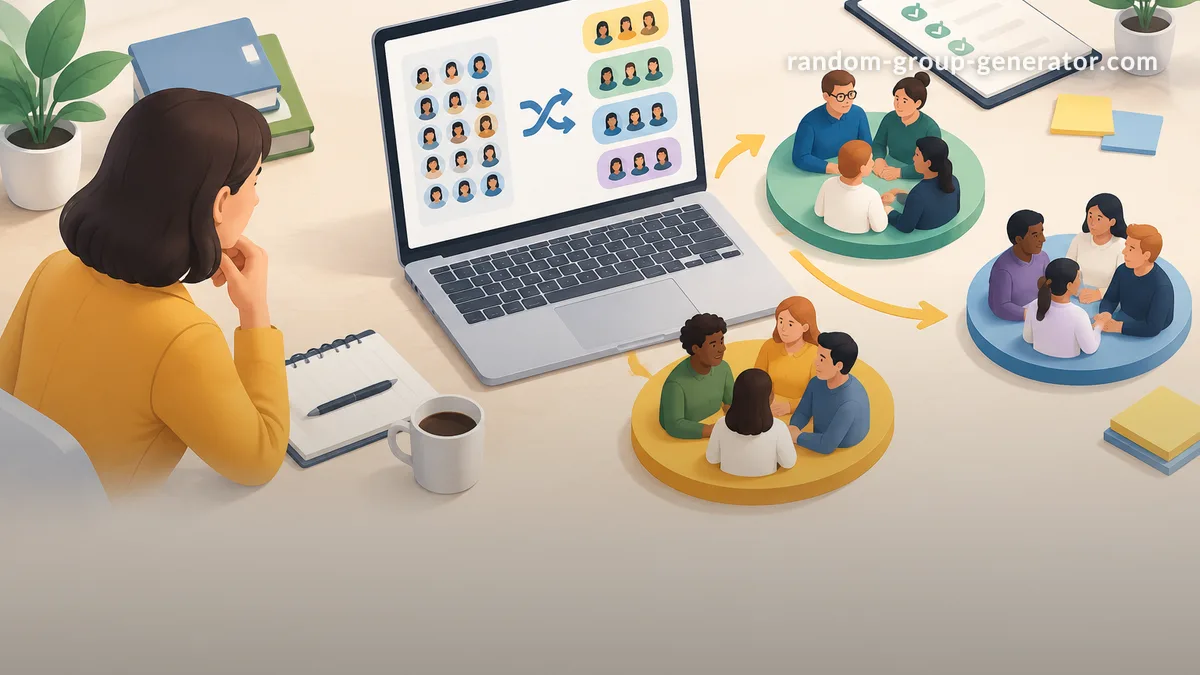
Randomization in workplace team formation has moved from a novelty experiment to a practical HR strategy. As organizations scale, hybrid work expands, and cross-functional collaboration becomes essential, HR managers increasingly rely on tools like a random team generator HR workflow to distribute talent, reduce bias, and improve team diversity.
Modern HR systems are not just about hiring and payroll—they also shape how employees interact, collaborate, and innovate. One often overlooked but highly impactful area is how teams are formed. When done manually, team assignment can unintentionally reinforce silos, favoritism, or uneven skill distribution. Randomization tools help mitigate these risks while adding speed and structure.
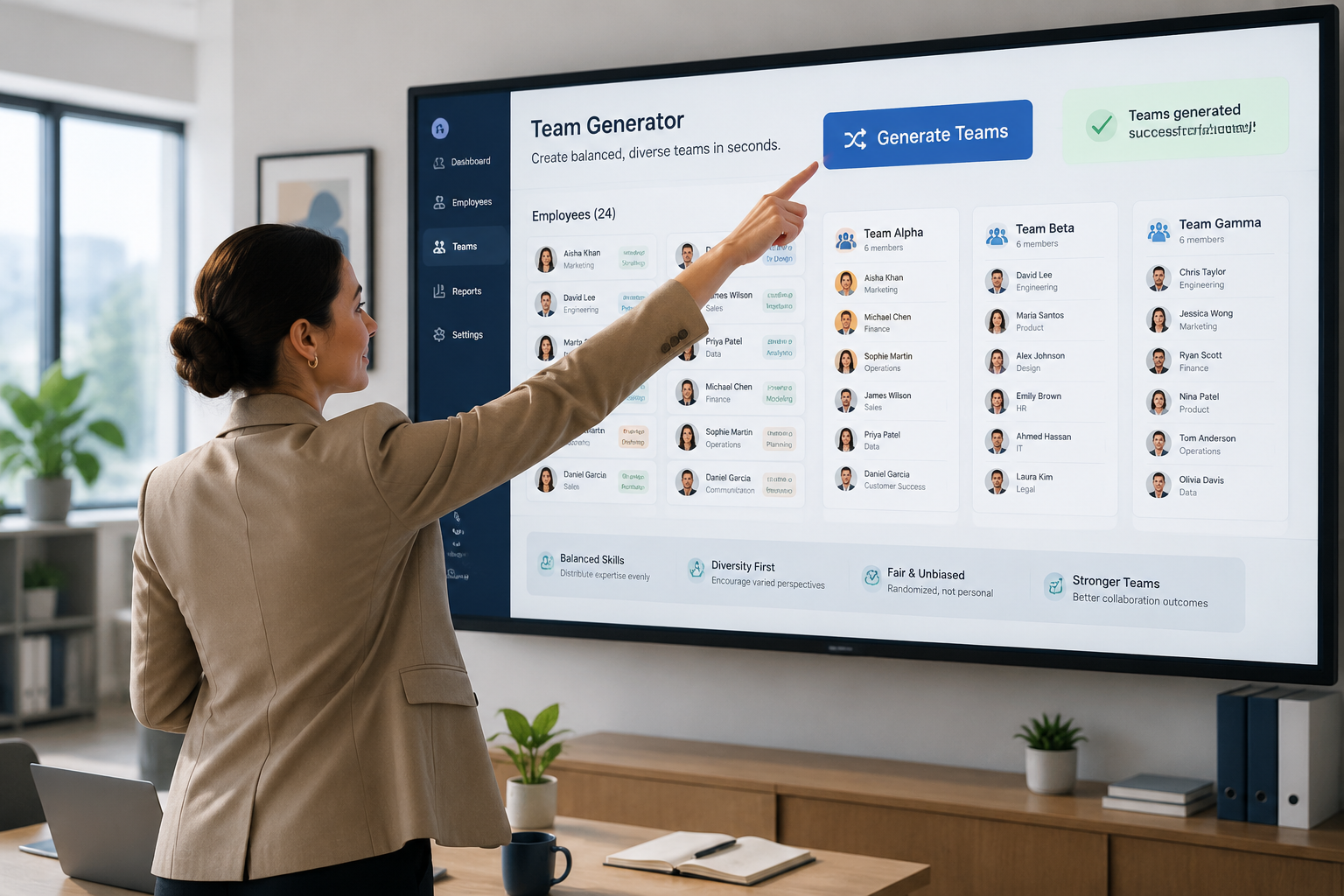
This article explores five practical ways HR managers use random team generators, along with real-world applications, implementation steps, benefits, and potential pitfalls.
Why HR Teams Use Randomization in the First Place
Before diving into specific use cases, it’s important to understand why random team generation matters. HR professionals often face competing goals:
- Ensuring fairness in team assignments
- Encouraging cross-department collaboration
- Avoiding unconscious bias
- Building psychological safety in new teams
- Saving administrative time during restructuring
According to workplace research discussed by organizations like the Society for Human Resource Management (SHRM) and Harvard Business Review, diverse and well-balanced teams tend to outperform homogeneous groups in problem-solving and innovation. However, achieving that balance manually is time-consuming and prone to error.
Random team generators provide a structured, transparent mechanism for distributing employees across groups while still allowing HR to apply constraints (e.g., skill balance, department distribution).
1. Creating Balanced Project Teams Across Departments
One of the most common uses of a random team generator HR workflow is building cross-functional project teams.
The Challenge
HR managers often need to assemble teams that include members from engineering, marketing, sales, and operations. Doing this manually can lead to overrepresentation of certain departments in high-visibility projects.
The Solution
A random generator can:
- Assign employees into groups while enforcing department caps
- Ensure each team includes a mix of skills
- Reduce unconscious bias in selection
Example
Imagine a product launch requiring 20 employees across 4 departments. Instead of manually selecting participants, HR inputs constraints into the generator:
- Max 2 engineers per team
- At least 1 marketing specialist per group
- Randomized distribution for remaining roles
This ensures fairness while still maintaining functional balance.
2. Supporting Fair Rotation in Team Assignments
Another powerful use case is rotating employees through different teams over time.
The Challenge
Employees often get “stuck” in the same group or under the same manager, limiting exposure and growth opportunities.
The Solution
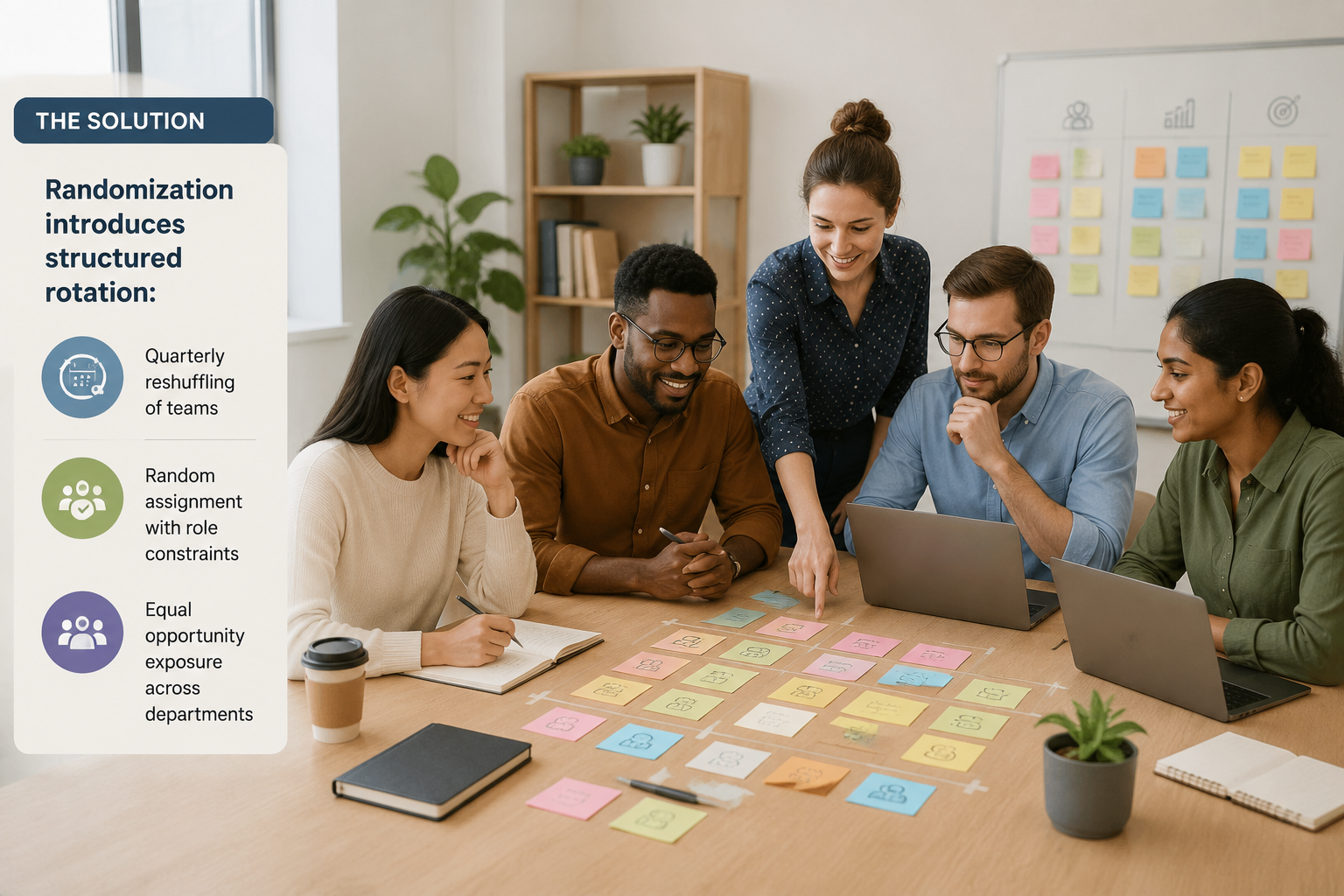
Randomization introduces structured rotation:
- Quarterly reshuffling of teams
- Random assignment with role constraints
- Equal opportunity exposure across departments
Benefits
- Reduces managerial bias in team selection
- Encourages knowledge sharing across departments
- Helps employees build broader internal networks
This approach is especially useful in large enterprises where internal mobility is a key retention strategy.
3. Designing Fair Training and Workshop Groups
Training sessions and workshops often require splitting employees into smaller groups for activities or simulations.
The Challenge
Employees tend to self-select into familiar groups, which reduces the learning value of cross-group interaction.
The Solution
A random team generator ensures:
- Mixed experience levels in each group
- Balanced seniority distribution
- Equal participation opportunities
Example Workflow
- HR uploads participant list
- Defines group size (e.g., 5 per group)
- Applies rule: no more than 2 managers per group
- Generates randomized training teams
This improves engagement and forces employees to collaborate outside their usual circles.
4. Improving Fairness in Employee Engagement Activities
HR departments often run engagement initiatives such as hackathons, wellness challenges, or innovation days.
The Challenge
Without structured assignment, employees tend to group with friends or familiar colleagues, reducing diversity of thought.
The Solution
Random grouping:
- Encourages new interpersonal connections
- Reduces cliques
- Increases participation fairness
Practical Example
In a company-wide hackathon:
- Employees are randomly assigned into 4–6 person teams
- Each team includes a mix of technical and non-technical staff
- Teams are reshuffled for each challenge round
This leads to more creative outcomes and broader participation.
5. Supporting Organizational Restructuring and Change Management
During mergers, acquisitions, or internal restructuring, HR must quickly reorganize teams.
The Challenge
Manual restructuring can be slow, politically sensitive, and biased.
The Solution
Randomized grouping helps:
- Quickly reassign employees into new departments
- Reduce perceived favoritism
- Provide a neutral starting point for new team formation
Example
During a departmental merger:
- HR uses a generator to redistribute staff into new working groups
- Constraints ensure leadership coverage across teams
- Final adjustments are made based on strategic needs
This method is particularly effective as a starting framework before human refinement.
How to Implement a Random Team Generator in HR Workflows
To effectively use randomization tools, HR teams should follow a structured approach:
Step 1: Define Objectives
Clarify whether the goal is fairness, skill balancing, or engagement.
Step 2: Prepare Employee Data
Include:
- Department
- Skill level
- Role
- Seniority
Step 3: Set Constraints
Examples:
- Max/min team size
- Role distribution rules
- Department caps
Step 4: Generate Teams
Use a structured randomization tool such as a random team generator HR system to create initial groupings.
Step 5: Review and Adjust
HR should always review outputs to ensure:
- No compliance issues
- Balanced workload
- Strategic alignment
Step 6: Communicate Transparently
Explain the process to employees to build trust in fairness.
Benefits of Using Random Team Generators in HR
1. Reduces Bias
Removes unconscious preferences in team selection.
2. Saves Time
Automates manual grouping processes.
3. Improves Collaboration
Encourages employees to work with new colleagues.
4. Enhances Fairness
Ensures equal opportunity participation.
5. Supports Scalability
Works efficiently for both small teams and large organizations.
Research from workplace psychology sources (such as the American Psychological Association) highlights that structured diversity improves problem-solving and team creativity when managed properly.
Common Pitfalls to Avoid
While powerful, randomization must be used carefully:
- Over-randomization can break essential skill balance
- Lack of transparency can reduce employee trust
- Ignoring team chemistry may affect performance
- Poor constraint design can produce uneven groups
HR should treat randomization as a framework, not a final decision-maker.
FAQ
1. What is a random team generator in HR?
A random team generator is a tool that assigns employees into groups using randomized algorithms, often with constraints for fairness, skill balance, or organizational structure.
2. Is random team assignment really fair?
Yes, when properly configured. It reduces human bias, but HR should still apply constraints to ensure functional balance.
3. Can HR control team composition in a random generator?
Yes. Most systems allow rules such as department limits, role balancing, or team size requirements.
4. When should HR NOT use random grouping?
Avoid randomization in cases requiring strict expertise alignment, sensitive leadership assignments, or regulated team structures.
5. Does random grouping affect productivity?
It can improve productivity in creative and collaborative tasks, but may require adjustment in highly specialized workflows.
Conclusion
A random team generator HR workflow is more than a convenience tool—it is a strategic mechanism for improving fairness, collaboration, and organizational agility. When used correctly, it reduces bias, enhances diversity of thought, and streamlines team formation across a wide range of HR scenarios.
The key is balance: combining structured randomness with thoughtful HR oversight ensures teams are both fair and effective.
Related guides
- 10 Classroom Random Grouping Strategies for Balanced Teams — Learn practical classroom random grouping strategies to create fair teams, improve participation, and save …
- How to Create Gender-Balanced Random Groups — Struggling to form fair, mixed-gender teams?
- How to Use a Team Generator Based on Skill to Create Balanced Groups — Struggling to form fair, productive teams?
- What Is a Random Group Generator? Definition, Uses & Best Practices — A random group generator is a digital tool that automatically divides a list of names or items into random …