
classroom random grouping strategies
10 Classroom Random Grouping Strategies for Balanced Teams
Learn practical classroom random grouping strategies to create fair teams, improve participation, and save time with simple teacher-friendly methods.

Teachers often face the same classroom challenge: creating groups quickly while making sure every student has a fair chance to participate. Classroom random grouping strategies help educators move beyond the same friendship-based teams and create more balanced opportunities for discussion, teamwork, and peer learning.
Random grouping does not mean placing students together without purpose. When used carefully, it can support variety, reduce repeated group patterns, and help teachers organize activities more efficiently. This guide explains 10 practical classroom random grouping strategies, when to use each approach, and how digital tools can make the process easier.
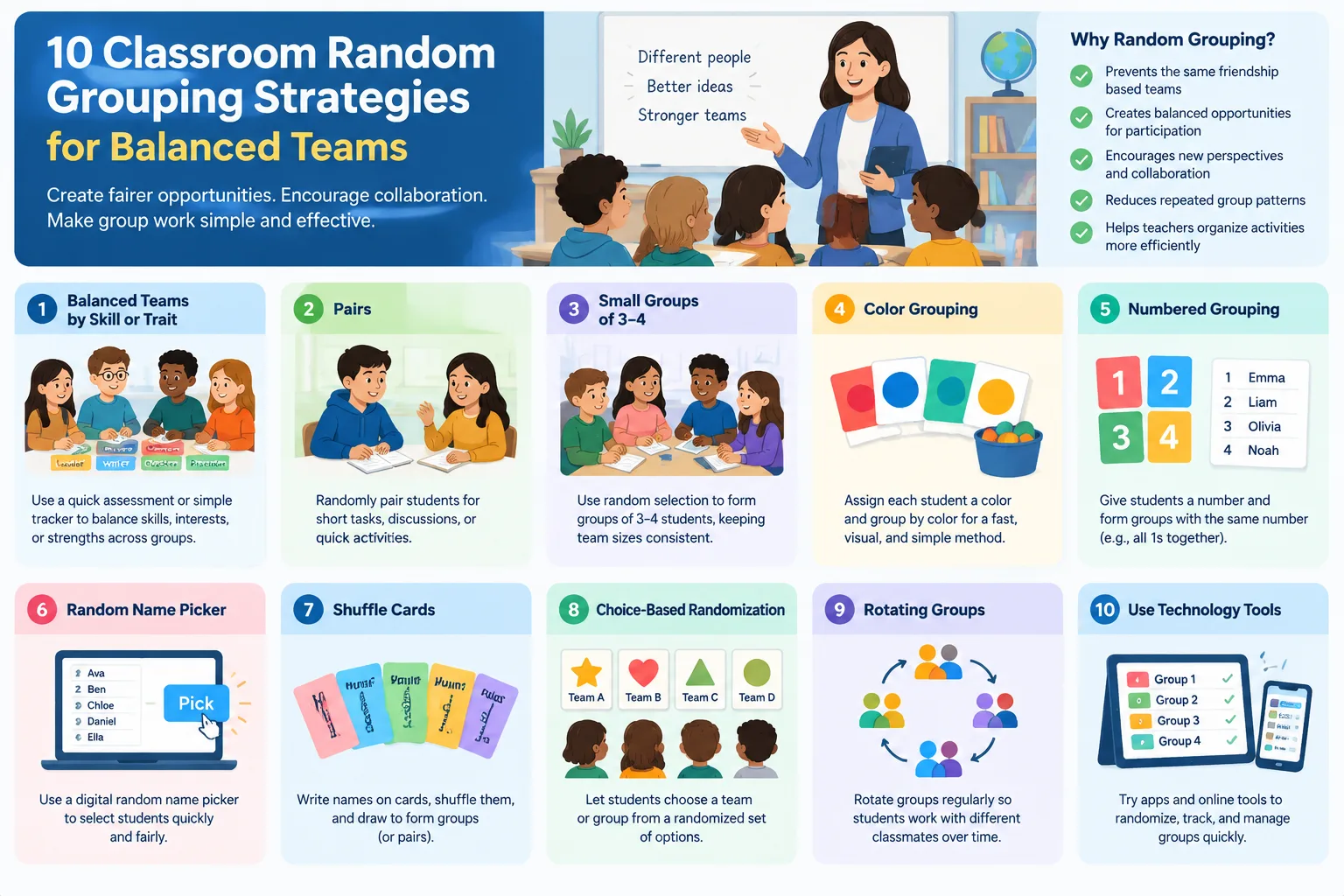
Why classroom random grouping strategies matter
Many teachers spend valuable classroom time deciding who works with whom. Students may also develop fixed patterns where the same confident learners lead every activity while quieter students participate less. A thoughtful grouping approach can create new interactions and give students more opportunities to contribute.
Classroom random grouping strategies are especially useful for activities such as project discussions, review games, laboratory work, workshops, and team challenges. The goal is not simply to make groups random, but to make group formation fair, transparent, and suitable for the learning activity.
For example, a science teacher preparing a lab activity may want four-person teams with a mix of students who do not usually work together. A quick random group process can create teams in seconds while allowing the teacher to adjust group size or exclusions when needed.
Teachers should also recognize the limits of random grouping. It may not be the best choice when an activity requires specific skill levels, carefully assigned roles, accessibility accommodations, or long-term project teams. In those cases, a teacher-guided approach may work better.
Strategy 1: Use a random group generator for quick team creation
A random group generator is one of the simplest ways to create classroom teams without manually sorting names. Teachers can enter a class list, choose the number of groups or group size, and generate results instantly.
This approach works well for short classroom activities where fairness and speed matter. For example, a history teacher can create discussion groups before a debate activity instead of spending several minutes assigning students while the class waits.
A digital tool can also reduce repeated patterns. Instead of choosing the same volunteers or allowing students to always select friends, the teacher can create a fresh arrangement for each activity.
To use this strategy:
- Prepare the student list.
- Decide the desired group size or number of groups.
- Generate the groups.
- Review the results and make any necessary teacher adjustments.
- Share the groups with students.
Teachers can try the free Random Group Generator to organize balanced classroom teams quickly.
Strategy 2: Create random pairs for quick discussions
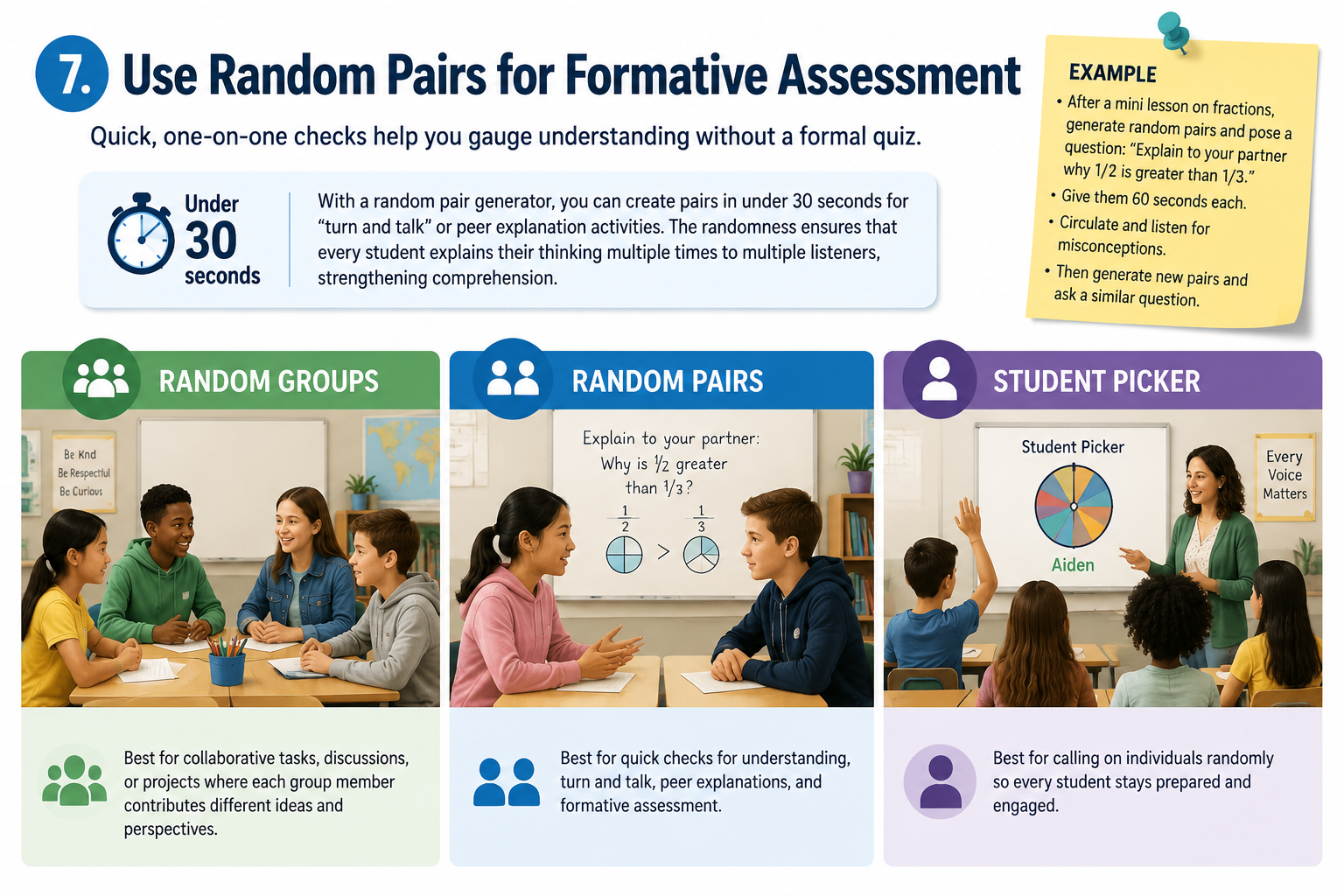
Pair activities are useful for think-pair-share exercises, language practice, peer review, and short problem-solving tasks. However, students often choose the same partner repeatedly unless the teacher changes the process.
A random pair strategy creates new connections while keeping activities simple. For example, an English teacher can randomly pair students for a five-minute vocabulary discussion, allowing learners to hear different perspectives.
Random pairs are also helpful in online or hybrid classrooms. During a virtual workshop, facilitators can create partner assignments before sending participants into breakout rooms.
The Random Pair Generator can help teachers create pairings without manual sorting. It is especially useful when a class has an uneven number of students and the teacher needs a practical way to handle the remaining participant.
Strategy 3: Rotate group members regularly
Random grouping becomes more effective when it is part of a regular classroom routine. Instead of using one group arrangement for an entire term, teachers can refresh groups for different lessons or projects.
Regular rotation helps students practice communication with different classmates. It also prevents groups from becoming dependent on one strong organizer or one frequent leader.
For example, a college instructor running weekly case discussions might generate new groups every Monday. Students learn to adapt, explain ideas clearly, and collaborate with different classmates.
A simple rotation system can include:
- New random groups each activity.
- Different responsibilities within each group.
- Reflection after teamwork tasks.
- Occasional teacher adjustments when needed.
Strategy 4: Combine random selection with teacher guidance
Pure randomness is not always the right answer. Some classroom activities benefit from a balance between random selection and teacher knowledge.
Teachers can start with random groups and then make small adjustments based on classroom needs. For example, a teacher may move one student to another group to support accessibility requirements or ensure every team has enough materials or experience.
This approach keeps the benefits of fairness while recognizing that teachers understand their students better than any automated system.
Strategy 5: Use random student selection for participation
Grouping is not the only classroom process that benefits from fair random selection. Teachers often need ways to choose students for questions, presentations, demonstrations, or classroom jobs.
A random student picker can help avoid repeatedly calling on the same volunteers. This encourages broader participation while making the selection process visible and predictable.
For example, during a math review session, a teacher can use a random picker to choose students who will explain different problem-solving steps. Students know that everyone has a chance to participate.
The Random Student Picker can support these activities by providing a quick way to select names fairly.
Strategy 6: Match group size to the activity goal
The best classroom random grouping strategy depends on what students need to accomplish. Smaller groups often work well for discussion, while larger teams may be useful for projects requiring multiple roles.
A teacher planning a debate may choose pairs or groups of three because every student needs speaking time. A teacher planning a design challenge may choose larger groups because students can divide responsibilities.
Before creating groups, consider:
- How much discussion each student needs.
- Whether students need specific roles.
- How much time the activity allows.
- Whether groups will stay together or change frequently.
Strategy 7: Give groups clear roles
Random groups work better when students understand their responsibilities. Without structure, some students may take over while others remain passive.
Assigning roles such as discussion leader, note taker, presenter, or timekeeper gives each learner a clear contribution. This makes random groups more comfortable because students know how to participate.
For example, during a workplace training workshop, a facilitator can randomly create teams and then assign each member a role for analyzing a case study.
Strategy 8: Use group names to build classroom identity
Simple group names can make activities feel more organized and engaging. They also help teachers manage multiple teams during busy lessons.
A group name generator can provide creative labels for teams during classroom games, workshops, and events. This is especially helpful when students need to report results or rotate between activities.
The Group Name Generator can help create quick team labels without requiring students to spend activity time choosing names.
Strategy 9: Apply grouping strategies to online and hybrid learning
Digital classrooms create additional challenges because teachers cannot always see who is naturally connecting with whom. Random grouping tools can support online discussions, breakout activities, and virtual workshops.
For example, a corporate trainer using video meetings can prepare discussion teams before a session begins. Participants can then move into breakout rooms with clear assignments.
When using online grouping, facilitators should explain the purpose of the activity and provide instructions before participants enter smaller groups.
Strategy 10: Review and improve your grouping process
Effective classroom grouping is an ongoing practice. After activities, teachers can reflect on whether groups supported participation, discussion, and learning goals.
Useful questions include:
- Did every student have a chance to contribute?
- Were group sizes appropriate?
- Did students understand their roles?
- Should future groups be changed or adjusted?
For example, after a semester of project work, a teacher may notice that random groups worked well for discussions but that longer assignments required more teacher planning.
How to choose the right classroom random grouping strategy
The best strategy depends on the classroom situation. Quick discussions usually need simple random pairs or small groups. Longer projects may require a combination of random selection and teacher planning.
Teachers should consider fairness, activity goals, student needs, and available time. Digital tools are most useful when they remove repetitive administrative work while leaving important classroom decisions with the educator.
A practical approach is to start small. Try random groups for a short discussion, review activity, or warm-up exercise. Once students understand the routine, teachers can expand the approach to larger activities.
FAQ about classroom random grouping strategies
What are classroom random grouping strategies?
Classroom random grouping strategies are methods teachers use to create student teams or pairs through a fair selection process. They help organize activities quickly while encouraging students to work with different classmates.
Are random groups effective for every classroom activity?
No. Random groups work well for many discussions, practice activities, and short-term collaborations, but some projects require teacher-selected teams based on skills, learning needs, or specific roles.
How can teachers make random groups more successful?
Teachers can improve random groups by choosing the right group size, assigning roles, explaining expectations, and reviewing whether the grouping method supported the learning goal.
Can random grouping tools be used for online classes?
Yes. Digital grouping tools can help teachers and facilitators prepare teams for virtual discussions, workshops, and breakout sessions before or during online activities.
What is the fastest way to create classroom groups?
Using a dedicated grouping tool is often faster than manually arranging names. Teachers can create groups, review results, and make adjustments before sharing assignments with students.
Try classroom random grouping strategies today
Fair group formation does not need to take up valuable teaching time. With the right classroom random grouping strategies, teachers can create new learning partnerships, encourage wider participation, and organize activities more smoothly.
Start creating balanced teams with the Random Group Generator and make your next classroom activity easier to manage.
Sources
Sources
- Cooperative learning — research overview on structured small-group work
Related guides
- How to Create Gender-Balanced Random Groups — Struggling to form fair, mixed-gender teams?
- How to Use a Team Generator Based on Skill to Create Balanced Groups — Struggling to form fair, productive teams?
- How to Create Weighted Random Groups — Learn how to create weighted random groups using the Random Group Generator.
- What Is a Random Group Generator? Definition, Uses & Best Practices — A random group generator is a digital tool that automatically divides a list of names or items into random …