
balanced team formation
What Is Balanced Team Formation? A Complete Guide to Fair and Effective Grouping
Balanced team formation is the process of creating fair, well-matched groups by distributing skills, experience, and roles evenly across teams. This guide explains principles, methods, use cases, and best practices for educators, managers, and organizers.
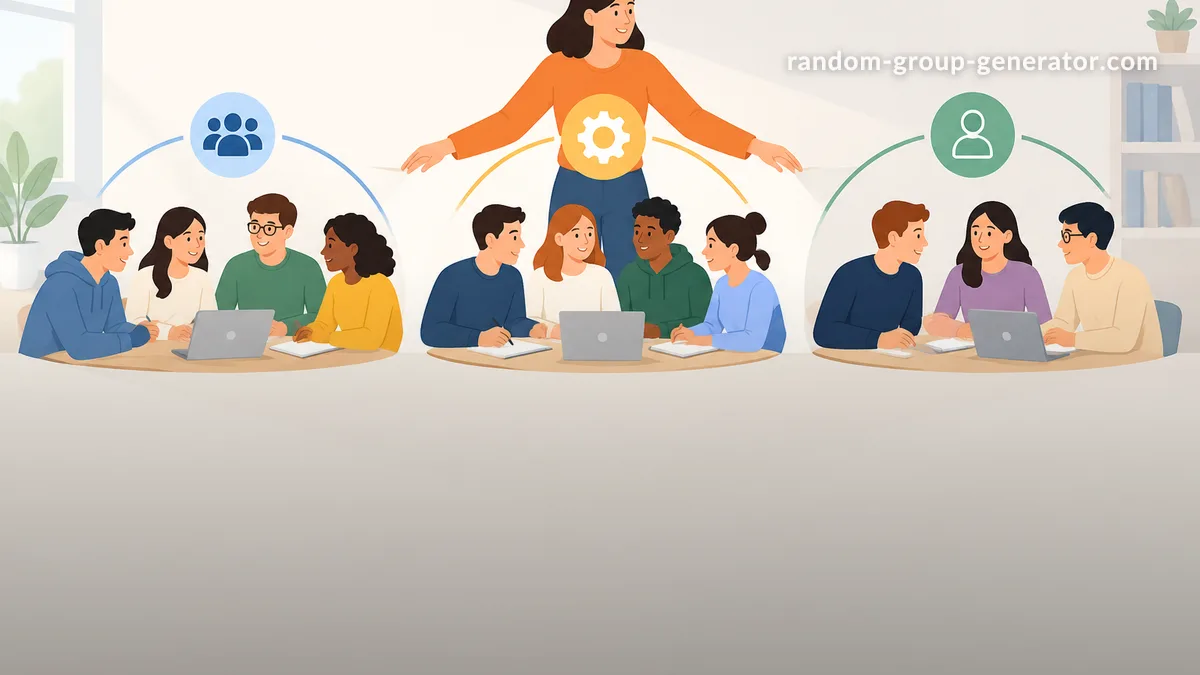
Balanced team formation refers to the structured process of creating groups in which members are distributed in a way that ensures fairness, diversity of skills, and comparable overall capability across all teams. The goal is not simply to divide people into groups, but to optimize how those groups function by avoiding extreme imbalances in skill level, experience, or role distribution.
In practice, balanced team formation is widely used in education, workplace collaboration, sports training, hackathons, and community projects. It helps ensure that no single team is overloaded with either high-performing individuals or inexperienced participants, which can significantly affect outcomes, motivation, and collaboration quality.
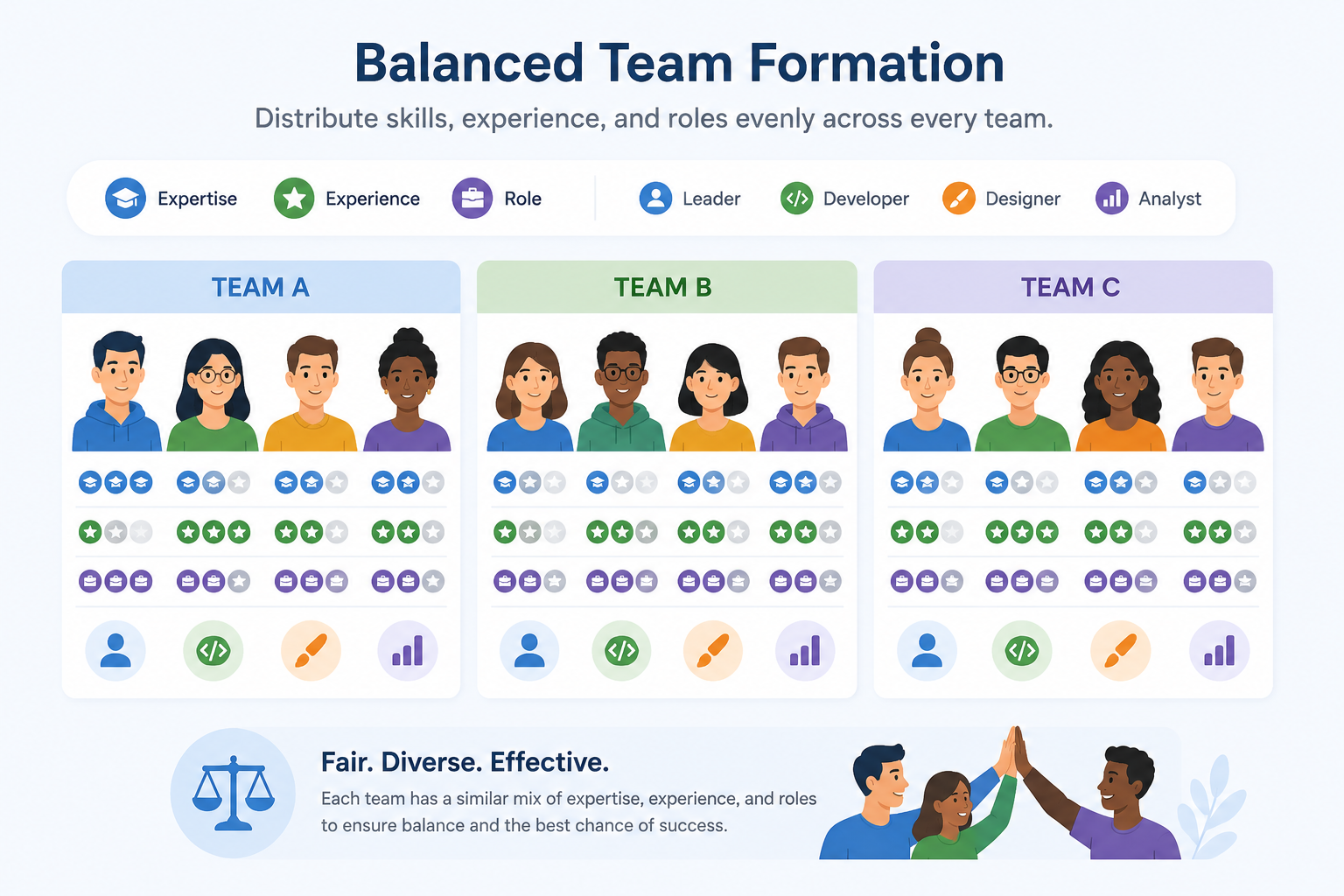
Why Balanced Team Formation Matters
Balanced teams are essential because group performance is often influenced more by distribution of talent than by individual excellence alone. When teams are uneven, several issues can arise:
- Overloaded teams may experience burnout and coordination problems.
- Underpowered teams may feel disengaged or demotivated.
- Results may become predictable rather than competitive or insightful.
Balanced formation improves:
- Fairness in evaluation (especially in classrooms)
- Collaboration efficiency in workplaces
- Engagement in group-based activities
- Learning outcomes through peer diversity
From a psychological perspective, research in group dynamics shows that heterogeneous but balanced teams often outperform homogeneous groups in problem-solving tasks because they combine varied perspectives while maintaining functional parity.
Core Principles of Balanced Team Formation
1. Skill Distribution
The most important principle is ensuring that high-skill and low-skill members are evenly distributed. For example, in a classroom project, each team might include a mix of advanced, intermediate, and beginner students.
2. Role Diversity
Balanced teams require a mix of roles such as leaders, analysts, creators, and implementers. Without role diversity, teams may struggle with coordination or decision-making.
3. Experience Equalization
Experience levels should be spread across teams so that no group has a disproportionate advantage. This is especially important in competitive settings like hackathons or business simulations.
4. Randomization with Constraints
Pure random grouping can lead to imbalance. Instead, constrained randomization is often used—assigning people randomly but within predefined categories (e.g., skill tiers).
5. Psychological Safety and Compatibility
Balanced teams are not just about technical skill; interpersonal dynamics matter. A team should have enough compatibility to function without excessive conflict while still maintaining diversity.
Methods for Creating Balanced Teams
Manual Structuring Method
Instructors or managers categorize participants based on skill level or experience, then distribute them evenly across teams. This is common in classrooms and small workshops.
Weighted Random Assignment
Participants are assigned numerical scores based on skill or experience, and algorithms distribute total scores evenly across teams. This reduces human bias while maintaining balance.
Round-Robin Distribution
Participants are sorted by skill level and then assigned one by one to different teams in a rotating pattern. This is simple and effective for moderate-sized groups.
Software-Assisted Grouping
Digital tools like a random group generator can automate balancing by applying constraints such as team size, skill distribution, and role coverage.
Many educators and facilitators use tools like a structured grouping system available at https://random-group-generator.com to simplify this process.
Practical Example of Balanced Team Formation
Imagine a classroom of 12 students with three skill levels: advanced, intermediate, and beginner.
Instead of grouping randomly, a balanced approach would assign:
- Team A: 1 advanced, 2 intermediate, 1 beginner
- Team B: 1 advanced, 2 intermediate, 1 beginner
- Team C: 1 advanced, 2 intermediate, 1 beginner
This ensures each team has similar capability distribution and learning potential.
In a workplace setting, the same principle applies. A product team might include senior developers, mid-level engineers, junior contributors, and a mix of design and analysis roles distributed evenly across squads.
Applications of Balanced Team Formation
Education
Teachers use balanced grouping to improve peer learning and ensure fair assessment conditions. It also encourages collaboration between students of different abilities.
Sports Training
Coaches create balanced squads to ensure fair competition during practice sessions, improving skill development and engagement.
Corporate Environments
Managers use balanced teams for project assignments to ensure productivity is not concentrated in one group.
Hackathons and Competitions
Balanced teams prevent competitive distortion and ensure that outcomes reflect teamwork rather than uneven skill distribution.
Common Mistakes in Team Formation
Over-Randomization
Relying purely on random assignment often leads to uneven skill distribution.
Ignoring Soft Skills
Focusing only on technical ability can lead to teams that lack communication or leadership capacity.
Over-Engineering Balance
Trying to perfectly equalize every factor can make grouping overly complex and impractical.
Neglecting Team Size Constraints
Even balanced skill distribution fails if teams are too large or too small for effective collaboration.
Best Practices
- Define what “balance” means for your context (education vs business vs sports)
- Use simple skill tiers rather than overly complex scoring systems
- Combine human judgment with algorithmic grouping
- Test and adjust group outcomes over time
- Prioritize communication dynamics alongside skill distribution
FAQ
What is the main goal of balanced team formation?
The main goal is to ensure that all teams have comparable overall capability, allowing fair outcomes and effective collaboration without one team having a disproportionate advantage.
Is random grouping bad for team formation?
Not necessarily, but pure random grouping often creates imbalance. Constrained or weighted random methods are usually more effective.
Can balanced teams still have conflicts?
Yes. Balance refers to skill and structure, not interpersonal harmony. Conflict management and communication still play a key role.
What tools help with balanced team formation?
Tools like structured grouping systems or online random group generators can help distribute members based on constraints like skill level or role.
Sources
Sources
- Cooperative learning — research overview on structured small-group work
Related guides
- Fisher-Yates Shuffle Algorithm Explained: Why It's the Key to Fair Random Groups — Learn how the Fisher-Yates shuffle algorithm works, why it produces unbiased random permutations, and how i…
- Random Grouping vs. Intentional Grouping: Key Differences and When to Use Each — Discover the critical differences between random and intentional grouping, plus expert tips on when to use …
- Stratified Randomization Groups: A Complete Guide for Teachers and Facilitators — Learn how stratified randomization creates balanced groups for classrooms and workshops.
- How to Use Random Group Generator: A Complete Guide for Teachers and Facilitators — Learn how to use Random Group Generator to create fair, balanced groups in seconds.