
random grouping
Random Grouping vs. Intentional Grouping: Key Differences and When to Use Each
Discover the critical differences between random and intentional grouping, plus expert tips on when to use each. Includes practical examples and a handy FAQ.
Random Grouping vs. Intentional Grouping: Key Differences
Introduction
Whether you’re a teacher organizing classroom activities, a manager planning a team-building workshop, or a coach dividing players for a drill, the method you use to form groups can make or break the experience. Two overarching approaches dominate: random grouping and intentional grouping. Each carries its own philosophy, strengths, and weaknesses.
This article breaks down the core differences between random and intentional grouping, explores real-world applications, and provides actionable guidance on when to choose one over the other. You’ll also find a practical FAQ and suggestions for further reading on our site.
What Is Random Grouping?
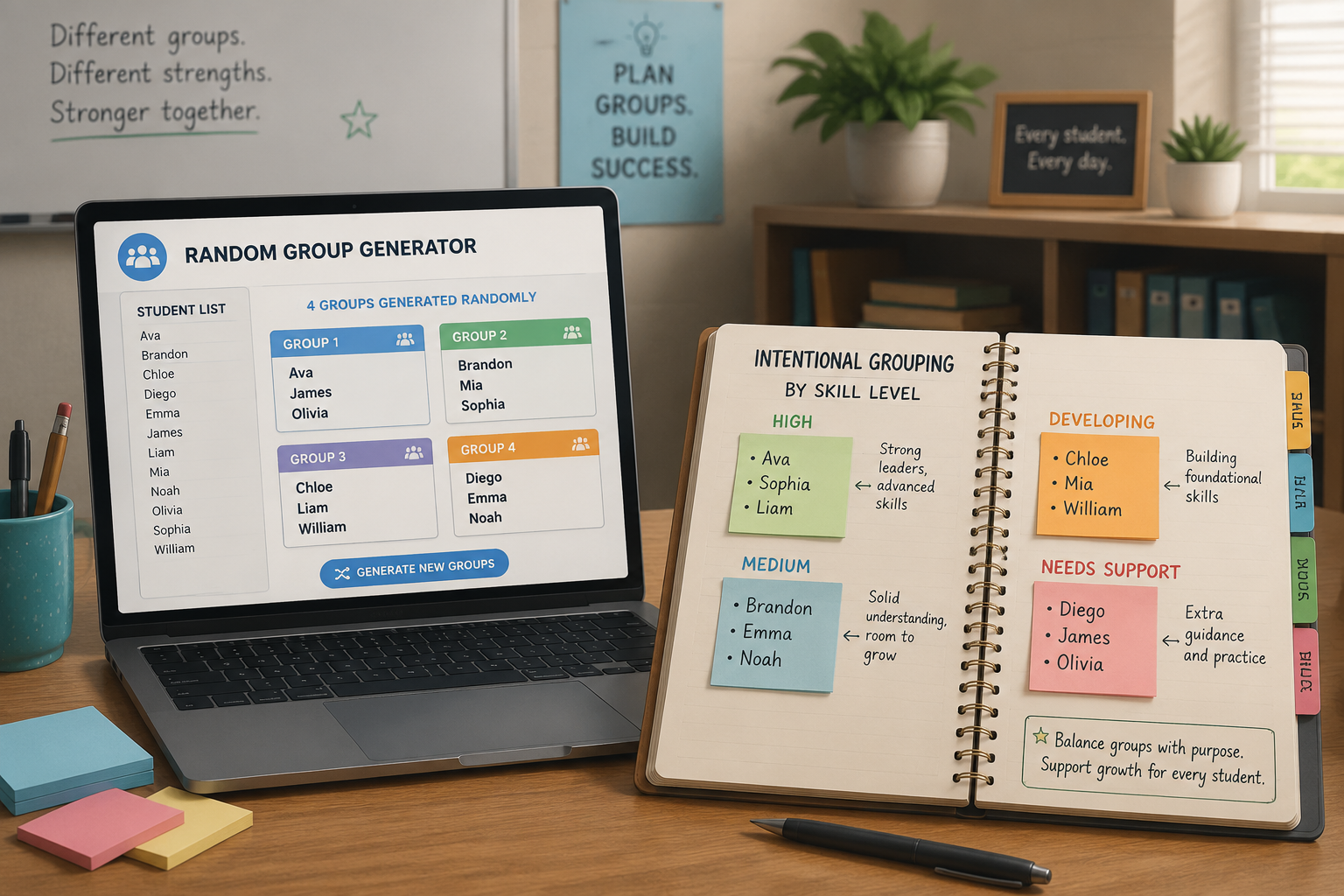
Random grouping refers to any process that assigns individuals to groups without consideration of their traits, abilities, or relationships. This can be as simple as drawing names from a hat, rolling dice, or using a digital random group generator (like the one at the heart of this site). Modern tools allow you to paste a list, set group sizes, and instantly get unbiased, shuffled teams.
Benefits of Random Grouping
- Eliminates Bias: No favoritism, no preconceived labels. Everyone has an equal chance of being placed with anyone else.
- Encourages Social Mixing: It breaks up cliques and forces interaction across social boundaries, potentially reducing classroom or office silos.
- Quick and Efficient: Random assignment takes seconds, saving valuable time during a lesson or meeting.
- Perceived Fairness: When processes are transparently random, participants are less likely to question the outcome.
Drawbacks of Random Grouping
- Unbalanced Skill Levels: Pure chance can create groups where all strong members are clustered together and others where weaker members cannot contribute meaningfully.
- May Clash with Learning Objectives: If a task requires specific roles or prior knowledge, random groups might fail to provide the necessary mix.
- Anxiety for Some: Shy or anxious individuals may feel safer in a group of familiar peers; random assignment can heighten discomfort.
What Is Intentional Grouping?
Intentional grouping (also called strategic or deliberate grouping) is the practice of forming groups based on predetermined criteria. Teachers, trainers, and leaders analyze data—test scores, personality traits, prior performance, or even friendship dynamics—to craft teams that are balanced, skills‑complementary, or homogenous for a particular goal.
Common intentional strategies include:
- Heterogeneous grouping: Mixing high‑, medium‑, and low‑achieving students so that each team has a range of talents.
- Homogeneous grouping: Placing learners with similar ability levels together to work on targeted tasks.
- Interest‑based grouping: Letting participants group by topic or hobby preference.
- Role‑based grouping: Assigning people according to the functions they will perform (leader, note‑taker, presenter, etc.).
Benefits of Intentional Grouping
- Aligned with Learning Goals: Groups are built to maximize the chances that the intended outcome—whether a product, a discussion, or a skill—will be achieved.
- Balanced Participation: By spreading strong facilitators or experts across teams, you avoid having one group dominate while another struggles.
- Supports Differentiation: Struggling students can receive peer support, while advanced students get appropriate challenge through leadership or complex problem‑solving.
Drawbacks of Intentional Grouping
- Time‑Intensive: Teachers must collect evidence, analyze it, and carefully place each student, which can become a logistical burden.
- Risk of Labeling: If overused, intentional grouping can reinforce stereotypes (“you’re always in the low group”).
- May Breed Resentment: Without transparency, participants may see grouped assignments as unfair or manipulate the system.
Key Differences at a Glance
| Dimension | Random Grouping | Intentional Grouping |
|---|---|---|
| Primary Goal | Fairness, speed, and social mixing | Outcome‑driven team composition |
| Method | Chance‑based (manual or digital generator) | Data‑informed selection (skill, behavior, role) |
| Time Required | Seconds | Minutes to hours (preparation + execution) |
| Predictability | Unpredictable: any combination possible | Predictable: designed for specific dynamics |
| Social Dynamics | Forces cross‑clique interaction; can be chaotic | Can maintain or break cliques depending on intent |
| Educational Alignment | May or may not match lesson objectives | Highly aligned with learning targets and differentiation |
| Teacher Control | Low (algorithm or chance decides) | High (educator makes all placement decisions) |
| Perception of Fairness | High when random process is transparent | Mixed, depending on communication |
When to Use Random Grouping
Random grouping shines in situations where the primary objective is not task‑specific proficiency but rather community building, idea generation, or rapid formation.
- Icebreakers and Team‑Building Activities: Random groups push people to interact with unfamiliar colleagues, exactly the goal of a getting‑to‑know‑you exercise.
- Large‑Scale Events: When you have 100+ participants and limited time, a random group generator is the only practical solution.
- Brainstorming and Divergent Thinking: Unexpected combinations often spark novel solutions. Random groups bring together minds that wouldn’t normally collaborate.
- When Fairness Is Paramount: In competitive games, debates, or selection tests where equal chance is valued above all, random assignment removes suspicion.
Example: Classroom Brain Break
A middle‑school teacher uses a random group generator to split 30 students into five teams of six for a quick trivia game. The rapid, visible randomness prevents arguments and keeps energy high.
When to Use Intentional Grouping
Intentional grouping should be your choice when the quality of the final product or the targeted learning outcome depends on the group’s internal skills and dynamics.
- Long‑Term Projects: If teams will work together for weeks, balancing technical skills, leadership styles, and work ethics is crucial.
- Differentiated Instruction: When running stations for math, you might place students in homogeneous groups so each group works on problems at their level.
- Skill‑Building Roles: In a science lab, you may need one group member who is strong in data analysis, another in writing, and another in hands‑on procedure.
- Managing Behavioral Challenges: Sometimes students with certain behavioral profiles do better apart; intentional grouping can preempt disruptions.
Example: High‑School Humanities Project
A history teacher assigns a documentary‑making project. She examines prior grades, checks for video‑editing experience, and deliberately mixes introverts and extroverts so each team has a balanced set of skills. The final videos are richer and the workload more equitable.
Practical Examples: Random vs. Intentional in Action
Scenario 1: Corporate Workshop
A company is running a half‑day innovation workshop for 60 employees. The facilitator wants to break departmental silos.
- Random grouping: Using a random group generator, she creates 10 cross‑functional teams. The initial conversations are awkward but eventually yield surprising process improvements.
- Intentional grouping: The same facilitator could manually craft groups based on personality profiles (e.g., one “big picture thinker” per table). This would likely produce smoother collaboration but takes significant prep time.
Takeaway: For a short, ideation‑heavy session, random grouping often wins because speed and fresh perspectives matter more than polished output.
Scenario 2: Youth Soccer Practice
A coach needs to run a 4‑v‑4 scrimmage.
- Random grouping: Names drawn from a cap. Strong and weak players are scattered unevenly; one team dominates, frustrating the others.
- Intentional grouping: The coach uses last week’s performance data to create two balanced teams. The match is competitive, and all players get touches.
Takeaway: In skill‑based physical activities, intentional grouping nearly always yields better engagement and development.
Combining Both Approaches
The best facilitators rarely rely exclusively on one method. A powerful hybrid is to start with random groups for initial brainstorming or icebreaking, then use what you’ve observed to form intentional groups for the main task. Alternatively, use an initial random draw for accountability—students know that after learning a concept, they’ll be randomly regrouped to teach it, creating a “jigsaw” effect.
FAQ
1. What’s the main advantage of using a digital random group generator over pulling names from a hat?
A digital tool is faster, transparent (everyone sees the result at once), and can handle large lists without error. It also prevents accusations of manipulation because the algorithm is visibly random.
2. Can I use random grouping for graded assignments without bias?
Yes, but with caution. Random groups can produce unbalanced teams, which may disadvantage some students. If you must use random grouping for a graded task, consider weighting individual contributions or designing tasks that don’t depend heavily on prior expertise.
3. How do I decide which grouping method to use?
Ask yourself three questions:
- What is the primary goal—social mixing or skill mastery?
- How much time do I have to prepare?
- Will the group’s internal dynamics significantly affect the outcome?
If you answered “social mixing,” “very little time,” and “no,” random is likely best. Otherwise, lean toward intentional.
4. Can random grouping improve social inclusivity?
Absolutely. Random grouping forces interaction across existing social lines, which helps reduce in‑group/out‑group feelings over time. Laughing together over an “unlikely” team can dissolve barriers.
5. What are the risks of relying solely on intentional grouping?
Overuse can lead to “grouping fatigue” for the teacher and a sense of rigid labeling for students. It may also inhibit the spontaneous collaboration that occurs when unlikely partners are thrown together. A balanced diet of both methods usually works best.