
stratified randomization
Stratified Randomization Groups: A Complete Guide for Teachers and Facilitators
Learn how stratified randomization creates balanced groups for classrooms and workshops. Step-by-step process, real examples, and how to use the Random Group Generator.
Stratified Randomization in Group Formation: What It Is and How to Use It
You’ve been asked to form groups for a classroom project, a workshop exercise, or a training activity. You want variety—different strengths, backgrounds, and perspectives in every team. But if you rely on pure random assignment, you might end up with a group of all quiet participants or all advanced learners. That’s where stratified randomization comes in. It’s a simple yet powerful method for creating balanced, fair groups that reflect the diversity of your whole class or team.
In this guide, you’ll learn exactly what stratified randomization means, how to apply it step by step, and when it’s the right tool for your facilitation toolkit. Whether you’re a K‑12 teacher, a college professor, or a corporate trainer, you’ll come away with a practical workflow you can use today—including how to adapt it with the Random Group Generator.
What Is Stratified Randomization?
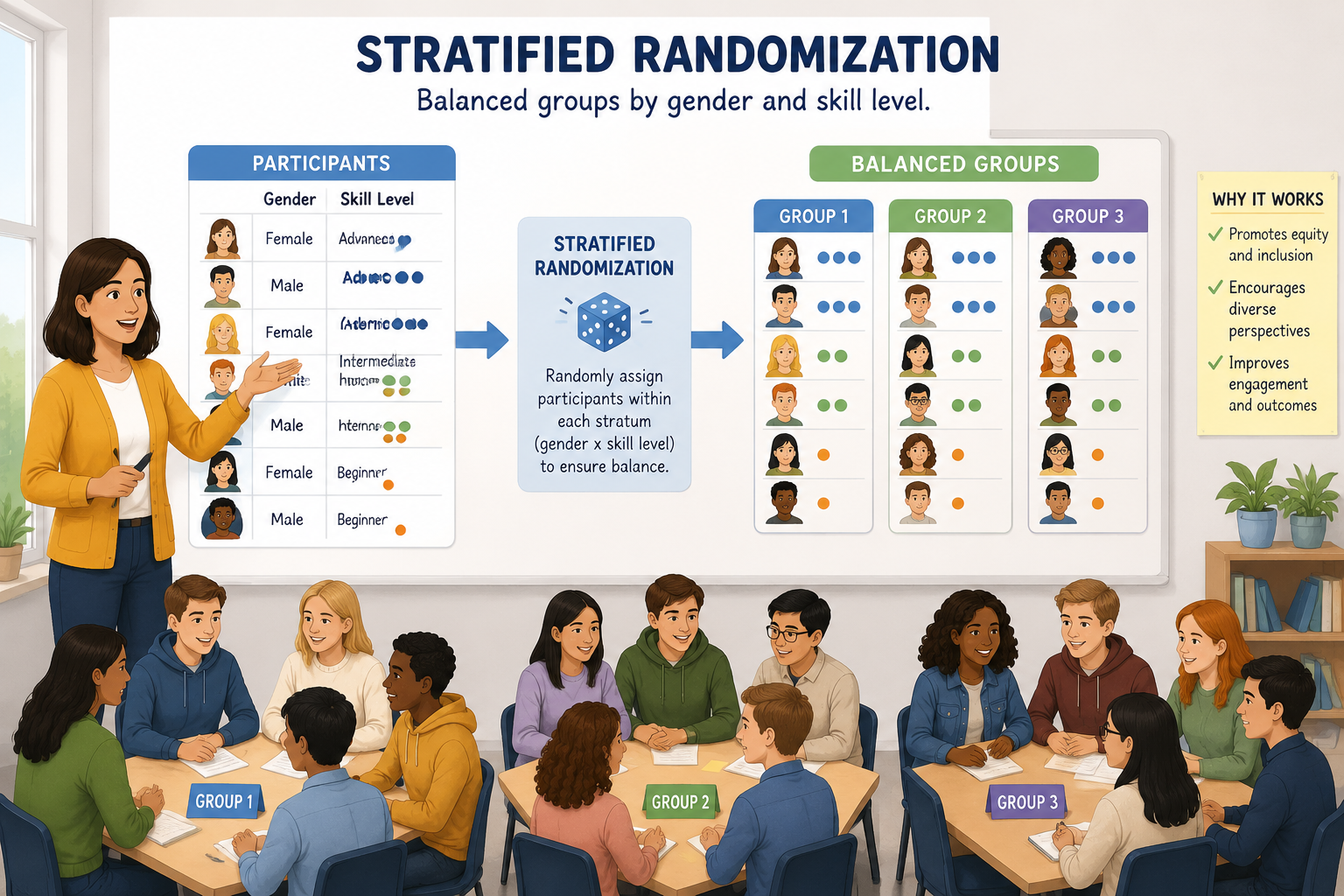
Stratified randomization is a technique that first divides your participants into distinct subgroups—called strata—based on one or more characteristics that matter for your activity. After that, you randomly select members from each stratum to form the final groups. The result is that every group has roughly the same proportion of each characteristic you care about.
Think of it as random sampling within categories. For example, if you want groups balanced by gender, you would split the class into two strata: female‑identifying and male‑identifying students. Then you randomly assign members from each stratum to each group, making sure no group ends up overwhelmingly one gender.
This method is widely used in research and education because it preserves the benefits of randomness while ensuring representation. It’s not a complicated statistical process—just a thoughtful way to organise your lists before the randomiser does its work.
Why Not Just Use Simple Random Grouping?
Simple random grouping (also called simple random assignment) treats every participant as interchangeable. It’s fast, but it can produce lopsided results. A random group of six might be all boys or all girls by chance, especially in a small sample. In a class of 30, the probability isn’t huge, but it happens often enough to cause frustration.
Stratification removes that gamble. By guaranteeing a certain mix, you create groups that are more likely to succeed in collaborative tasks where diverse input is valuable. It’s particularly useful when you want to avoid reinforcing stereotypes or when the learning goal depends on hearing multiple viewpoints.
How Stratified Randomization Works: A Step‑by‑Step Classroom Example
Let’s walk through a concrete scenario. Suppose you teach a class of 30 students, and you need to create five groups of six for a science lab. You know that a mix of genders improves discussion, and you also want to spread out the four students who have already completed an advanced science camp (let’s call them “experienced”).
Step 1: Identify your strata. For this activity, you’ll stratify by two factors: gender (boy/girl) and experience level (experienced/not experienced). So each student falls into one of four possible strata:
- Experienced boys (2 students)
- Not‑experienced boys (10 students)
- Experienced girls (2 students)
- Not‑experienced girls (16 students)
Step 2: Decide how many from each stratum should appear in each group. Since you want five groups and the experienced students are only four, they can’t be in every group. That’s okay—stratification doesn’t demand perfect equality when numbers are off. You’ll distribute them as evenly as possible. A fair split: four groups get one experienced student each, and one group gets none. Within those groups, you also want the gender balance to be roughly 60% girls, 40% boys (because the class is 18 girls, 12 boys). But don’t over‑complicate—start with the experienced students and then let the numbers fall naturally.
Step 3: Randomly assign within each stratum. Write each student’s name on a slip and place them in bowls labelled by stratum. Draw names one by one to fill each group’s “slot.” For example, draw from the “experienced boys” bowl and assign one to Group A, then one to Group B. Then move to “not‑experienced boys” and draw two for Group A, two for Group B, and so on, aiming for the target totals.
Step 4: Check the balance. Once all groups are formed, count the number of girls, boys, and experienced students in each. Adjust if necessary—the goal is approximate balance, not mathematical perfection.
Hand‑sorting 30 names like this takes about 10 minutes. But if you want to save time, you can use a digital tool to do the randomising for you after you’ve organised your strata. I’ll show you how at the end.
Real‑World Applications for Teachers and Facilitators
Stratified randomisation shines in scenarios where intentional diversity is the goal. Here are two examples beyond the science lab.
Elementary reading groups. A third‑grade teacher divides her class into small reading circles. She stratifies by reading level (emerging, on‑level, advanced) so that every group has a mix of peer models and those who need support. After listing students in a spreadsheet by level, she uses the Random Group Generator to randomise each level’s list separately, then combines them. The result: groups where stronger readers can help without the whole group being stuck.
Corporate training. A facilitator runs a leadership workshop with 40 participants from four departments: Engineering, Sales, HR, and Marketing. To avoid departmental echo chambers, he stratifies by department. He creates four lists and then randomly assigns members from each department into eight cross‑functional teams. The activity sparks unexpected collaboration and fresh insights.
Stratified randomisation is also useful in physical education to balance teams by skill, in university research seminars to mix majors, and in community workshops to ensure age or gender representation.
When Not to Use Stratified Randomization
Like any tool, stratified randomisation isn’t always the best choice. Here are situations where you might skip it:
- Very small groups (2–3 people). With only one or two members, stratification can feel forced and may not provide meaningful diversity. A simple random draw or a deliberate pairing may work better.
- No clear characteristic to balance. If your participants are homogenous or the activity doesn’t benefit from varied perspectives, stratification adds unnecessary complexity.
- Activities that require maximum randomness. Some games or brain‑breaks thrive on chaos—a completely random mix can be fun and energising.
- Sensitive characteristics. Avoid stratifying by traits that could make individuals uncomfortable or that aren’t visible to you as the facilitator. Always get consent if you plan to use personal information for grouping.
How to Adapt the Random Group Generator for Stratified Randomization
The Random Group Generator doesn’t have a built‑in “stratify by attribute” button, but you can still achieve stratified results with a little preparation. Here is a reliable workflow many teachers use:
- Create separate lists for each stratum. For example, in a spreadsheet, list all your female‑identifying students on one tab (Labelled “Stratum-Female”) and male‑identifying students on another (“Stratum-Male”).
- Decide on group size and number of groups. If you want 5 groups of 6, you’ll aim for 3 girls and 3 boys per group, or 2 and 4 if the overall ratio is uneven.
- Go to the Random Group Generator and enter the first list. Set the group size to the number of seats you need from that stratum per group. For instance, if you want exactly 3 girls in each group, generate groups of 3 from the female list. You’ll get groups like “Female‑A,” “Female‑B,” etc.
- Repeat for each stratum. Do the same for the male list, generating groups of 3 (or the appropriate number).
- Merge the pieces. Combine each female‑sized group with a male‑sized group. So Group 1 = Female‑A + Male‑A, Group 2 = Female‑B + Male‑B, and so on.
- Check and finalise. If numbers don’t divide perfectly (e.g., 16 girls for 5 groups), allow one group to have an extra person. Perfect balance isn’t mandatory.
This method works for any number of strata. You can also use the same approach with the Random Pair Generator if you are forming pairs from balanced halves.
For more advanced needs, such as stratifying by multiple variables at once, you might export your groups from each stratum randomisation and manually combine them in a document or spreadsheet. The key is that the random part happens within each list, preserving the fairness of the draw while honouring your balance goals.
Frequently Asked Questions
1. What is the difference between stratified randomization and simple random sampling?
Simple random sampling treats the whole group as one pool and assigns members completely by chance. Stratified randomisation divides the pool into meaningful subgroups first, then pulls random samples from each. The result is a more balanced distribution of those subgroup traits across the final groups.
2. Can I stratify by more than one characteristic at the same time?
Yes. You can create strata that combine two or more characteristics, such as “grade level + gender.” However, the more strata you define, the smaller each subgroup becomes, and you may struggle to fill groups evenly. For most educational purposes, one or two strata are enough.
3. What if the numbers don’t divide evenly?
Don’t worry. Perfection isn’t the goal—approximate balance is. Allow one group to have an extra member from a larger stratum, or rotate the “imbalance” across groups. Students rarely notice if one group has 3 girls and 2 boys while the others have 2 and 3.
4. Is stratified randomization the same as blocking in research?
They are related. Blocking in experimental design uses similar logic to ensure treatment groups are comparable. In group formation, stratified randomisation serves the same purpose but is applied informally without strict statistical controls.
5. How do I apply this in a corporate workshop setting without making it awkward?
Frame it positively. Instead of saying “I’m separating you by department,” you could say “I’d like to mix up our expertise so each team has someone from Sales, Engineering, and Marketing.” Most adults appreciate the intentional mix and the variety it brings.
Ready to try stratified randomisation for your next activity? Head over to the **Random Group Generator** and start creating balanced, diverse groups in minutes. Whether you’re a teacher forming reading circles or a facilitator designing workshop teams, a little stratification goes a long way toward better collaboration.