
random seating chart generator
How to Create a Random Seating Chart for Any Classroom
A practical back-to-school guide: turn a class roster into a fair, printable random seating chart in under a minute, and keep it working all year.

Why randomize seating at all
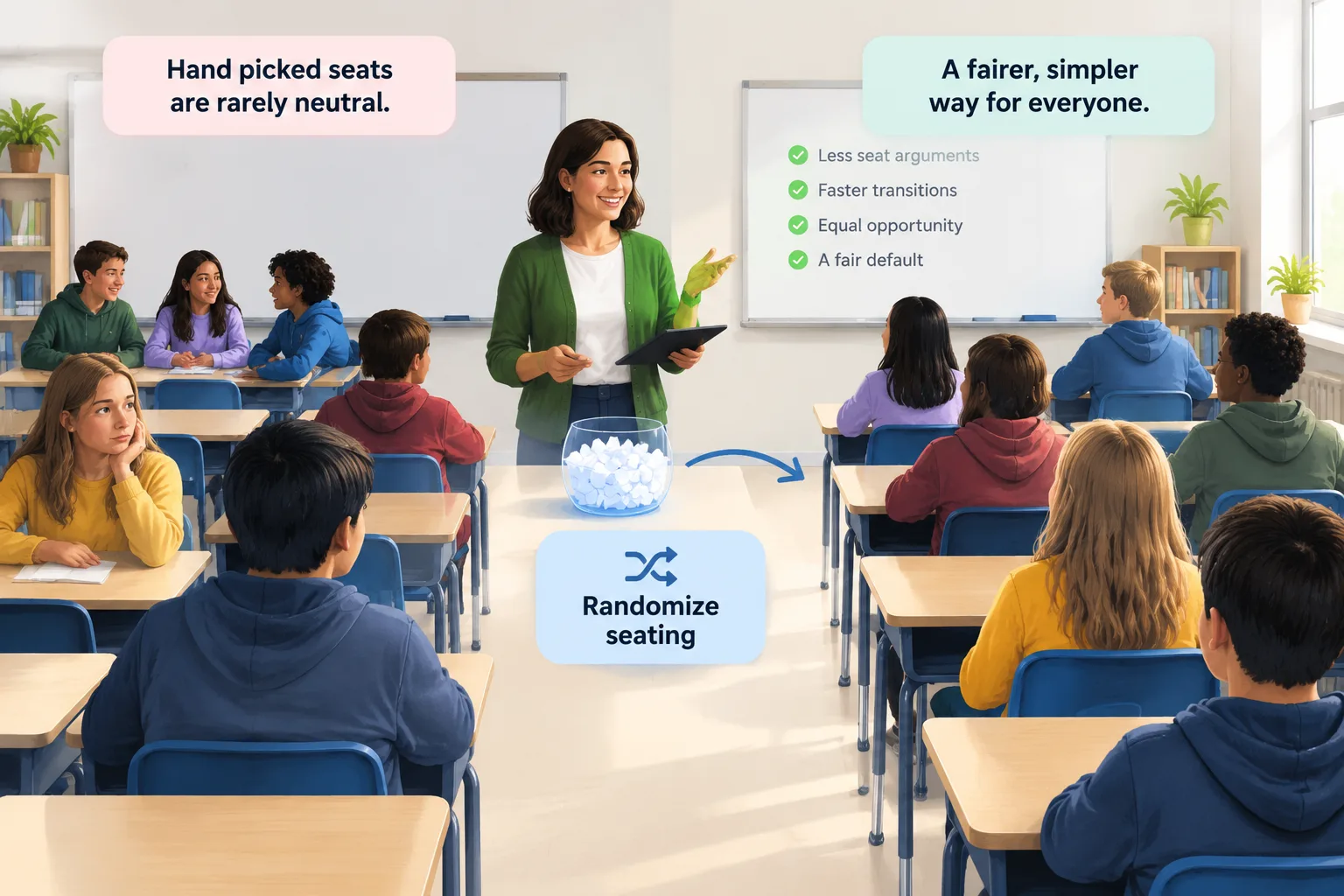
Hand-picked seats are rarely neutral. Within a few weeks, friendship clusters harden into fixed territories, quiet students drift to the edges, and every redraw becomes a negotiation. A random seating chart replaces that negotiation with a visible, repeatable rule that everyone can watch happening.
Randomization is not about control. It is a fairness default: every student has the same chance of the front row, the window seat, or the friend they hoped for. Teachers who shuffle seats on a schedule report fewer seat arguments and faster transitions, because the answer to 'why am I here' is simply 'the draw'.
The one-sentence rationale: If seat assignment is visibly random, students argue with the shuffle instead of with you.
Prepare before you shuffle
A good random chart starts with an accurate roster and an honest map of the room. Decide what a 'row' means in your space, whether seats are numbered left to right or front to back, and how many students must fit.
Check these before you generate the chart, because every one of them changes the layout you should ask for:
Pre-shuffle checklist
- One clean roster: full names, no duplicates, absent students removed or kept deliberately.
- The physical grid: how many rows the room actually has and how many seats fit per row.
- Fixed constraints you must honor by hand afterwards, such as vision accommodations near the front.
- A decision on numbering, so seat 12 means the same thing on the chart and in the room.
Create the chart in under a minute
Open the random seating chart generator and paste your roster as a plain list, one name per line. Set the shape of the room: either the number of rows, or the number of seats per row if your rows are fixed length. Generate, and the tool deals the shuffled names into the grid and numbers every seat.
If the result looks wrong, generate again; nothing is saved between runs, so experimenting is free. When the grid looks right, use the print view to get a clean copy for the door and a second copy for your records.
The three settings that matter, and what they do:
| Setting | What it controls | Typical use |
|---|---|---|
| Rows only | Exact number of rows, names spread as evenly as possible | Irregular rooms where row length can flex |
| Seats per row | Fixed seats in every row, tool computes the row count | Rooms with identical desks in each row |
| Seat numbers | A stable number printed on every seat | Making the chart readable from the doorway |
A first-day script that keeps it calm
Presenting a random chart for the first time sets the tone for the whole year. Announce the rule before showing the chart: seats today are drawn at random, they will change again on a schedule, and nobody's seat says anything about them as a student.
Then post the chart where everyone can read it at once, give the class two minutes to find seats, and start teaching. The faster the first activity begins, the less time there is for lobbying. Repeat the same script at every reshuffle and the routine becomes unremarkable within a month.
How often to reshuffle, and when to adjust
A monthly reshuffle is the most common rhythm: often enough that no seat feels owned, rare enough that students settle in between. Younger classes often do better with a reshuffle at the start of each unit or grading period, tied to something visible on the calendar.
Random is the default, not a cage. After generating, move the one or two seats that genuinely need moving, such as a pair that cannot share a row, and say so openly. Small manual edits after a random draw are honest; a fully hand-built chart that claims to be random is not.
Random seating chart or random groups: which tool when
The two problems look similar but are not. Use a seating chart when every student needs exactly one fixed place in the room: the output is a grid of seats tied to the physical space. Use random grouping when the room layout does not matter and the output is a set of teams for a task.
A quick test: if you would print the result and tape it to the door, you need a seating chart. If you would write the groups on the board for this period's activity, you need the group generator. Both tools take the same roster, so switching between them costs nothing.
Related tools and guides
- Random seating chart generator
- Random group generator for classes
- Classroom grouping strategies
Print it, post it, hand it to the substitute
A seating chart earns its keep on paper. Keep one copy at the door so students self-serve on entry, one in your own binder for attendance and behavior notes, and one in the substitute folder with the numbering explained.
Make each print do double duty:
Print routine
- Door copy: large enough to read from three steps away, seat numbers visible.
- Teacher copy: dated, with space to jot notes next to names.
- Substitute copy: the current chart plus one sentence on how numbering works.
Common mistakes to avoid
The classic failure is shuffling once in September and never again: the random chart quietly becomes a fixed chart, with all the old lobbying returning by November. The second is shuffling too often, so students never settle and you spend more time on seat logistics than on teaching.
The last mistake is pretending. If you regenerate a random chart five times until you like the look of it, students will notice, and the fairness story collapses. Generate once, adjust at most a seat or two, and let the rest stand.
FAQ
Is a random seating chart fair to every student?
Yes, in the specific sense that every student has an identical chance at every seat before the draw. Front rows, window seats, and seats next to friends are all decided by the same shuffle, which is exactly what makes the outcome easy to defend.
How often should I reshuffle classroom seats?
Most teachers reshuffle monthly or at the start of each unit. Monthly keeps seats from feeling owned while still letting students settle; unit-based reshuffles tie the change to something concrete on the class calendar.
What if two students absolutely cannot sit together?
Generate the random chart first, then move the one seat that needs moving and tell the class you did. A single open adjustment after a fair draw is honest and keeps the rule intact, unlike quietly engineering the whole chart by hand.
Should I use a seating chart or random groups?
Use a seating chart when each student needs one fixed place in the room, and random groups when you need teams for an activity and the room layout does not matter. If the result belongs taped to the door, it is a seating chart; if it belongs on the board for one lesson, it is a grouping task.
Do random seating charts work for substitute teachers?
Very well, which is one of their strongest arguments. A numbered, printed random chart lets a substitute attach names to faces immediately without any inside knowledge of the class dynamics. Keep a current copy in the substitute folder.
Related guides
- 10 Classroom Random Grouping Strategies for Balanced Teams — Learn practical classroom random grouping strategies to create fair teams, improve participation, and save time with simple teacher-friendly methods.
- What Is a Random Group Generator? Definition, Uses & Best Practices — A random group generator is a digital tool that automatically divides a list of names or items into random subgroups.
- How Teachers Can Integrate a Random Student Picker Tool into the Classroom — Learn how to use a random student picker to boost classroom engagement, ensure fair participation, and save time.
- How to Use Random Group Generator: A Complete Guide for Teachers and Facilitators — Learn how to use Random Group Generator to create fair, balanced groups in seconds.
FAQ
Is a random seating chart fair to every student?
Yes, in the specific sense that every student has an identical chance at every seat before the draw. Front rows, window seats, and seats next to friends are all decided by the same shuffle, which is exactly what makes the outcome easy to defend.
How often should I reshuffle classroom seats?
Most teachers reshuffle monthly or at the start of each unit. Monthly keeps seats from feeling owned while still letting students settle; unit-based reshuffles tie the change to something concrete on the class calendar.
What if two students absolutely cannot sit together?
Generate the random chart first, then move the one seat that needs moving and tell the class you did. A single open adjustment after a fair draw is honest and keeps the rule intact, unlike quietly engineering the whole chart by hand.
Should I use a seating chart or random groups?
Use a seating chart when each student needs one fixed place in the room, and random groups when you need teams for an activity and the room layout does not matter. If the result belongs taped to the door, it is a seating chart; if it belongs on the board for one lesson, it is a grouping task.
Do random seating charts work for substitute teachers?
Very well, which is one of their strongest arguments. A numbered, printed random chart lets a substitute attach names to faces immediately without any inside knowledge of the class dynamics. Keep a current copy in the substitute folder.
Related Tools
Pick the right generator for the job — every tool runs free in your browser.