
group name generator
Group Name Generator vs Team Name Generator: Which One Do You Really Need?
Not sure whether a group name generator or a team name generator fits your classroom, event, or workplace? Compare the two, see real examples, and learn how one flexible tool can handle both needs.

You’re staring at a blank whiteboard or an empty sign‑up sheet, and you need to name five small groups for a classroom activity—or maybe you’re setting up teams for a corporate trivia night. Do you search for a “group name generator” or a “team name generator”? While the two terms often get used interchangeably, they hint at very different output styles and real‑world uses. In this article, we’ll walk you through exactly how these naming tools differ, when each one shines, and how the free Group Name Generator at Random Group Generator can serve both scenarios beautifully.
What Is a Group Name Generator?
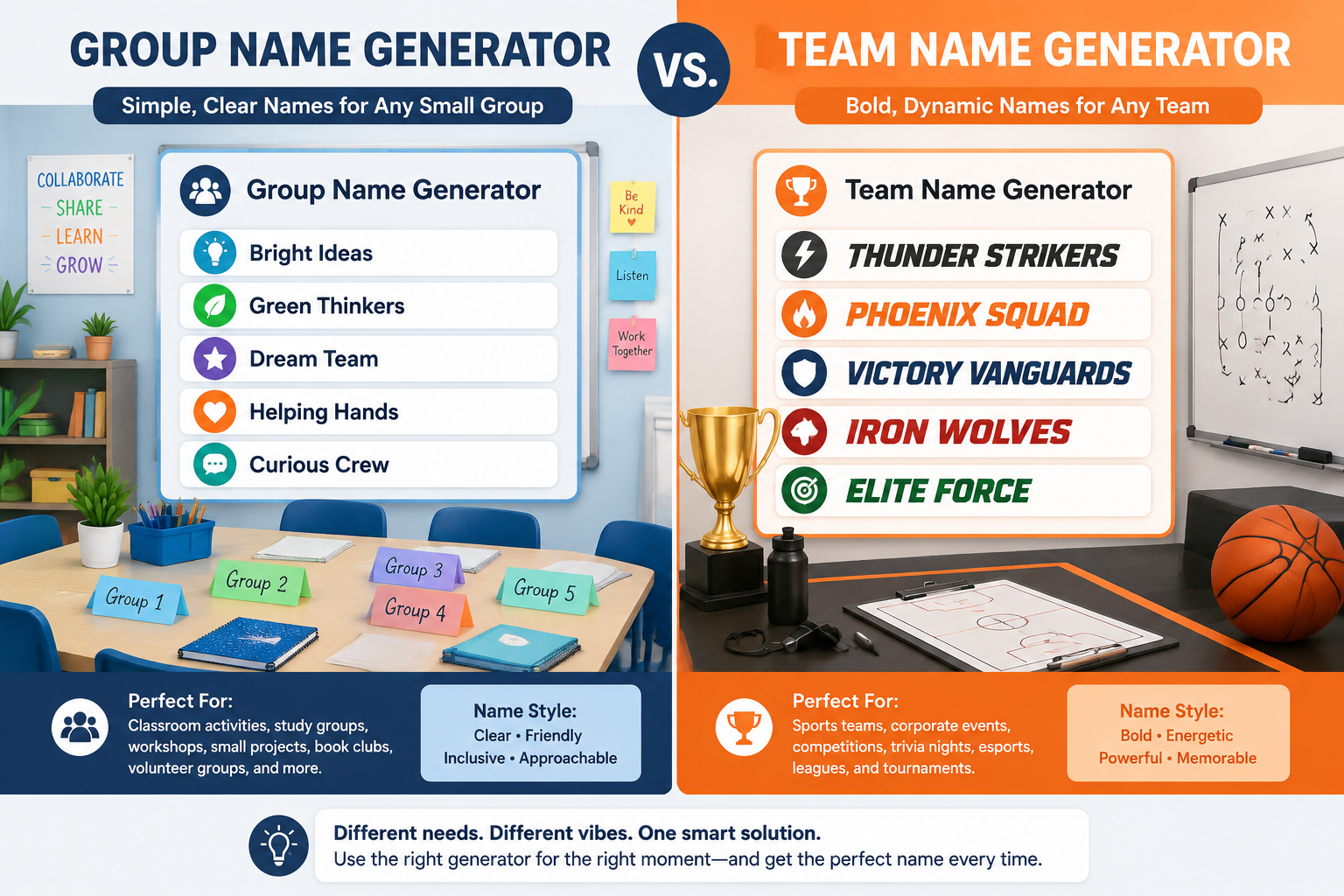
A group name generator produces simple, clear labels for small clusters of people who need a shared identifier during a short‑ to medium‑term activity. Think of a third‑grade teacher who wants to call her reading circles “Red Group,” “Blue Group,” and “Green Group,” or a workshop facilitator organizing tables as “Table 1,” “Table 2,” and so on. These names are meant to be functional, easy to remember, and non‑distracting.
Most group name generators draw from everyday word categories like colors, animals, shapes, fruit, or even common objects. The goal is to give an instant, recognizable label that works across ages and settings, without any pressure to be witty or competitive. Because the names are straightforward, participants spend zero energy debating whether “Lightning Dragons” is cooler than “Shadow Warriors”—they just get to work.
In educational settings, especially K‑12, group names also reduce social status effects. A teacher can assign “Yellow Group” and “Purple Group” without signaling which group is “better,” which keeps the focus on learning. The same principle applies in corporate training rooms, where neutral group names help attendees cluster quickly for breakout discussions.
What Is a Team Name Generator?
A team name generator leans into creativity, energy, and often a competitive edge. It’s the tool you reach for when you’re organizing a sales team for a quarterly challenge, setting up a trivia night squad, or even naming a group of friends for a weekend scavenger hunt. The output tends to be more imaginative and sometimes humorous—think “Neon Ninjas,” “Data Crunchers,” or “Trail Blazers.”
These generators frequently include categories inspired by sports, mythology, pop culture, or alliterative adjectives. The personality of the name matters because it can boost morale, foster a sense of identity, and inject a little fun into an otherwise routine event. In a workplace, a team name can become a rallying point for a sprint goal or a wellness challenge, giving people a chance to express personality while still aligning with the activity’s tone.
However, many standalone team name generators are tailored for very specific niches, like fantasy football or esports, which can make them less useful for everyday classroom or workshop settings. That’s where a more flexible tool that can simulate a team name generator—while still handling basic group naming—really earns its keep.
Key Differences Between Group Name Generators and Team Name Generators
Here are the four main areas where the two types of generators usually differ, along with what that means for you.
- Tone: Group name generators prioritize clarity and neutrality; team name generators promote energy, humor, or competitiveness.
- Naming categories: A group name generator might offer “Colors,” “Numbers,” “Shapes,” and “Simple Animals.” A team name generator often adds “Power Words,” “Adjective + Animal,” “Mythical Creatures,” or specific pop‑culture references.
- Flexibility: Many group generators allow you to generate names and then manually assign them to groups formed by a random group maker. Team name generators are sometimes stand‑alone tools, disconnected from the actual group‑forming process.
- Age and context suitability: Group name generators work for any audience; team name generators often need a filter so you don’t end up with names that feel immature in a boardroom or too corporate for first graders.
Neither approach is inherently better—you just need the right tool for the mood you’re trying to create.
When Should You Use a Group Name Generator?
Opt for a group name generator when your primary goal is organization, not entertainment. This includes:
- Classroom reading groups, math stations, or project pods.
- Workshop breakout tables at a professional development day.
- Zoom breakout rooms during a webinar or online class.
- Any activity where you’ll form groups, pairs, or tables quickly and repeatedly.
In these cases, a name like “Orange Group” or “Group D” works perfectly because the facilitator can call out the name, learners hear it instantly, and the layout stays predictable. If you later want to group students randomly, you can use the Random Group Generator to assign members first, then give each cluster a name from the group name generator for easy reference on slides or shared documents.
When Should You Use a Team Name Generator?
Reach for a team name generator when the name itself becomes part of the experience. Think:
- Monthly office wellness challenges (step‑count teams, hydration teams).
- Charity fun runs and relay races.
- Trivia nights, game shows, or quiz competitions.
- Long‑term project teams where a name reinforces identity and social bonding.
A strong team name can spark conversation and even inside jokes that carry through the whole event. But if the group’s mission is purely academic or task‑oriented, an overly flashy name might distract from the actual work. So use a team‑style name only when the vibe calls for it.
How to Use the Group Name Generator at Random Group Generator for Both Scenarios
The Group Name Generator on this platform does more than just spit out “Purple Group.” Because it offers multiple categories and customizable output, you can easily steer it toward either a group‑focused or team‑focused result. Here’s a simple step‑by‑step for both use cases.
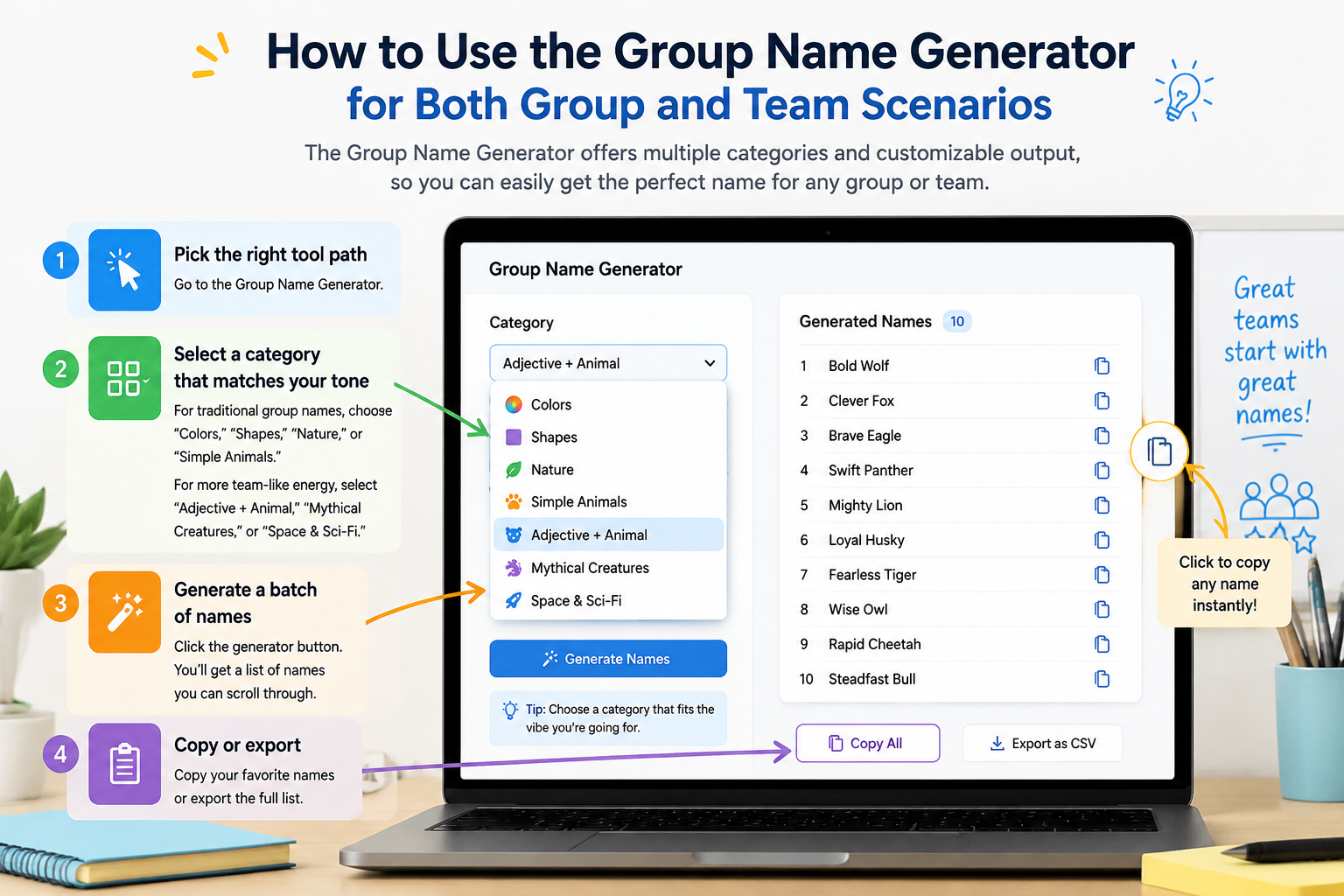
- Pick the right tool path: Go to the Group Name Generator.
- Select a category that matches your tone:
- For traditional group names, choose “Colors,” “Shapes,” “Nature,” or “Simple Animals.”
- For more team‑like energy, select “Adjective + Animal,” “Mythical Creatures,” or “Space & Sci‑Fi.”
- Generate a batch of names: Click the generator button. You’ll get a list of names you can scroll through.
- Copy or export your favorites: The tool lets you quickly copy names to your clipboard. If you already used the Random Group Generator to divide your list of participants, you can paste the names right next to each group.
- Optional — connect to your workflow: If you’re running a virtual class, you can rename breakout rooms in Zoom or Microsoft Teams using the generated names. The tool’s integrations with Zoom, Teams, Google Classroom, and Slack make this a one‑click step for many educators and facilitators.
For example, Ms. Rodriguez, a middle‑school science teacher, wanted to add a sense of adventure to her ecology unit. After dividing her 30 students into six groups with the Random Group Generator, she switched to the Group Name Generator, selected “Mythical Creatures,” and got “Griffin Team,” “Phoenix Squad,” and “Dragon Force.” The names took 30 seconds to produce yet gave each group an identity that students loved. The same process works just as easily for a corporate trainer forming battle lines for a sales role‑play workshop.
Customization: Making a Group Name Generator Work Like a Team Name Generator
If you want maximum control, you can combine the generator’s built‑in categories with a little manual tweaking. Suppose the generator gives you “Golden Cheetahs” from the “Adjective + Animal” category. If that’s too long or too wild, just take the core idea and shorten it to “Cheetahs” or “Gold Team.” Many facilitators keep a shortlist of approved words (e.g., “Squad,” “Crew,” “Force,” “Unit”) and tack them onto a generated base to instantly shift a classroom‑friendly name into team‑friendly territory.
You can also save custom name lists within the tool’s session and revisit them later. For recurring events like weekly math centers or monthly sales sprints, reusing a familiar set of names builds continuity and saves time. And because the tool supports nine languages, you can generate names that feel native to your participants, whether your workshop is in English, Spanish, Mandarin, or French.
Limitations of Group Name Generators (and When to Look Elsewhere)
No tool fits every situation perfectly. Here are a few cases where a dedicated group or team name generator might fall short, and what to do about it.
- Highly specific branding: If you need a name that aligns with a strict corporate brand playbook (e.g., all team names must include the product name), you’re better off brainstorming manually or working with a creative team.
- Niche subculture names: Fantasy sports leagues with complex inside jokes or game‑specific lore may require a generator that pulls from that specific universe.
- Legal clearance: Randomly generated names might coincidentally resemble trademarked terms. Always do a quick check if you plan to put the name on official merchandise or public communications.
For the vast majority of everyday classroom, workshop, and workplace needs, however, a well‑rounded group name generator like the one at Random Group Generator gives you exactly the right balance of speed, variety, and tone control—whether you call the output a “group name” or a “team name.”
FAQ
Can I use the Group Name Generator to create team names for a sports league?
Yes, absolutely. Selecting categories like “Adjective + Animal,” “Mythical Creatures,” or “Space & Sci‑Fi” yields names with the energy and personality you’d expect from a dedicated team name generator. You can further customize the output by prepending words like “The” or adding “United” to fit your league’s culture.
What’s the actual difference between a group name and a team name?
It’s mostly about tone and purpose. A group name (like “Blue Table”) is functional and neutral, designed to identify a subset of people without drawing attention to itself. A team name (like “Lightning Lions”) is meant to inspire, entertain, or rally a group. In practice, many facilitators use the same generator to produce both styles by choosing different categories.
Does the tool work in languages other than English?
Yes, the Group Name Generator supports nine languages. You can switch the interface and the generated names to languages such as Spanish, French, German, Japanese, and Mandarin, which is especially helpful for international teams, language classes, or bilingual workshops.
Can I get names based on a theme, like superheroes or outer space?
Yes, the generator includes themed categories such as “Space & Sci‑Fi,” “Mythical Creatures,” and “Adjective + Animal.” While it may not have an exhaustive list of every pop‑culture theme, the existing options cover the most popular motifs for both educational and professional settings.
Is the Group Name Generator free to use?
Completely free. The tool is part of the Random Group Generator platform, which offers a full suite of free grouping and naming tools for educators, trainers, and event facilitators. There are no logins required, no hidden fees, and no usage limits for the core features.
Ready to give your next classroom group, project pod, or company team a name that sticks? Try the Group Name Generator right now—for free—and see how one flexible tool can cover all your naming needs.
Related guides
- Creative Group Name Ideas for Class Projects (That Students Love) — Need a catchy nom de groupe projet scolaire?
- How to Choose a Great Group Name: A Practical Guide — Struggling to pick the perfect group name?
- Complete Group Name Generator Tutorial: Easy Step-by-Step Guide — Learn how to use the Group Name Generator for classrooms, team building, and events.
- What Is a Random Group Generator? Definition, Uses & Best Practices — A random group generator is a digital tool that automatically divides a list of names or items into random …
SponsoredExplore more resources