
random mlb team generator
Random MLB Team Generator: Randomize All 30 Baseball Teams
Use a random MLB team generator to pick one of all 30 baseball teams or split a group into team-named groups. Step-by-step guide, full team list, and FAQ.
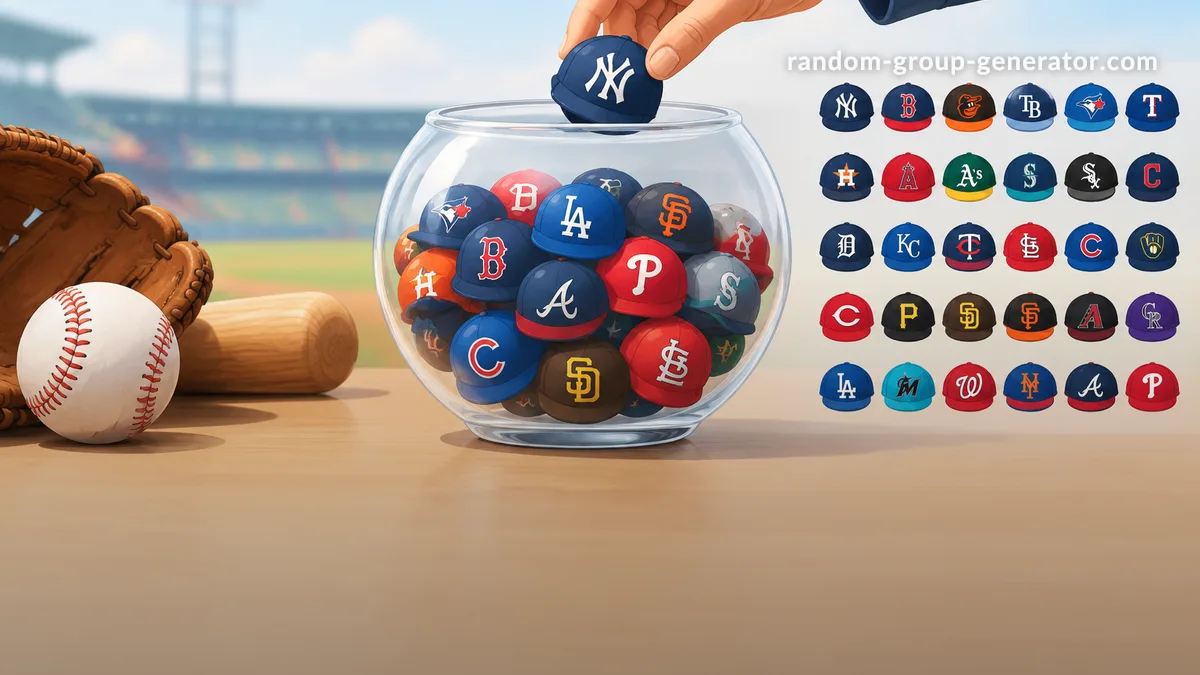
You need one team out of 30 — for a fantasy draft order, a classroom project, a video-game tournament, or an office pool — and the pick has to look obviously fair. A random MLB team generator solves exactly that problem: it takes the list of Major League Baseball clubs and returns one team, or splits a group of people into team-named groups, without anyone accusing you of playing favorites. This guide covers what the tool does, how to run a draw in a few minutes, and when a plain random picker is the wrong instrument for the job.
{{IMG_0:clean instructional illustration of a spinning wheel split into thirty numbered wedges with a cursor resting on a spin button and faint baseball stitching in the background}}
What a random MLB team generator actually does
There is no single official MLB randomizer. In practice, a random MLB team generator is any tool that takes a list of team names and applies a random pick or shuffle to it. That produces two distinct jobs, and most people only need one of them.
The first job is selection: one name comes back from a pool of 30. Each franchise has the same 1-in-30 chance on a given draw, which works out to roughly 3.3 percent. If repeats are allowed, every draw is independent, so the same club can come up twice in a row. That is rare, but it is not a bug.
The second job is distribution. Here you have people, not just team names. You paste a class list or a roster into a random group generator, choose how many groups you want, and the tool returns balanced groups. If you want the baseball theme visible on the whiteboard, name each group after a club with a group name generator.
One honest note about this site: it does not ship with a built-in MLB data file. You supply the team list. That means the picker never silently re-weights a popular team, and it also means your list is only as current as what you paste. Check the MLB.com team directory before a draw that people actually care about.
Who uses a random MLB team picker
Demand for a random baseball team generator comes from a surprisingly wide set of situations. Fantasy baseball commissioners use it to set a draft order. Teachers use it for baseball-themed reading groups, geography projects, or a sports unit where each group follows one club for a month. Coaches and PE teachers use it to assign practice stations. Game-night hosts use it for MLB The Show tournaments or a 30-team board-game bracket. Trivia hosts use it to pick a team of the night.
If your group is a classroom, it helps to separate choosing a topic from choosing a person. When the goal is to call on a student rather than a team, a random student picker is the better fit, because it removes the recurring complaint that the same two people always get picked. When the goal is two-person work, a random pair generator keeps partners from turning into a popularity contest.
Facilitators also use the same pattern at work. A fifteen-person team meeting can draw one club each, then spend two minutes explaining the pick. It is a low-stakes way to give everyone a speaking turn without a round-robin that drags.
How to pick one random MLB team in six steps
Here is the whole workflow. It takes about two minutes the first time and closer to thirty seconds once you have a saved list.
- Copy the 30-team list from the section further down this page, or paste a shortlist if you only want six division winners from last season.
- Open the random group generator. It runs in the browser, so there is nothing to install.
- Paste the team names into the name field, one team per line. Keep all 30 in a single list when you want a single winner.
- Decide the repeats rule before you draw. One team only suits a draft; repeats allowed suits a quick icebreaker where duplicates are harmless.
- Run the draw in front of the audience when you can. Watching the shuffle happen is what makes the result feel legitimate rather than announced.
- Record the result immediately — screenshot, whiteboard, or shared doc. Redrawing because the outcome felt wrong is the fastest way to destroy trust in the process.
{{IMG_1:clean grouping diagram showing thirty team labels being shuffled into six balanced groups of five with even counts labelled on the side}}
How to split people into MLB team groups
Team names are often just the label on a group of people. This is where the grouping side of the tool earns its keep, because it distributes sizes evenly instead of leaving someone stranded at the end of the list.
- Paste your names into the generator, one per line.
- Choose the number of groups. Six groups of five mirrors the MLB division structure, which fits nicely into a sports unit.
- Set either group count or group size, whichever your activity constrains, and let the tool balance the remainder.
- Assign each group a club name, either by letting groups choose or by drawing from the 30-team list.
- Save the output somewhere shared before the activity starts, so a late arrival can be slotted in without a full redraw.
Example: a 28-student class splitting into six groups produces four groups of five and two groups of four. That unevenness is normal arithmetic, not a fairness failure, and knowing it in advance saves a five-minute debate in front of the room.
How to run a full 30-team draw with no repeats
Sometimes you want every team used exactly once. Fantasy leagues with 30 owners, a classroom where each student adopts a club, or a bracket that covers the whole league all follow this pattern.
The reliable method is shuffle plus ordered assignment. Put all 30 teams in one list, shuffle once, then work down the shuffled order and hand out team one to person one, team two to person two, and so on. Every participant gets a unique franchise, and the only random step is the opening shuffle.
If you need a repeatable structure, run it as rounds. Six rounds of five draws covers all 30 teams and produces a tidy six-week schedule. Draw five teams per round without replacement, skip any club already assigned, and log each round. It is slightly more work than a straight shuffle, but it gives you a written trail you can show if someone questions the outcome.
All 30 MLB teams, ready to copy and paste
Paste any block below into the random group generator and you are ready to draw. Teams are grouped by division using the current league alignment.
American League East: Baltimore Orioles, Boston Red Sox, New York Yankees, Tampa Bay Rays, Toronto Blue Jays
American League Central: Chicago White Sox, Cleveland Guardians, Detroit Tigers, Kansas City Royals, Minnesota Twins
American League West: Houston Astros, Los Angeles Angels, Athletics, Seattle Mariners, Texas Rangers
National League East: Atlanta Braves, Miami Marlins, New York Mets, Philadelphia Phillies, Washington Nationals
National League Central: Chicago Cubs, Cincinnati Reds, Milwaukee Brewers, Pittsburgh Pirates, St. Louis Cardinals
National League West: Arizona Diamondbacks, Colorado Rockies, Los Angeles Dodgers, San Diego Padres, San Francisco Giants
Two practical cautions. First, the Athletics played in Oakland for decades and now appear on official lists simply as the Athletics, so older copied lists may still say Oakland. Second, club names, cities, and league rules change over time. Treat any team list on the internet, including this one, as a starting point and confirm it against the official team directory before a high-stakes draw.
Why fairness is a design problem, not just a button
Humans are bad at random. Ask someone to pick randomly from 30 teams and they will avoid repeating, avoid the obvious favorites, and unconsciously spread their choices around. Real randomness does the opposite: it clusters. Two draws of the same club in ten spins is completely plausible, and it will still feel rigged to the person who wanted a different outcome.
That is why the process matters as much as the tool. Draw in public, fix the repeats rule first, and write the result down. If you change the rules after seeing the outcome, you have replaced a random draw with a negotiation.
The limits are worth stating plainly. A generic randomizer has no idea which teams are strong, so it cannot weight by standings, payroll, or last season's record. It produces no audit log and no verifiable seed. If your context requires auditable randomness — a paid competition, a compliance-driven assignment, a league with a written constitution — use a documented method you can re-run, or a spreadsheet with a recorded seed, and publish the procedure. This tool is built for everyday fairness, not for formal certification.
{{IMG_2:simple comparison infographic with three columns labelled single team pick, pair match, and balanced groups, each with a small icon and a one line use case}}
Four real-world examples that work
Fantasy league draft order. Twelve owners, twelve draws from the full 30-team list with repeats allowed. Each owner keeps the club they draw as a root team for the season of trash talk, and the draw order sets the draft. Total time: about four minutes.
Fifth-grade sports unit. Thirty students, six groups of five, each group following one MLB club for six weeks: a wins graph, a city map, and a short presentation. The grouping is random; the work is not.
MLB The Show or board-game tournament. A 30-team bracket needs seeding nobody can argue with. Draw the opening-round matchups randomly, then lock the bracket. If your game night covers more than baseball, the same method works for basketball — see the random NBA team generator guide for the parallel setup.
Office icebreaker. Fifteen colleagues each draw a team and answer one two-minute question about it, or invent a slogan. Repeats are fine here, so a single spin is enough.
Alternatives compared: wheel, groups, pairs, or a hat
Choose the tool that matches the decision, not the one with the best name. A group wheel spinner is the most theatrical option for a single winner, because the audience sees every name in play. A random group generator is the right call when you are dividing people rather than crowning one. A random pair generator handles two-person work such as reading partners or lab buddies. A seating chart tool is worth considering if the baseball theme is really about arranging the room rather than assigning teams.
A physical hat draw is still perfectly valid, and it has one advantage no app can match: nobody suspects the software. Its weakness is logistics. Thirty slips of paper, a small room, and someone inevitably peeking before the reveal. If you want both spectacle and neutrality, a public single spin on a wheel is the compromise most facilitators settle on.
FAQ
Is a random MLB team generator truly random?
It is as random as an unweighted browser shuffle can be. Every team on your pasted list has the same chance on each draw, and no team is favored by position in the list. The honest caveat is that browser-based randomness is not the same as a certified lottery system. For classroom, office, or casual league use, it is more than sufficient — especially when the draw happens in front of the people affected.
Can I draw MLB teams without repeats?
Yes, by drawing without replacement. Run one shuffle of all 30 names, then assign teams down the resulting order, skipping any club already given out. Alternatively, work in rounds: draw five teams, remove them, and repeat. Either way, each club is used exactly once, which is what fantasy leagues with 30 owners and bracket setups usually need.
Can I use this to split my class into baseball teams?
Yes, and this is the most common school use. Paste the class list, choose six groups to mirror the divisions, then label each group with a club name drawn from the 30-team list. Groups will be as even as the numbers allow, so a class of 28 becomes four groups of five and two of four rather than one oversized group and one leftover student.
Does it work for the NBA, NFL, or other leagues?
Yes. Nothing in the tool is baseball-specific — it works with any list of names you paste, whether that is 30 NBA franchises, 32 NFL teams, or the twelve clubs in a local youth league. The only change is that you replace the team list. The filtering and grouping behavior stays identical.
How do I keep the draw fair if someone disputes the result?
Decide the rules before the draw, run it publicly, and record the outcome immediately. If a dispute still happens, do not redraw — that rewards complaining and penalizes whoever already won. Instead, show the recorded result and the rule you set. For high-stakes situations, use a written, re-runnable procedure and keep the log alongside the outcome.
Ready to run your draw?
Whether you need one random club for a trivia round or six balanced groups for a six-week sports unit, the setup is the same: paste the list, set your repeats rule, and draw in front of the room. Start with the random group generator for groups and team assignments, switch to the group wheel spinner when the audience wants a dramatic single reveal, and grab the random pair generator if the activity is really one-on-one. Copy the 30-team list above, and your next MLB team draw takes about thirty seconds.