
pseudo-random number generator
Pseudo-Random Number Generator Definition: How PRNGs Work
Learn the pseudo-random number generator definition, how seeds and algorithms produce random-looking numbers, and how PRNGs support simulations, games, and fair group assignments.
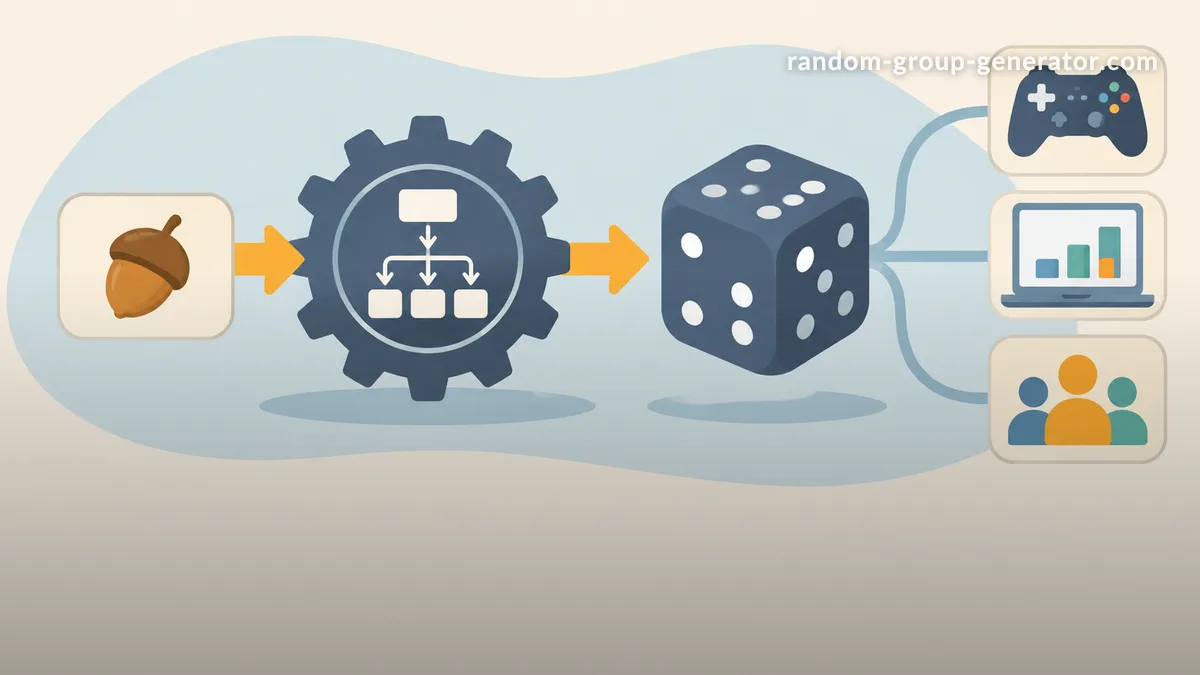
Imagine a teacher who needs to divide 28 students into seven balanced groups. Instead of choosing students manually, the teacher uses an online random group generator. The tool produces a different-looking arrangement in seconds. But how does a computer decide which student goes where? The answer often involves a pseudo-random number generator (PRNG). Understanding the pseudo-random number generator definition helps explain how computers create random-looking results, why those results are useful, and where their limitations matter. PRNGs are used in simulations, games, software testing, digital tools, and everyday random selection tasks.
What Is the Pseudo-Random Number Generator Definition?
A pseudo-random number generator is an algorithm that produces a sequence of numbers that appears random but is actually calculated using a mathematical process. The term PRNG stands for pseudo-random number generator. Unlike a process based on unpredictable physical events, a traditional PRNG follows a defined set of computational rules.
The word "pseudo" means that something resembles another thing without being exactly the same. In this context, pseudo-random numbers look random even though a computer generates them deterministically. A well-designed generator can produce sequences with useful statistical properties, such as an even distribution and no obvious repeating patterns within the expected operating range.
The National Institute of Standards and Technology (NIST) describes a pseudorandom number generator as a deterministic algorithm that uses an initial input called a seed to produce a much longer sequence of random-looking bits. This distinction is important: the output can behave like random data for many practical applications even though its generation follows a mathematical process.
For example, a teacher might use a PRNG-powered tool to select one student from a class list. The computer does not need to make a conscious decision. It generates a number, maps that number to a student on the list, and displays the selection.
How Does a Pseudo-Random Number Generator Work?
A PRNG works by starting with an initial value and repeatedly applying mathematical operations to generate new values. The process is designed to produce results that are difficult to predict by simply looking at the previous numbers.
The initial value is called a seed. Once the seed and algorithm are established, the generator follows a predictable sequence of calculations. Depending on the algorithm, the resulting values may be converted into integers, decimals, percentages, or other formats that an application needs.
A simplified example looks like this:
- The computer receives an initial seed value.
- The PRNG processes that value using its mathematical algorithm.
- The algorithm produces a new pseudorandom value.
- The internal state changes, allowing the next value to be generated.
- The process continues whenever the application requests another number.
Consider a classroom activity in which a teacher wants to assign students to four groups. The software can generate a sequence of numbers, use those numbers to shuffle the student list, and then distribute students across the four groups.
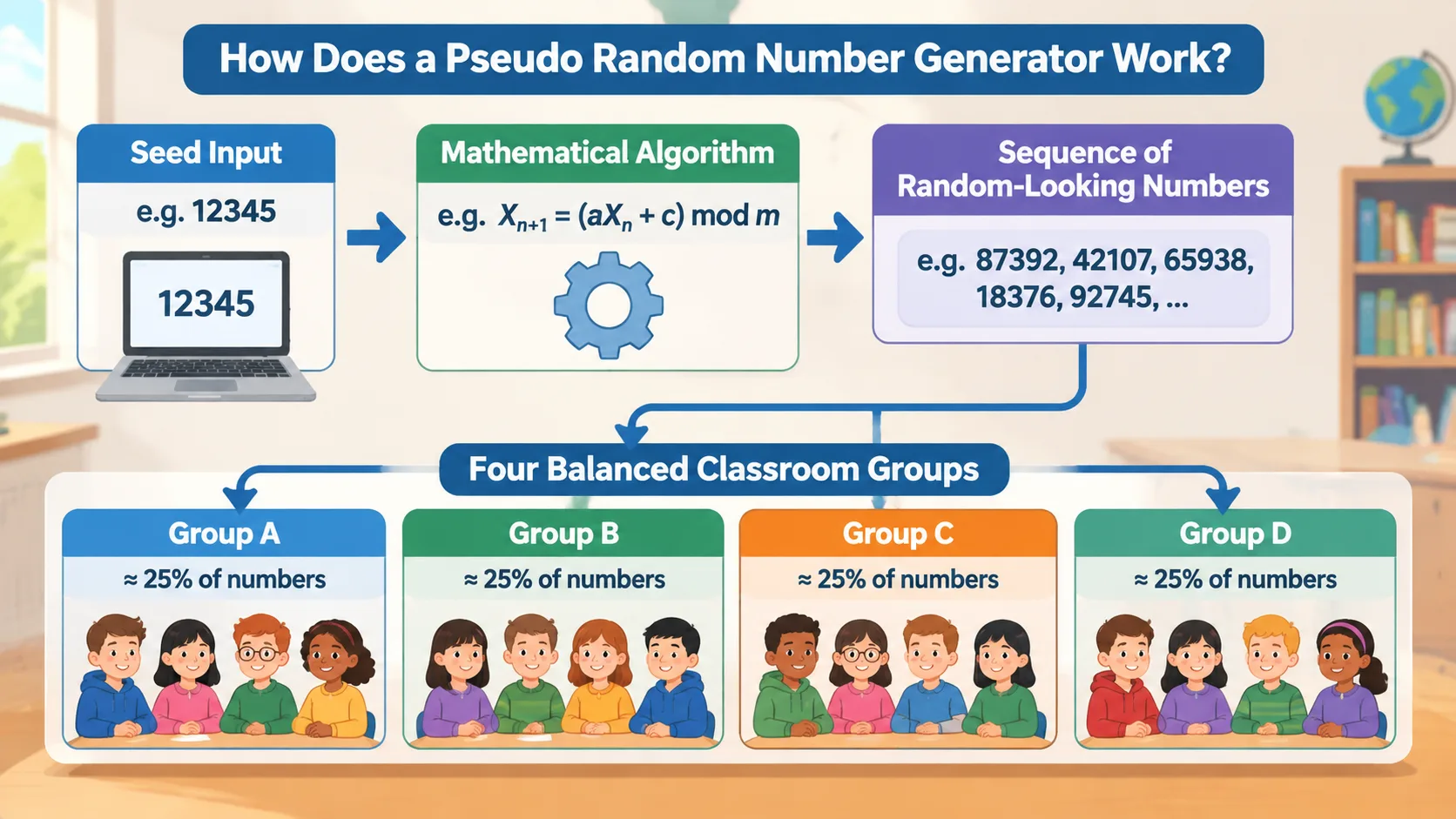
The important point is that the generator does not need a human to choose each result. It follows the same computational process each time it runs with the same initial conditions.
What Is a Seed in a PRNG?
A seed is the starting value used to initialize a pseudo-random number generator. It provides the initial state from which the algorithm begins producing its sequence. Different seeds generally produce different sequences, while using the same seed with the same algorithm and conditions can reproduce the same sequence.
Think of a seed as the starting position in a mathematical process. It does not contain the entire sequence of numbers. Instead, it gives the generator the information it needs to begin calculating that sequence.
For example, imagine two students using the same computer program to simulate dice rolls. If both use the same seed and the same PRNG implementation, they can obtain matching results. If they use different seeds, their sequences will generally differ.
This repeatability is useful in several situations:
- Software testing: Developers can reproduce a random sequence that caused a bug.
- Education: Teachers can demonstrate how the same starting conditions lead to the same results.
- Scientific simulations: Researchers can repeat an experiment using identical random inputs.
- Team activities: Facilitators can document the conditions behind a particular randomized assignment when the software supports reproducible seeds.
However, a seed is not automatically a guarantee of security or fairness. A predictable seed can make the resulting sequence easier to anticipate. Applications that require strong unpredictability need appropriate entropy sources and cryptographically secure generation methods.
PRNG vs. True Random Number Generator: What Is the Difference?
Pseudo-random number generators and true random number generators both produce numbers for applications, but they use different approaches.
A PRNG uses a deterministic algorithm. A true random number generator (TRNG), sometimes called a nondeterministic random number generator, relies on physical processes that provide unpredictable input. Examples can include electronic noise and other physical phenomena.
The distinction is not simply that one is good and the other is bad. Each approach has different strengths and practical uses.
| Feature | PRNG | True random number generator |
|---|---|---|
| Generation method | Mathematical algorithm | Physical source of randomness |
| Repeatability | Possible with the same seed and conditions | Normally not reproducible in the same way |
| Speed | Often efficient for software applications | Depends on the physical source and implementation |
| Main advantage | Fast, repeatable number generation | Unpredictable physical input |
| Typical applications | Simulations, games, testing, random selection | Hardware-based randomness and security systems |
For a teacher organizing students into teams, a suitable PRNG-based tool is usually a practical option. The activity does not normally require physical randomness. It requires an unbiased assignment process that distributes participants without giving the organizer an arbitrary reason to favor particular students.
For a cryptographic application, however, the requirements are different. Security systems need generators designed to resist prediction and manipulation. A basic PRNG should not be assumed suitable for passwords, encryption keys, or other sensitive information.
Common Types of Pseudo-Random Number Generators
PRNGs use different mathematical approaches. Some are designed for speed and general-purpose simulations, while others are built for stronger security properties. Understanding the main categories helps explain why different applications choose different generators.
Linear Congruential Generators
A linear congruential generator (LCG) is one of the simplest traditional PRNG designs. It uses a mathematical formula involving the previous number, a multiplier, an increment, and a modulus.
Its basic structure is:
\[X_{n+1} = (aX_n + c) \bmod m\]
Here, \(X_n\) represents the current value, \(a\) is the multiplier, \(c\) is the increment, and \(m\) is the modulus. The next value becomes the starting point for the following calculation.
LCGs are relatively easy to understand and implement. They are useful for teaching introductory computer science concepts, although their statistical limitations make some implementations unsuitable for demanding simulations or security applications.
Mersenne Twister
The Mersenne Twister is a widely known pseudorandom number generation algorithm developed for general-purpose use. It is recognized for its long period and strong statistical characteristics in many non-cryptographic applications.
It has been used in programming environments and scientific applications where repeatable random sequences are useful. However, it is deterministic and is not appropriate for cryptographic security. Statistical quality does not automatically mean that an algorithm is unpredictable to an attacker.
Cryptographically Secure Pseudorandom Number Generators
Cryptographically secure pseudorandom number generators are designed with security requirements in mind. They aim to make generated values computationally difficult to predict without knowledge of the secret internal state or seed.
NIST Special Publication 800-90A describes deterministic random bit generator mechanisms based on cryptographic techniques, including hash functions and block ciphers. These mechanisms are intended for applications with stronger security requirements than ordinary random selection or simulations.
The correct generator depends on the problem. A classroom grouping application and a password-generation system should not automatically use the same randomization approach.
Why Are Pseudo-Random Number Generators Important?
Computers rely on random-looking values in many everyday applications. Without a practical way to generate them, developers would need to build more complicated systems for activities that benefit from unpredictable-looking sequences.
PRNGs are particularly valuable because they combine computational efficiency with repeatability. They allow software to produce many values without requiring a physical random event for every calculation.
Common applications include:
- Video games: Creating randomized events, game environments, item distributions, and simulations.
- Scientific research: Supporting Monte Carlo simulations and other computational experiments.
- Software development: Testing different inputs and reproducing errors.
- Education: Supporting probability lessons, random selection, and classroom activities.
- Business workshops: Helping facilitators assign participants to teams and discussion groups.
- Data analysis: Generating randomized samples for certain statistical procedures.
For example, a corporate trainer running a workshop for 32 employees might need eight discussion groups of four. A randomization tool can help create those assignments without manually deciding who works with whom.
Similarly, a teacher can use a Random Group Generator to organize a class into smaller teams. For paired activities, a Random Pair Generator can help assign partners without repeatedly making manual choices.
These tools make randomization easier to apply in real activities. Their usefulness still depends on appropriate settings, accurate participant lists, and a grouping method that matches the activity's goals.
How PRNGs Support Fair Random Group Assignments
Random group assignments are a practical example of how pseudorandom number generation can support everyday decisions. When teachers and facilitators repeatedly assign participants manually, personal preferences and unconscious habits can influence the results.
A computerized randomization process can reduce this manual influence by applying a consistent procedure to the participant list. However, the use of a PRNG alone does not guarantee balanced groups. The application must also handle the participant list, group sizes, duplicate entries, and distribution rules correctly.
Consider a teacher with 24 students who wants six groups of four. A straightforward workflow is:
- Enter the names of all 24 students.
- Choose six groups or four students per group.
- Run the random grouping process.
- Review the resulting assignments.
- Share the groups with the class or transfer them into the lesson plan.
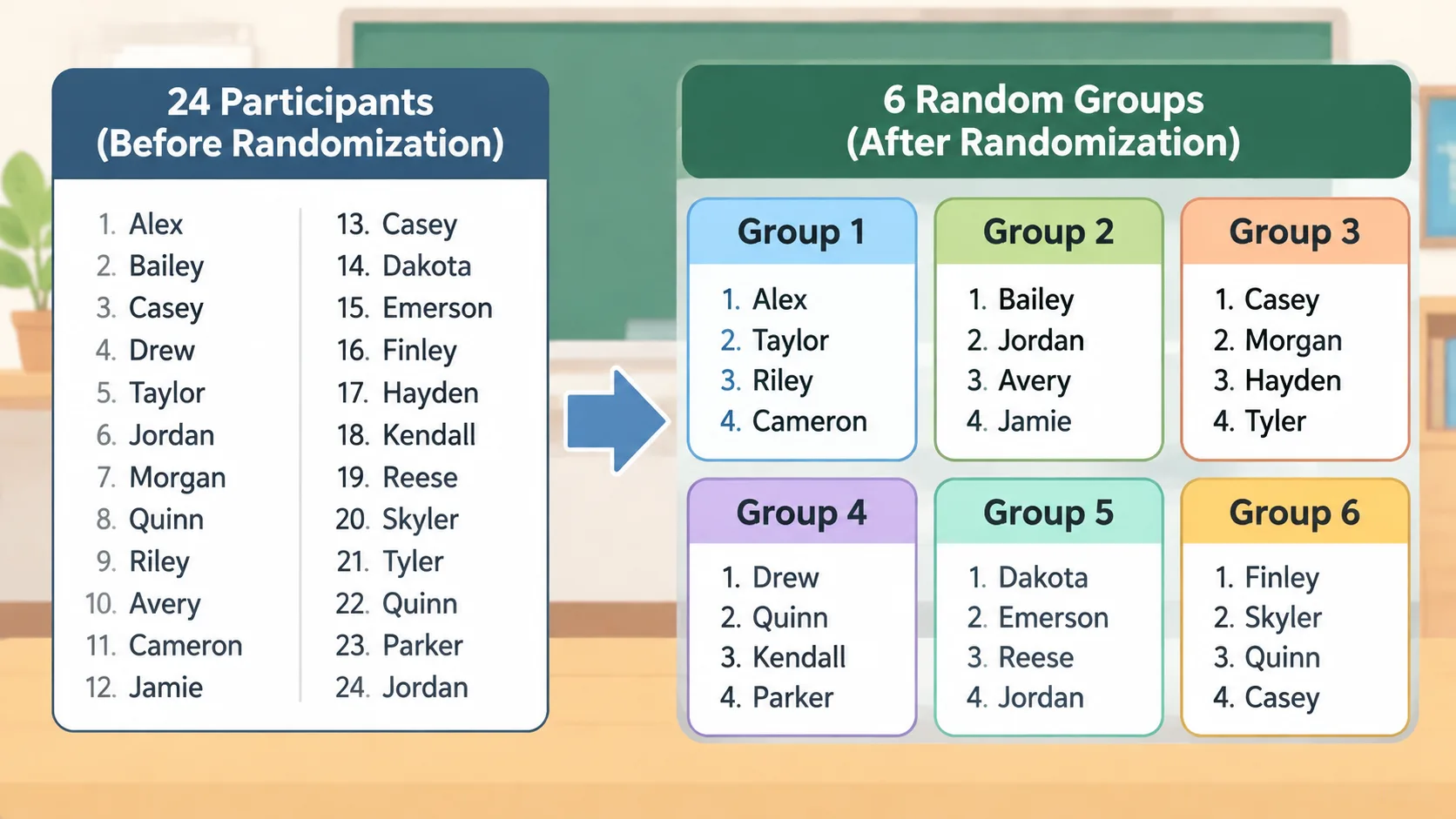
The result provides a practical starting point for collaborative work. The teacher can then make adjustments if specific educational requirements apply, such as accessibility needs, language support, or intentionally mixed skill levels.
For a different classroom activity, a Random Student Picker can help select a participant to answer a question or demonstrate a solution. It serves a different purpose from a group generator, but the underlying idea of using computerized random selection is similar.
It is also important to distinguish randomness from balance. Random groups may not automatically contain equal numbers of students with different skill levels, backgrounds, or experience. If an activity requires those conditions, the organizer should use a controlled grouping method rather than relying on unrestricted random assignment alone.
Limitations of Pseudo-Random Number Generators
Although PRNGs are useful, they are not perfect solutions for every problem. Their deterministic nature creates limitations that users and developers should understand before relying on their results.
First, a sequence can repeat. Every PRNG has a finite internal state and a finite period, meaning that its sequence eventually cycles. For many everyday applications, a well-designed generator has a sufficiently long period, but the possibility of repetition is part of the underlying design.
Second, the quality of the algorithm matters. A weak generator may produce noticeable patterns, poor distributions, or correlations between values. Such problems can affect simulations and statistical experiments even when the numbers initially look random.
Third, predictable seeds can make results easier to reproduce or anticipate. This is helpful for testing but potentially dangerous for security-sensitive applications. A standard non-cryptographic PRNG should never be treated as a secure source of passwords or encryption keys.
Finally, random numbers do not correct poor application design. A grouping tool might generate a valid random sequence but still create an unsuitable result if the participant list contains duplicates or if the group-size settings are incorrect.
For teachers and facilitators, the practical lesson is simple: use randomization when impartial selection is appropriate, check the participant data, and apply additional constraints when the activity requires them.
How to Choose the Right Randomization Tool
Choosing a randomization tool begins with identifying what needs to be selected or organized. Different activities require different outputs, even when they rely on similar random number generation principles.
For classroom team assignments, choose a group generator that lets you enter participant names and specify the number of groups or participants per group. For partner discussions, a pair generator is more direct. For choosing one participant, a student picker is the better match.
Before using a tool, consider these practical questions:
- Does it support the number of participants in your activity?
- Can you choose the desired group size or number of groups?
- Does it handle leftover participants clearly?
- Can you review and share the resulting assignments?
- Does it offer any additional controls needed for your activity?
For example, a workshop facilitator with 17 participants who wants four groups should check how the tool distributes the extra participant. One reasonable result is three groups of four and one group of five. If the activity requires identical group sizes, the facilitator must choose a different number of groups or participants.
A randomization tool is also not the right choice for every situation. If you need to create groups based on expertise, accessibility, job role, or carefully balanced experience levels, a structured assignment process may be more appropriate. Randomization can still be used within those constraints, but it should not replace professional judgment.
Frequently Asked Questions
Is a pseudo-random number generator really random?
A PRNG is deterministic rather than truly random because it calculates values from an initial seed and an algorithm. However, a well-designed generator can produce sequences that appear random and satisfy useful statistical requirements. Whether it is suitable depends on the intended application.
Why is it called pseudo-random instead of random?
The word pseudo indicates that the generated values resemble random numbers without being produced through a genuinely unpredictable process. The generator follows mathematical rules, even when its output has no obvious pattern. This distinction explains why the same seed and algorithm can reproduce the same sequence.
What happens if a PRNG uses the same seed twice?
When the same algorithm starts with the same seed and identical operating conditions, it generally produces the same sequence. This property is useful for repeating experiments and debugging software. It also means that a predictable seed should not be used when security depends on unpredictable output.
Are pseudo-random number generators suitable for classroom group assignments?
Yes. A suitable PRNG-powered grouping tool can help teachers distribute students into groups or pairs without making every assignment manually. However, random selection does not guarantee balanced academic ability, accessibility, or experience, so teachers should review the results when those factors matter.
Can a pseudo-random number generator be used for passwords?
An ordinary PRNG should not be used to generate passwords or cryptographic secrets unless it has been specifically designed and implemented for security. Cryptographically secure generators use stronger mechanisms to make their outputs difficult to predict. Applications involving sensitive information should rely on established security libraries and recommendations.
What is the difference between a PRNG and a random group generator?
A PRNG is a mathematical or computational mechanism for producing random-looking values. A random group generator is an application that uses randomization to organize a list of participants into groups. The first describes how values can be generated, while the second describes a practical tool that applies randomization to a real task.
Try Randomization for Your Next Activity
Understanding the pseudo-random number generator definition makes it easier to see how everyday digital tools produce random-looking results. PRNGs provide efficient, repeatable number generation for simulations, games, testing, and practical selection activities. They are not truly random in the physical sense, and ordinary PRNGs are not suitable for every security application, but they are valuable when used appropriately.
If you are preparing a classroom lesson, team workshop, or collaborative exercise, you can put randomization into practice without manually assigning every participant. Try the Random Group Generator to organize participants into groups and create a starting point for your next activity.
Related Tools
Pick the right generator for the job — every tool runs free in your browser.