
psychology of random grouping
The Psychology of Random Grouping: Why It Works
Discover the psychology of random grouping and why it can improve fairness, encourage new connections, reduce social bias, and support better classroom and workplace collaboration.

Imagine walking into a classroom and asking everyone to form groups of four. Within seconds, students move toward their friends. A few people hesitate, some students are left looking for partners, and familiar social circles quickly reappear. The same thing happens in workplace workshops when colleagues choose teammates they already know. This is where the psychology of random grouping becomes useful. Randomly assigning people to groups can reduce the influence of familiar social preferences, create opportunities for new connections, and make group selection feel fairer. However, randomness alone does not guarantee successful teamwork. Understanding why it works—and when it needs support—helps teachers and facilitators create more productive group experiences.
1. Why People Naturally Choose Familiar Group Members
People often prefer working with individuals they already know. Familiar classmates, trusted colleagues, and friends provide a sense of comfort. Members understand each other's communication styles, know what to expect, and may feel less pressure when sharing ideas. From a psychological perspective, familiarity can reduce uncertainty and make social interaction feel easier.
However, choosing familiar people repeatedly can create predictable social patterns. Students may always work with the same friends, while quieter classmates have fewer opportunities to participate in different social circles. In professional environments, employees may select colleagues from their own departments or people with similar working styles. Over time, these habits can limit the range of perspectives available to a group.
This tendency is connected to social similarity and group identification. People often feel more comfortable with individuals they perceive as similar to themselves. Similarity might involve interests, communication habits, experience, or social background. Although these preferences are natural, they can influence who gets included and who gets overlooked.
For example, imagine a middle school class with 28 students. When students choose their own partners, several friendship groups form immediately. Two students who recently joined the class may struggle to find partners. If the teacher uses random assignment instead, everyone receives a group without having to negotiate social relationships.
Random grouping does not automatically eliminate social differences or guarantee equal participation. Its value is that it changes the starting point: group membership is determined by a transparent process rather than personal popularity or existing friendships.
2. The Psychology of Random Grouping and Perceived Fairness
Fairness is one of the most important reasons educators and facilitators use random assignment. When a teacher personally selects every group member, students may wonder whether the decision reflects academic ability, friendship, behavior, or favoritism. Even when the teacher has good intentions, the selection process can appear subjective.
Random selection offers a simple alternative. Everyone enters the same process, and no individual has to publicly choose or reject another person. This can reduce the social pressure associated with forming teams. It also gives facilitators a consistent explanation when participants question why they have been assigned to a particular group.
There is an important psychological distinction between an outcome being equal and a process being fair. Random assignment provides equal opportunity to be placed in a group under the chosen rules, but it does not guarantee that every resulting group has identical strengths, experience, or resources. A random process can produce uneven combinations, particularly when groups are small.
Consider a corporate training session with 20 employees. If participants choose their own teams, experienced employees might cluster together, while newer employees form separate groups. A random team generator can distribute people without making the facilitator appear to favor particular individuals. The resulting teams may still need support, but the selection process is easier to explain and repeat.
The practical lesson is to communicate the purpose of random grouping before using it. Explain that the process is designed to give everyone an opportunity to collaborate with different people, not to rank participants or measure their abilities.
3. How Random Grouping Can Reduce Social Bias
One of the most interesting aspects of group formation is how quickly people create social categories. Individuals may identify themselves through friendship groups, academic interests, departments, experience levels, or shared backgrounds. These categories can influence expectations about who will contribute and who will be comfortable working together.
Social psychology research on group identity shows that even relatively arbitrary group distinctions can influence how people perceive group membership. The minimal group paradigm, associated with Henri Tajfel's research, demonstrates that group categorization can influence social preferences even when the original distinction has little personal significance.
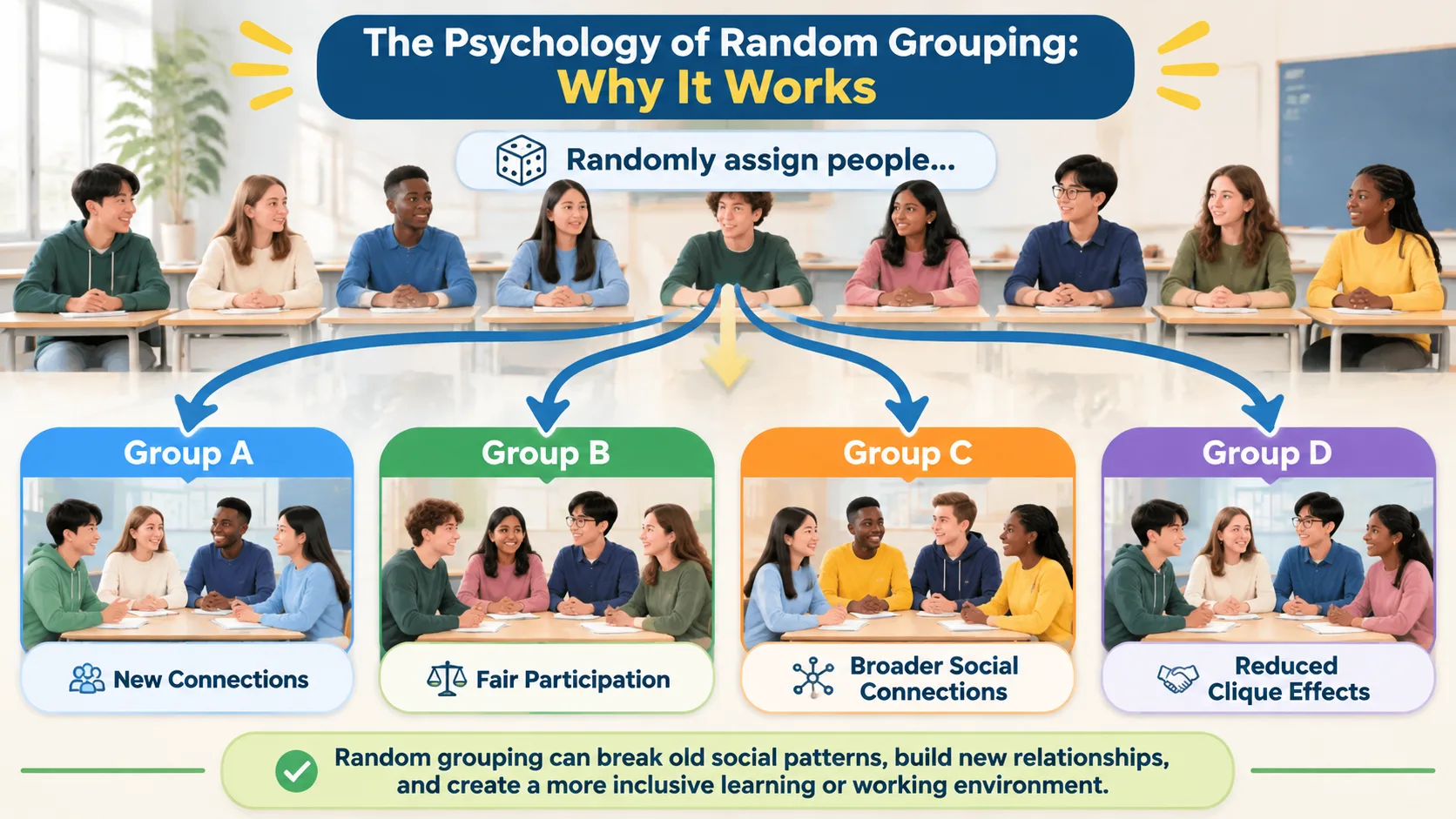
Random assignment can interrupt some established patterns by placing people together who might not otherwise choose one another. Students may discover that a classmate they rarely speak to has a useful perspective. Employees may learn that someone from another department approaches a problem differently. These interactions can make existing assumptions easier to question.
Research on student group formation also illustrates why this benefit should be described carefully. A study involving 555 undergraduate students examined whether an initial period of random group interactions changed how students later selected their teammates. The researchers found little effect on final group satisfaction or grades, although random interactions influenced some students' willingness to reconsider working with persistently poorly rated group members. Random contact is therefore an opportunity for new interactions, not a guaranteed way to remove social preferences.
For a practical example, consider a university discussion activity about environmental policy. Instead of allowing students to sit with their usual friends, the instructor randomly creates groups. Each team receives a different perspective to investigate, such as economic impact, public health, or environmental protection. Students have a reason to listen to unfamiliar viewpoints rather than simply repeat the opinions of their usual social circle.
4. Why Different Perspectives Can Improve Group Discussions
Random grouping can increase the variety of experiences and viewpoints represented in a discussion. When people work with familiar teammates, they may already share assumptions about how to approach a task. A newly formed group has a chance to bring different questions, experiences, and problem-solving approaches into the conversation.
This variety can be useful for brainstorming, collaborative problem-solving, creative exercises, and professional development. For example, a marketing workshop might randomly combine employees from sales, customer support, finance, and product development. Each person brings knowledge from a different part of the organization. Their discussion may reveal issues that a department-specific group would not consider.
However, diversity of perspectives does not automatically create better results. Different opinions can lead to misunderstandings, slower decisions, or disagreement about priorities. Participants may need more time to establish trust and understand one another's communication styles.
Research on cooperative learning emphasizes that successful collaboration depends on how the activity is designed, not simply on who sits together. Social interdependence theory, developed through the work of researchers including David and Roger Johnson, highlights the importance of shared goals, individual accountability, supportive interaction, interpersonal skills, and group reflection.
Teachers can apply this principle by giving each group member a meaningful responsibility. For example, a science project might assign one student to research, another to record observations, another to organize the materials, and another to present the findings. The task gives everyone a reason to contribute rather than allowing one confident student to dominate the discussion.
5. How to Use Random Grouping Effectively
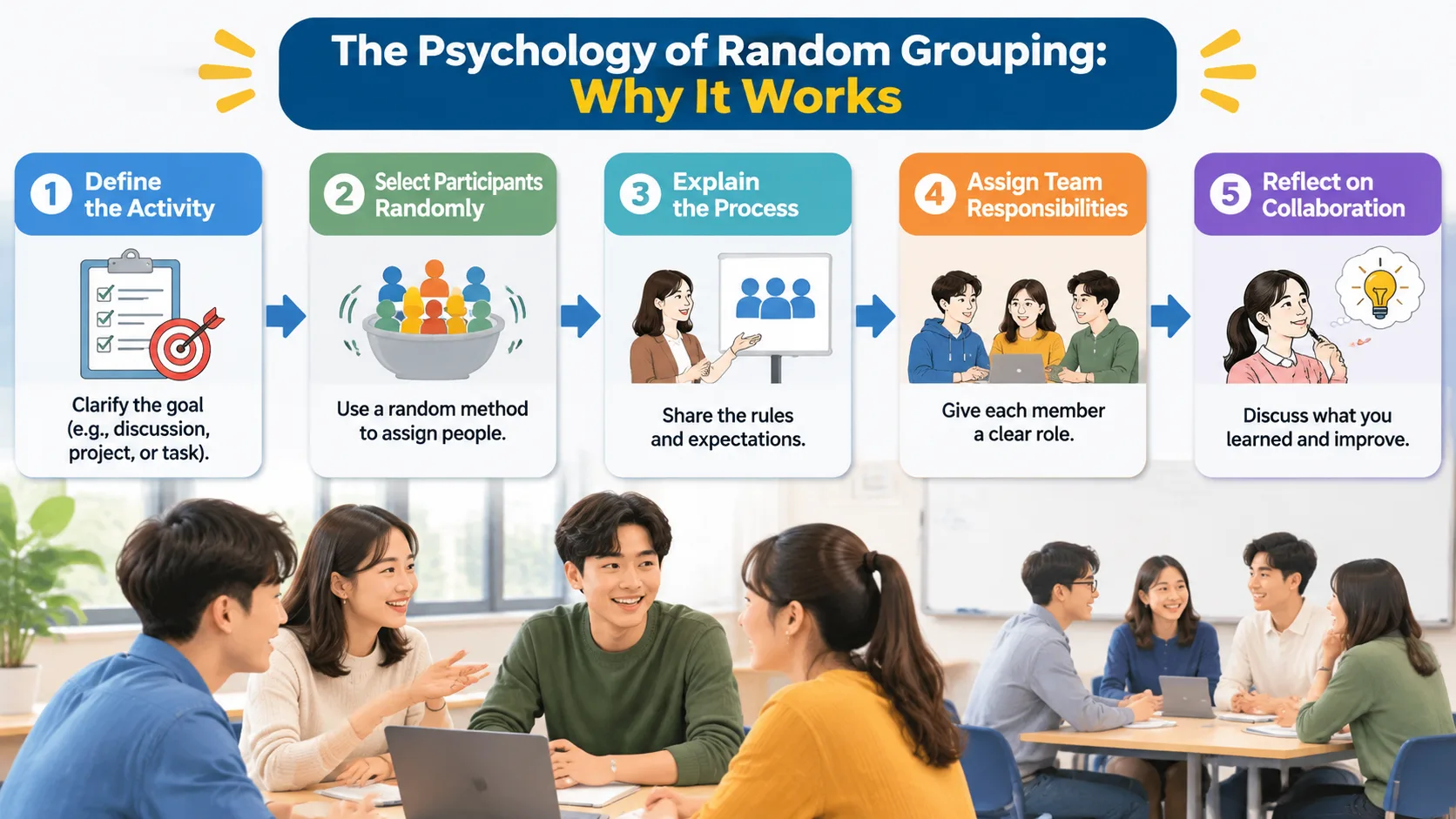
Understanding the psychology of random grouping is only the beginning. The way a facilitator introduces the process and structures the activity determines whether participants benefit from it. A good approach combines transparent selection with clear expectations and an activity that requires cooperation.
Here is a practical process for teachers, trainers, and event organizers.
Step 1: Define the purpose of the groups
Start by deciding what participants need to accomplish. Are they discussing a reading, solving a problem, completing a project, or getting to know colleagues? The purpose helps determine group size, activity length, and the level of interaction required.
For example, a teacher planning a ten-minute reading discussion may choose groups of three. A corporate brainstorming workshop may use groups of four or five so participants have enough opportunities to share ideas.
Step 2: Choose an appropriate grouping method
Select a method that matches the situation. Drawing names from a container works for small activities, while an online random group generator is more convenient when working with larger classes or repeated assignments.
With an online tool, the facilitator can enter participant names, select a group size or number of groups, and generate assignments. A dedicated Random Group Generator provides a straightforward way to organize participants without manually rearranging names.
Step 3: Explain the selection process
Before displaying the results, explain why the groups are random. Let participants know that the objective is to create opportunities for different interactions, not to separate friends or identify stronger and weaker performers.
A simple explanation might be: "Today, we are working with different classmates so everyone has a chance to exchange ideas. Each person will have an important role in the activity."
Step 4: Give everyone a clear responsibility
Randomly assigned groups may not immediately know how to work together. Provide a task, a time limit, and individual responsibilities. This creates structure and helps prevent one participant from completing all the work.
For example, in a group of four, assign a discussion leader, note-taker, timekeeper, and presenter. Rotate these roles during future activities so the same people do not always lead.
Step 5: Review the experience afterward
Ask participants what worked and what could improve. Useful questions include: Did everyone have an opportunity to contribute? Did the group consider different ideas? Was the task clear? What would help the team collaborate more effectively next time?
A short reflection can help facilitators identify practical issues that a random selection process cannot detect, such as accessibility requirements, communication barriers, or unresolved interpersonal conflicts.
6. Random Grouping in Classrooms and Workplaces
The psychology of random grouping has practical applications in different learning and professional environments. The underlying principle is similar, but the facilitator should adapt the activity to the participants and the desired outcome.
In K-12 classrooms, random assignment can help teachers vary discussion partners, introduce new peer interactions, and prevent students from repeatedly working with the same classmates. For example, a fifth-grade teacher might generate new groups for a weekly science experiment. Each group receives the same instructions, but students rotate responsibilities between activities.
In higher education, random groups can support seminar discussions, case studies, and short collaborative exercises. A university instructor might create groups of four for a discussion about a business case. Each student first considers the problem independently, then shares their reasoning with the group. This structure gives participants time to develop ideas before discussing them.
In corporate training, randomly assigned teams can bring together employees from different roles and experience levels. A facilitator running a communication workshop might create new teams for each exercise. Participants practice explaining ideas to colleagues they do not normally work with, making the activity relevant to cross-functional collaboration.
At events and workshops, random grouping can make networking activities more structured. Instead of expecting attendees to approach strangers without guidance, an organizer can create small discussion groups around a specific question. Participants receive a shared starting point, which can make introductions easier.
For quick activities involving exactly two people, a Random Pair Generator offers a more suitable format. For classroom activities where the teacher needs to select one participant to answer a question, a Random Student Picker addresses a different task. Choosing the right tool helps keep the selection process aligned with the activity.
7. When Random Grouping Is Not the Best Choice
Although random assignment has several advantages, it should not be treated as the right solution for every situation. Some activities have requirements that make deliberate group formation more appropriate. For example, an advanced engineering project may require specific technical skills in every team. A language-learning activity might benefit from grouping students according to their current proficiency levels.
Random selection can also produce groups with uneven experience, conflicting schedules, or communication challenges. In a small class, it may repeatedly place students together who have unresolved interpersonal conflicts. In a workplace, a random team may lack the technical knowledge needed to complete a specialist task.
Teachers and facilitators should also consider accessibility, safeguarding, and individual support needs. If a participant requires a particular accommodation, the facilitator should account for it before accepting the generated assignments. Fairness does not mean ignoring individual circumstances.
A useful alternative is structured random grouping. The facilitator first identifies essential constraints, such as required skills, accessibility needs, or availability, and then randomizes participants within the appropriate boundaries. This preserves an element of chance while respecting practical requirements.
The distinction between random, balanced, and self-selected groups is important:
| Grouping method | Main advantage | Potential limitation |
|---|---|---|
| Random grouping | Transparent selection and new interactions | Group composition may be uneven |
| Balanced grouping | Can distribute selected skills or experience | Requires information and facilitator judgment |
| Self-selected grouping | Familiarity and participant choice | Can reinforce existing social circles |
| Skill-based grouping | Matches participants to specific task requirements | May limit interaction across different ability levels |
The best method depends on the goal. A short classroom discussion may benefit from random selection, while a long-term project with specialist requirements may need carefully planned teams.
Frequently Asked Questions
Does random grouping improve student participation?
Random grouping can create opportunities for students to work with classmates they might not normally approach. However, it does not guarantee equal participation. Teachers should provide clear responsibilities, meaningful tasks, and opportunities for every student to contribute.
Why is random grouping considered fair?
Random grouping uses a consistent selection process rather than allowing popularity, friendship, or personal preference to determine team membership. Each participant has an opportunity to be assigned through the same method. However, equal selection opportunities do not guarantee identical group strengths or experiences.
Is random grouping better than letting students choose their own groups?
Neither approach is always better. Random grouping can encourage new interactions and reduce the influence of established friendship circles, while self-selection can provide comfort and a greater sense of choice. Teachers and facilitators should choose according to the activity's purpose and participants' needs.
Can random grouping improve workplace collaboration?
It can create opportunities for employees from different departments or professional backgrounds to exchange ideas. This is particularly useful in workshops, brainstorming sessions, and team-building activities. Clear objectives and individual responsibilities are still necessary for effective collaboration.
How often should teachers create new random groups?
There is no universal schedule. Teachers can change groups for short activities, weekly discussions, or new learning units depending on the class and instructional goals. Regular changes provide opportunities for new interactions, but facilitators should also allow enough time for groups to develop effective working habits.
Does random grouping guarantee balanced teams?
No. Random assignment determines membership through chance, not through an assessment of participants' skills, experience, or abilities. If a task requires specific combinations of strengths, a balanced or constrained grouping approach may be more appropriate.
Give Everyone a Chance to Work with Someone New
The psychology of random grouping explains why a simple change in team selection can influence classroom and workplace interactions. Random assignment can make group formation more transparent, reduce the pressure of choosing partners, and create opportunities to exchange ideas with unfamiliar people.
The real value comes from combining fair selection with thoughtful facilitation. Give every participant a meaningful role, establish a shared goal, and make time for reflection. When a group needs to meet specific skill or accessibility requirements, adjust the process rather than relying on randomness alone.
Ready to make your next classroom activity or team workshop easier to organize? Try the free Random Group Generator to create random teams and give everyone an opportunity to collaborate with someone new.
Related Tools
Pick the right generator for the job — every tool runs free in your browser.