
soccer team picking
Soccer Team Picking: How to Create Fair Teams for Players
Learn how soccer team picking works, why fair team selection matters, and how teachers, coaches, and facilitators can create balanced teams quickly with a random team generator.
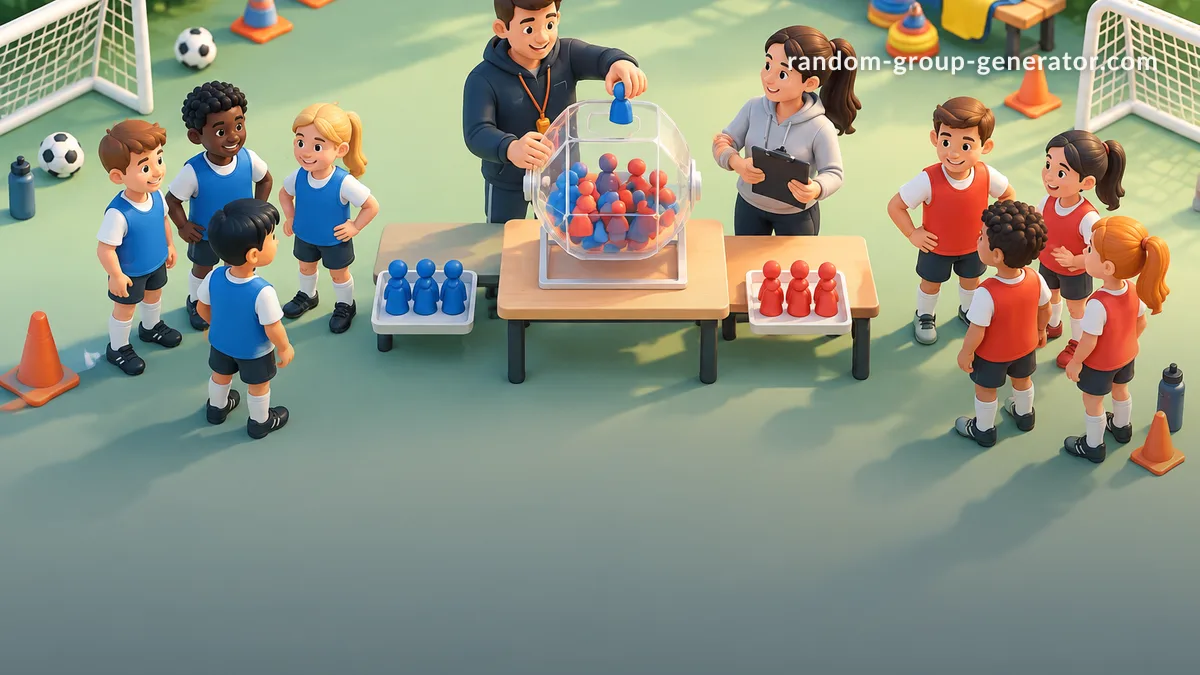
When a coach, teacher, or event organizer needs to divide players quickly, soccer team picking can become a challenge. Choosing teams manually often leads to repeated problems: stronger players are selected first, some participants feel left out, and the final teams may not be balanced. A fair team selection process helps everyone participate and creates a better experience for practice sessions, school activities, and friendly matches.
A simple way to improve soccer team picking is to use a structured random method. A random team generator can help assign players fairly while saving time. This guide explains how to prepare player lists, create balanced teams, run the selection process, and use the results in real soccer activities.
Why fair soccer team picking matters
Picking soccer teams is not only about deciding who plays together. It also affects motivation, teamwork, and participation. When the same people are always chosen first, other players may feel less confident or less interested in joining activities. A transparent process helps everyone understand that the selection is based on a fair system.
For schools, fair team creation is especially useful because students have different skill levels, personalities, and levels of experience. A teacher organizing a sports lesson may not have enough time to evaluate every student before making teams. A consistent process allows the activity to begin faster and gives students a clearer sense of inclusion.
For example, a physical education teacher has 24 students and wants six soccer teams for a rotation activity. Instead of letting captains pick players one by one, the teacher can prepare the list of names and use a random grouping approach. The result is a faster setup and fewer arguments about who was selected first.
Fair selection does not mean every team will always have exactly the same skill level. Random methods create equal opportunity, but organizers may still need adjustments for age, ability, safety, or the purpose of the activity. The goal is to create a practical starting point rather than replace all coaching decisions.
Common problems with manual soccer team selection
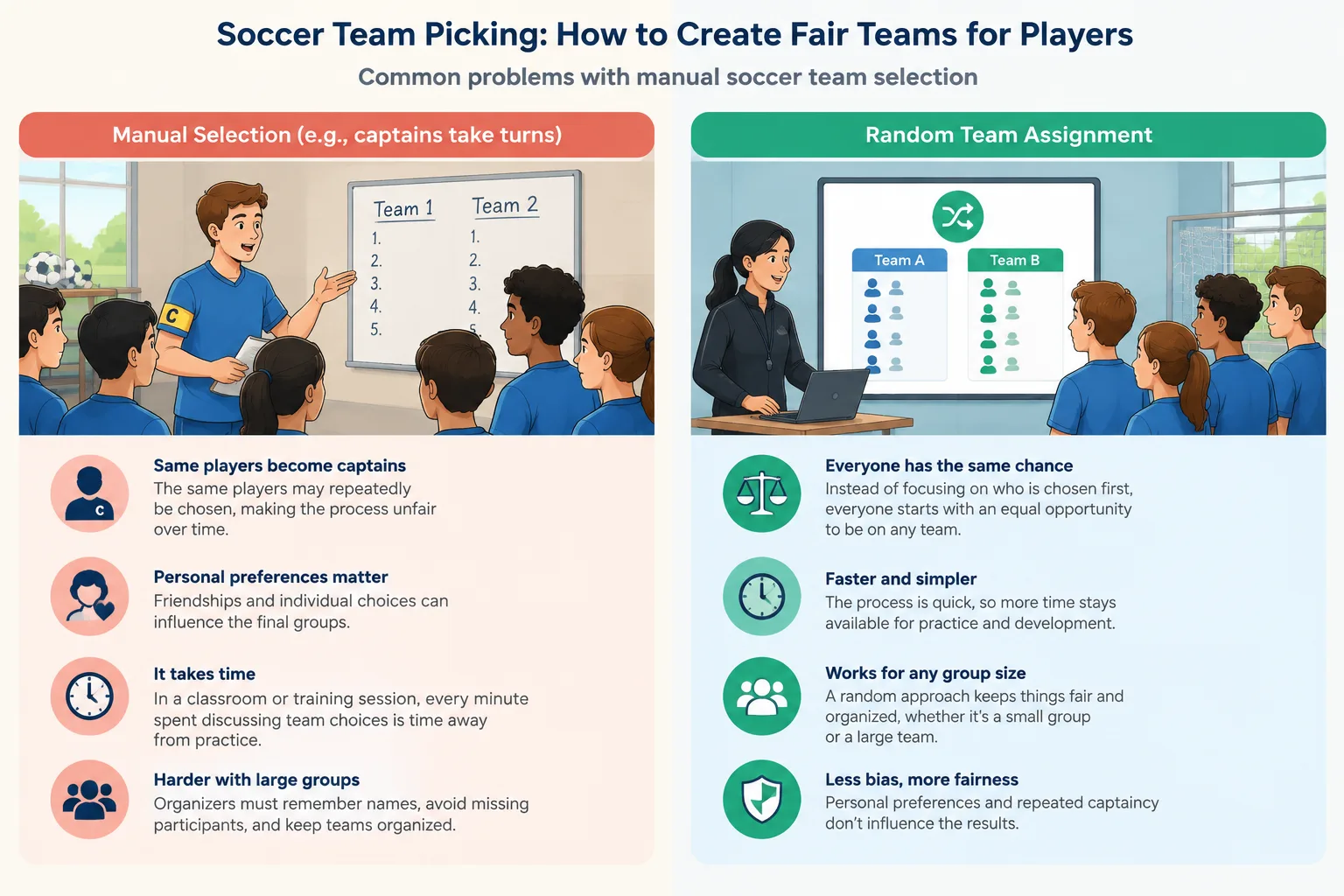
Many groups still choose teams using traditional methods, such as asking captains to take turns selecting players. This method can work for casual games, but it has limitations. The same players may repeatedly become captains, and personal preferences can influence the final groups.
Another issue is time. In a classroom or training session, every minute spent discussing team choices is time away from practice. Large groups make the process even harder because organizers must remember names, avoid missing participants, and keep teams organized.
A random approach solves many of these workflow problems. Instead of focusing on who is chosen first, everyone starts with the same chance of being assigned to a team. Coaches can then make small changes if needed based on the activity goals.
Consider a community soccer event with 40 players arriving for a friendly tournament. The organizer needs eight teams in a short period. A manual draft could take a long time and may create uncomfortable moments for players. A prepared random assignment can produce groups immediately, allowing the event to start on schedule.
How to use a random method for soccer team picking
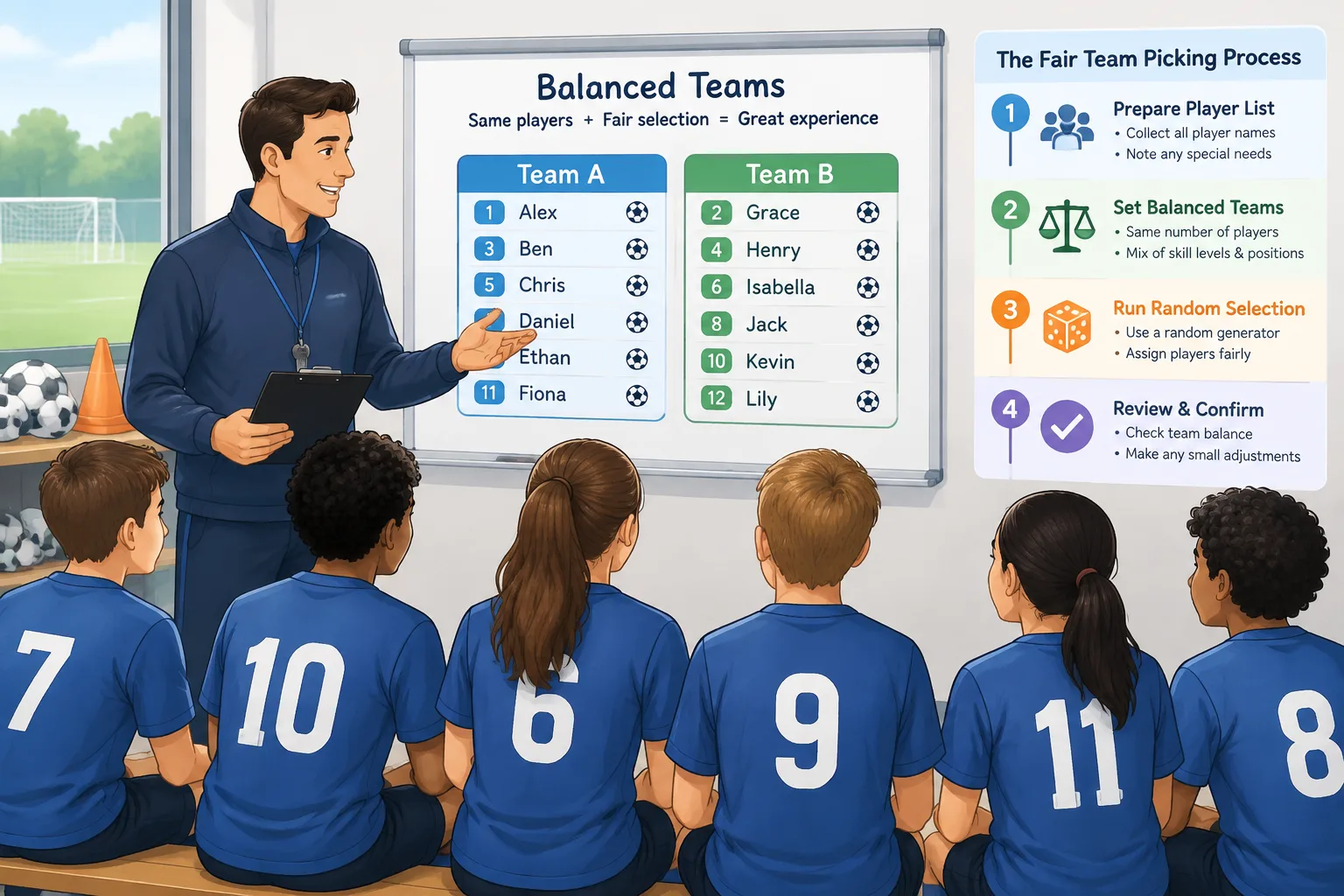
Creating teams with a random team generator is simple when the player information is prepared first. Follow these steps to organize a fair selection process.
- Prepare the player list. Write each participant's name clearly. Remove duplicates and confirm that everyone who should participate is included.
- Decide the team structure. Choose how many teams you need or how many players should be on each team. This depends on the field size, activity type, and number of participants.
- Enter the names into the team generator. The tool can distribute players into groups automatically instead of requiring manual sorting.
- Review the results. Check whether the teams meet practical requirements. If necessary, make small adjustments for safety, experience levels, or special situations.
- Share the teams. Display the results on a screen, send them to participants, or use them as the starting groups for practice.
For example, a coach has 18 players and wants three teams of six. The coach enters all 18 names, selects three groups, and receives the team assignments. Before starting the game, the coach checks positions and makes any changes needed for goalkeeper availability.
If you need different formats, you can also use related tools such as the Random Group Generator for larger team activities or the Random Pair Generator for partner drills.
Ways coaches and teachers can use soccer team picking
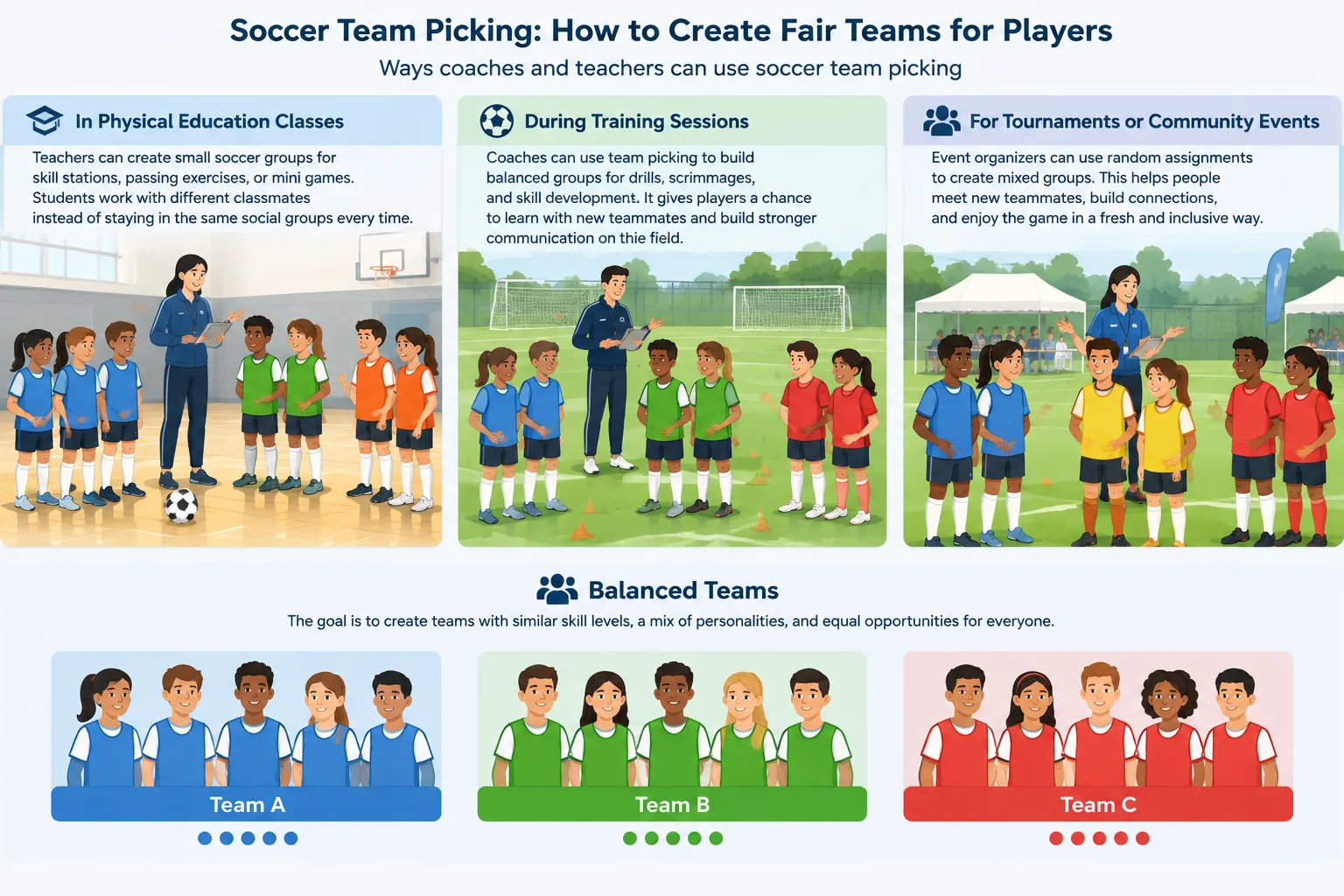
Soccer team picking is useful in many settings beyond regular matches. Teachers can use it during physical education classes, coaches can use it during training sessions, and event organizers can use it for tournaments or recreational games.
In a classroom setting, random teams can support cooperative activities. A teacher may create small soccer groups for skill stations, passing exercises, or mini-games. Students work with different classmates instead of staying in the same social groups every time.
In a workplace or community event, soccer team selection can help people meet new teammates. A facilitator organizing a company sports day can use random assignments to create mixed groups where employees interact with different colleagues.
The same idea can apply to youth camps. A camp leader may have children with different experience levels. Random grouping can provide a fair first arrangement, while the leader can later adjust teams to support learning and safety.
How to improve team balance after random selection
Random soccer team picking creates fairness in the selection process, but organizers should understand its limits. A completely random result may place many advanced players together or create teams with different levels of experience. This is why a quick review step is useful.
For competitive training, coaches may want to consider factors such as position, experience, age, or physical requirements. For example, if one team receives all available goalkeepers, a coach may move one goalkeeper to another team. This keeps the activity functional while preserving the fairness of the original process.
For casual games, fewer changes may be necessary. The purpose may simply be to help people meet new teammates and enjoy the activity. In these situations, a random assignment often provides exactly the balance of speed and fairness that organizers need.
A practical workflow is to use random selection first, then apply only necessary adjustments. This avoids spending too much time designing perfect teams while still respecting the needs of the group.
Soccer team picking alternatives and when to use them
Different situations call for different selection methods. A captain draft may be useful when creating highly competitive teams and when coaches have detailed knowledge of player abilities. However, drafts can take longer and may affect how players feel about the selection process.
Random team picking is often better for classroom games, friendly matches, and large events where speed and fairness are important. It creates a clear process that participants can understand.
Another option is skill-based grouping, where organizers intentionally place players into teams based on ability. This can help create balanced competition, but it requires more information and preparation.
For example, a school tournament may use skill-based decisions for final competition teams, while weekly practice sessions may use random grouping to encourage teamwork. Choosing the right method depends on the purpose of the activity.
FAQ about soccer team picking
What is soccer team picking?
Soccer team picking is the process of dividing players into teams for matches, practices, or activities. It can be done manually, by skill assessment, or through a random selection method.
How can I make soccer team picking fair?
A fair process gives every participant an equal opportunity to be assigned. Using a random team generator and reviewing the results for practical needs is one simple approach.
Can random team picking create balanced soccer teams?
Random selection can create fair groups quickly, but it does not guarantee equal skill levels. Coaches may need to make small adjustments depending on the activity goals.
How many players can I include when picking soccer teams?
The number of players depends on the tool and the activity. Many group generators are designed for small classes, training groups, and larger events.
Is random soccer team picking useful for schools?
Yes. Teachers can use random team selection for physical education classes, sports activities, and cooperative games where quick and fair grouping is needed.
Create your soccer teams faster
A clear team selection process helps coaches, teachers, and organizers spend less time arranging groups and more time focusing on the activity. Whether you are preparing a practice session, school game, or community event, a random approach can make soccer team picking simple and transparent.
Try the Random Group Generator to create soccer teams quickly and organize your next activity with a fair starting point.
Want to try it right away? Use the Random Group Generator to split your list into balanced teams, the Group Name Generator to name each team, and the Random Pair Generator when you need one-on-one pairings.
Related Tools
Pick the right generator for the job — every tool runs free in your browser.