
secret santa without email
Secret Santa Without Email: How to Organize Online Gift Draws
Learn how to run a Secret Santa without email using a simple online generator. Follow practical steps for private gift assignments at work, school, and events.

Planning a holiday gift exchange can become difficult when participants do not want to share email addresses, manage long message threads, or reveal who they picked. A Secret Santa without email approach uses a simple online process to assign gift partners privately while keeping the organizer’s workflow clear. This method is useful for teachers, team leaders, HR coordinators, and event organizers who need a fair way to arrange anonymous gift exchanges.
A private online draw helps solve common problems: missing invitations, accidental reveals, repeated assignments, and manual tracking. Instead of collecting many messages and spreadsheets, organizers can use a dedicated tool to create assignments and share the results in a controlled way.
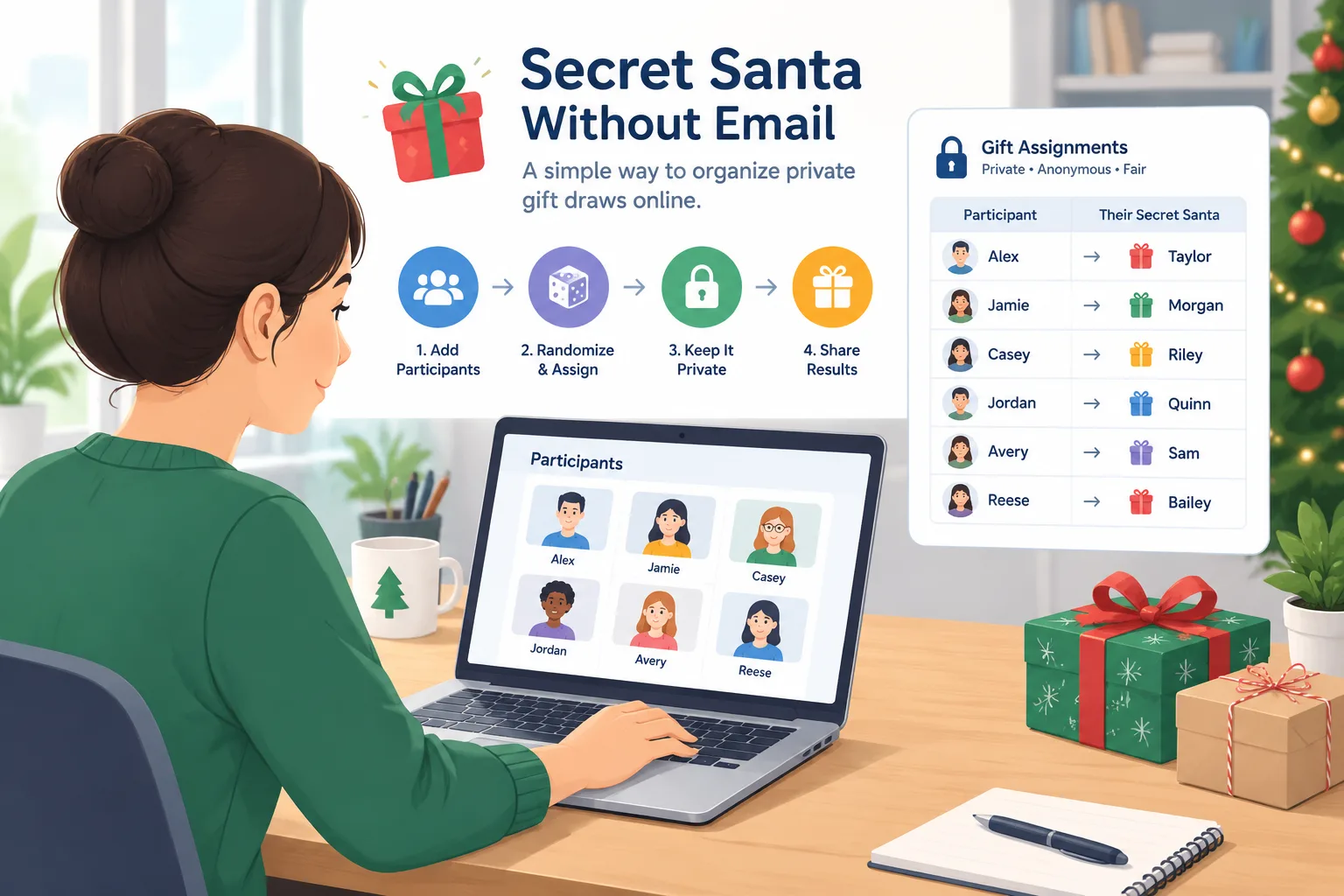
Why organize Secret Santa without email?
Traditional Secret Santa planning often depends on email invitations. The organizer creates a list, sends messages, waits for replies, and manually records who is assigned to whom. This works for small groups, but it can become difficult when a class, department, or community group has many participants.
A Secret Santa without email system changes the workflow. Participants can be added to a digital draw, assignments can be generated automatically, and organizers can share results using a method that fits their group. This reduces administrative work and helps maintain the surprise element of the exchange.
For example, an office manager organizing a December team activity may have employees who use different communication channels. Some prefer chat apps, while others check email less often. A private generator allows the manager to organize the exchange without requiring every participant to provide an email address or follow the same communication process.
This approach is also useful in education settings. A teacher running a classroom kindness activity may want students to exchange small gifts or notes without creating accounts or collecting unnecessary contact information. A simple participant list and private assignment process can be enough.
How a private Secret Santa draw works
A successful Secret Santa exchange usually has three stages: collecting participants, creating assignments, and sharing results. The goal is to keep the process fair while protecting each person’s assigned recipient.
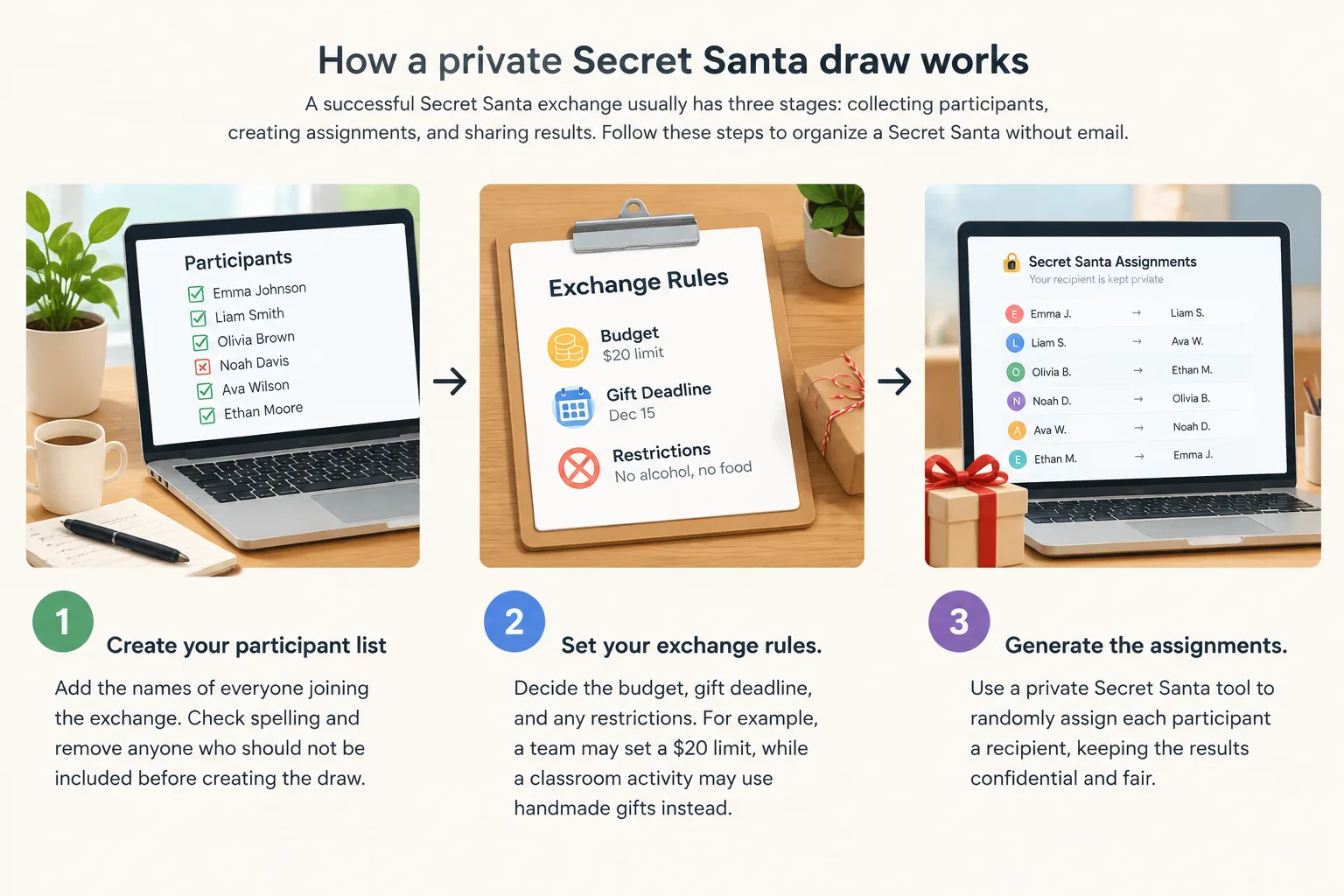
Follow these steps to organize a Secret Santa without email:
- Create your participant list. Add the names of everyone joining the exchange. Check spelling and remove anyone who should not be included before creating the draw.
- Set your exchange rules. Decide the budget, gift deadline, and any restrictions. For example, a team may set a $20 limit, while a classroom activity may use handmade gifts instead.
- Generate the assignments. Use a private Secret Santa tool to randomly match participants. A good generator should avoid assigning people to themselves and should create balanced results.
- Share assignments privately. Give each person only the information they need. Avoid posting the complete list because it removes the mystery from the exchange.
- Track the event details. Keep a note of the deadline and rules so participants know when and how to complete their gift exchange.
The exact sharing method depends on your group. A small workplace team might share private links through a chat platform. A classroom teacher might display instructions and allow students to access their assignments individually.
Choosing the right online Secret Santa method
Not every gift exchange needs the same setup. The best method depends on the size of the group, privacy needs, and how participants communicate.
For a small group of friends, a simple manual draw may be enough. However, manual methods can create problems if someone forgets their assignment or if the organizer accidentally reveals the pairings. An online generator reduces these risks by handling the random selection process.
For workplace exchanges, privacy is often more important. Employees may not want their gift partner publicly known before the event. A private Secret Santa generator can support a smoother experience by separating the organizer’s task from the participants’ results.
For schools and training events, simplicity matters. Participants may have different levels of comfort with technology. A clear process with fewer steps is easier to manage than asking everyone to create accounts or complete several forms.
When selecting a tool, consider:
- Whether it creates random assignments fairly
- Whether it prevents self-selection
- Whether participants can receive only their own result
- Whether the workflow fits your communication tools
- Whether the process works for your group size
Random assignment tools are also useful beyond gift exchanges. For example, facilitators who regularly create activities can use a Random Group Generator to organize balanced teams for workshops, discussions, and classroom projects.
Real examples of Secret Santa without email
Different groups use private online draws in different ways. The following examples show how the process can fit common situations.
Workplace team exchange
A company with 35 employees wants to run a holiday gift activity. The HR coordinator creates the participant list, sets a spending limit, and generates assignments. Instead of sending dozens of individual emails, the coordinator shares instructions through the company’s existing communication channel and keeps the pairings private.
The benefit is not only speed. The organizer also avoids maintaining a spreadsheet that shows every match, which could accidentally reveal the surprise.
Classroom kindness activity
A teacher plans a winter appreciation activity for students. The goal is not expensive gifts but encouraging positive interactions. The teacher creates a participant list, explains the rules, and uses a private draw process to assign partners.
Students receive only the information they need. The teacher can focus on managing the activity rather than manually checking every possible pairing.
Community or event exchange
A club or volunteer group may have participants who meet only during events. Asking everyone for email addresses may add unnecessary steps. A simple online process allows the organizer to prepare the exchange before the event and share instructions in person.

Common mistakes to avoid in online Secret Santa draws
Even with an automated process, organizers should think about the experience of participants. The technology handles the assignment, but clear communication makes the event successful.
One common mistake is not explaining the rules before the draw. Participants should know the budget, timing, and expectations before they receive their assignment. This prevents confusion and helps everyone participate comfortably.
Another mistake is sharing too much information. A complete assignment list should usually remain private. The purpose of Secret Santa is the surprise, so only the necessary details should be shared.
It is also important to consider exceptions. Some groups may have people who cannot participate, people who should not be paired together, or accessibility needs. In these cases, the organizer may need a more customized approach.
An online Secret Santa tool is helpful for standard random draws, but it is not a replacement for thoughtful planning. Organizers should review the participant list and rules before launching the exchange.
FAQ: Secret Santa without email
Can I organize Secret Santa without collecting email addresses?
Yes. A Secret Santa exchange can be organized without email by using a private online assignment method and sharing instructions through another communication channel. This can be useful for classrooms, teams, and events where email collection is inconvenient.
How do I make sure a Secret Santa draw is fair?
A fair draw should randomly assign participants, prevent people from selecting themselves, and avoid duplicate matches. Reviewing the participant list before generating results also helps prevent mistakes.
Is an online Secret Santa generator suitable for work teams?
Yes. Workplace groups often use online generators because they reduce manual coordination. The organizer should still explain the rules, budget, and deadline clearly before starting the exchange.
Can I use the same platform for other group activities?
Yes. Organizers who run multiple activities may also need tools for creating pairs, selecting participants, or naming teams. For example, a facilitator can use a Random Pair Generator for partner activities or a Group Name Generator for team events.
When is a manual Secret Santa draw better?
A manual draw may work well for very small groups where everyone knows each other and privacy is not a concern. For larger groups or organized events, an online method usually reduces administrative effort.
Make your next gift exchange easier
A Secret Santa without email setup can make gift exchanges simpler for schools, workplaces, and community groups. By using a clear participant list, fair random assignments, and private sharing, organizers can spend less time managing details and more time enjoying the event.
When you are ready to create your own private gift exchange, use the Secret Santa Generator to organize assignments quickly and keep the process simple.
SponsoredExplore more resources