
round-robin group assignment
Round-Robin Group Assignment: How It Works and When to Use It
Learn how round-robin group assignment distributes students or team members fairly. Explore step-by-step instructions, examples, group size calculations, and practical classroom applications.

You have 27 students, need five working groups, and want everyone assigned without spending ten minutes organizing the classroom. Round-robin group assignment offers a straightforward solution. It distributes people across groups in a repeating sequence, helping teachers, trainers, and facilitators create organized teams while keeping group sizes as balanced as possible. Whether you are planning a classroom discussion, a professional development workshop, or a collaborative project, understanding this method can make group formation quicker and easier.
What Is Round-Robin Group Assignment?
Round-robin group assignment is a method of distributing participants across several groups by moving through the group list in a repeating order. Instead of filling the first group completely before moving to the second, you assign one person to each group, then repeat the sequence until everyone has a place.
For example, imagine you have 15 students and want three groups. The first student goes into Group 1, the second into Group 2, and the third into Group 3. The fourth student returns to Group 1, and the pattern continues until all 15 students are assigned. The result is three groups with five students each.
The method takes its name from the idea of taking turns in a cycle. In computing, round-robin scheduling distributes processing time among tasks in a repeating order. In group formation, the same general principle is applied to distributing people rather than processing resources.
It is important to distinguish round-robin group assignment from round-robin tournaments. In a tournament, each participant or team competes against every other participant or team. In group assignment, the goal is simply to distribute people among teams. Some educators also use round-robin rotation activities, where groups move between stations or tasks. These are related organizational approaches, but they solve different problems.
How Does Round-Robin Group Assignment Work?
The basic process is easy to understand: establish the groups, choose an assignment order, and distribute participants one at a time in a repeating cycle. You do not need complicated calculations or specialist software for a small class.
Consider a workshop with 20 participants and four groups. The assignment pattern looks like this:
| Participant | Assigned group |
|---|---|
| Participant 1 | Group 1 |
| Participant 2 | Group 2 |
| Participant 3 | Group 3 |
| Participant 4 | Group 4 |
| Participant 5 | Group 1 |
| Participant 6 | Group 2 |
| Participant 7 | Group 3 |
| Participant 8 | Group 4 |
| Participant 9 | Group 1 |
| Participant 10 | Group 2 |
| Participant 11 | Group 3 |
| Participant 12 | Group 4 |
| Participant 13 | Group 1 |
| Participant 14 | Group 2 |
| Participant 15 | Group 3 |
| Participant 16 | Group 4 |
| Participant 17 | Group 1 |
| Participant 18 | Group 2 |
| Participant 19 | Group 3 |
| Participant 20 | Group 4 |
Each group receives exactly five participants. The repeating pattern prevents the first group from filling up before the others receive members.
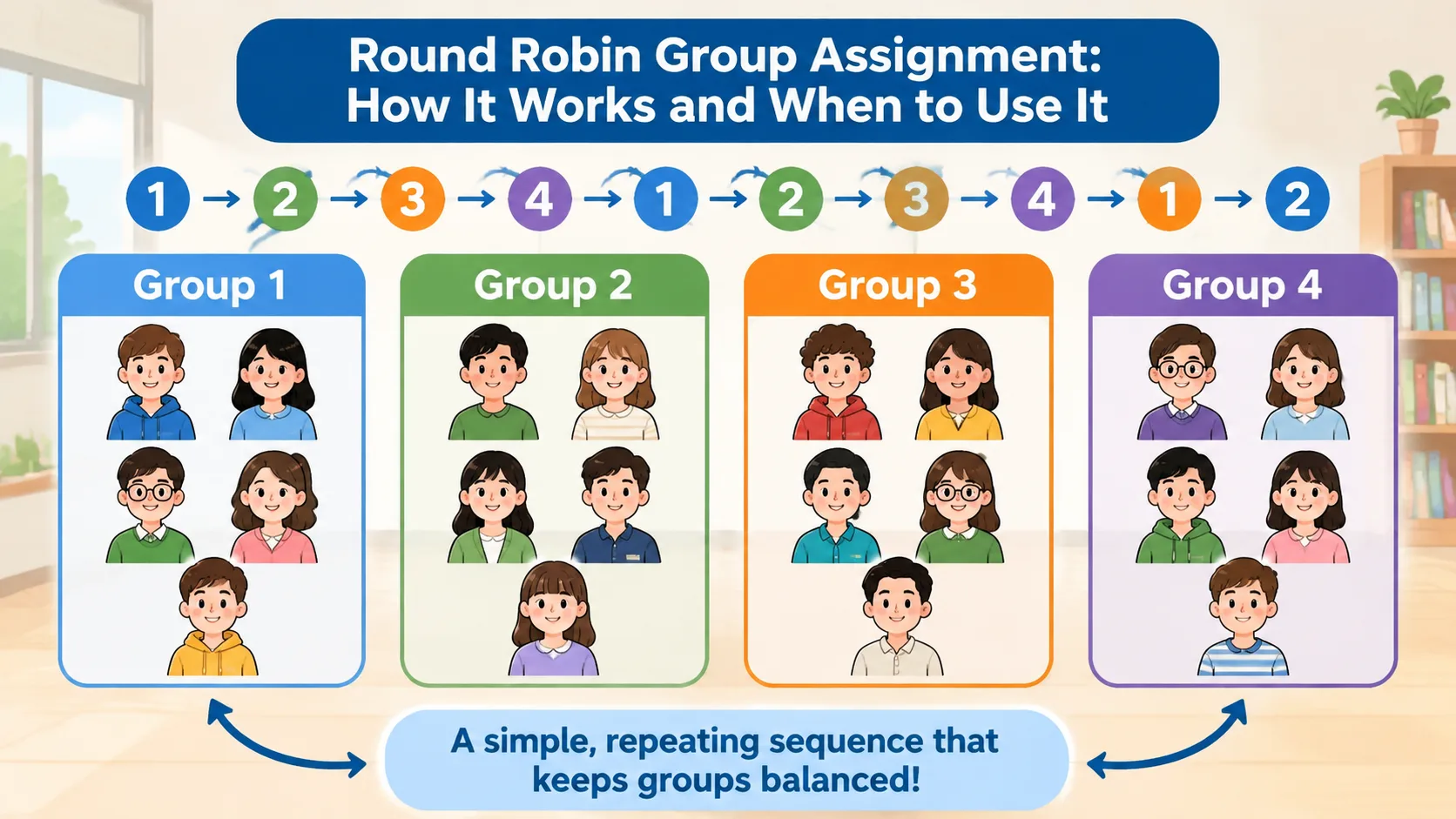
The assignment order matters. If participants are entered alphabetically, the distribution follows alphabetical order. If you shuffle the participant list first, the resulting groups reflect that shuffled order. The round-robin pattern controls distribution, but it does not automatically make the original participant order random.
How to Create Round-Robin Groups Step by Step
You can use this approach with a paper roster, a spreadsheet, or a digital grouping tool. The following steps work for classroom activities, training sessions, and collaborative projects.
Step 1: Count Your Participants
Start by identifying how many people need to be assigned. Include everyone who will participate in the activity, and check your attendance list before beginning.
For example, a teacher preparing a science experiment might have 26 students present. A corporate trainer might have 32 employees attending a workshop. Knowing the exact number helps you decide how many groups to create and whether the final group sizes will be equal.
Step 2: Decide How Many Groups You Need
Choose the number of groups based on the activity rather than simply dividing the participants into as many teams as possible.
Small groups are useful when every participant needs an opportunity to contribute. Larger groups may be more suitable for activities that require different perspectives, several responsibilities, or more extensive discussion. Cornell University's Center for Teaching Innovation discusses group sizes of two to five students as a practical range for many in-class collaborative activities.
For example, if you have 24 students and want groups of four, create six groups. If the activity involves a short discussion where everyone should speak, groups of three or four may be easier to manage than larger teams.
Step 3: Prepare the Participant List
Write each participant's name on a separate line or prepare a numbered list. If you want unpredictable group membership, randomize the list before distributing participants.
This distinction is important. Round-robin assignment produces a repeating distribution pattern, but it does not independently guarantee random membership. An alphabetical list will produce an orderly distribution, while a shuffled list will produce a different composition.
For example, a teacher could shuffle 24 student names and then assign them sequentially to six groups. The students receive different teammates while the final groups remain equal in size.
Step 4: Assign Participants in a Repeating Sequence
Start with Group 1 and continue through the final group. Once you reach the last group, return to Group 1 and repeat the process.
For six groups, the sequence is:
- First participant: Group 1.
- Second participant: Group 2.
- Third participant: Group 3.
- Fourth participant: Group 4.
- Fifth participant: Group 5.
- Sixth participant: Group 6.
- Seventh participant: Group 1 again.
Continue until everyone has been assigned. If you are organizing a large class, a digital Random Group Generator can help create groups without manually distributing every name.
Step 5: Check the Final Group Sizes
After assigning everyone, count the members in each group. When the participant count is not divisible by the number of groups, some groups will have one more person than others.
For instance, 23 participants distributed across five groups produce three groups of five and two groups of four. This is a normal result, not an assignment error.
Finally, share the group lists and make sure everyone knows where to work. In a physical classroom, display group numbers on the board. In an online workshop, share the assignments in the meeting chat or an appropriate collaboration channel.
Round-Robin Group Assignment Example: 23 Students in Five Groups
A practical example makes the method easier to understand. Imagine a middle school teacher organizing a collaborative geography activity. There are 23 students in the classroom, and the teacher wants five teams.
First, the teacher prepares a list of all 23 students and shuffles the names. Next, the teacher creates five empty groups and assigns students one at a time in this order: Group 1, Group 2, Group 3, Group 4, Group 5. After the fifth student, the next person returns to Group 1.
The resulting distribution is:
| Group | Number of students |
|---|---|
| Group 1 | 5 |
| Group 2 | 5 |
| Group 3 | 5 |
| Group 4 | 4 |
| Group 5 | 4 |
| Total | 23 |
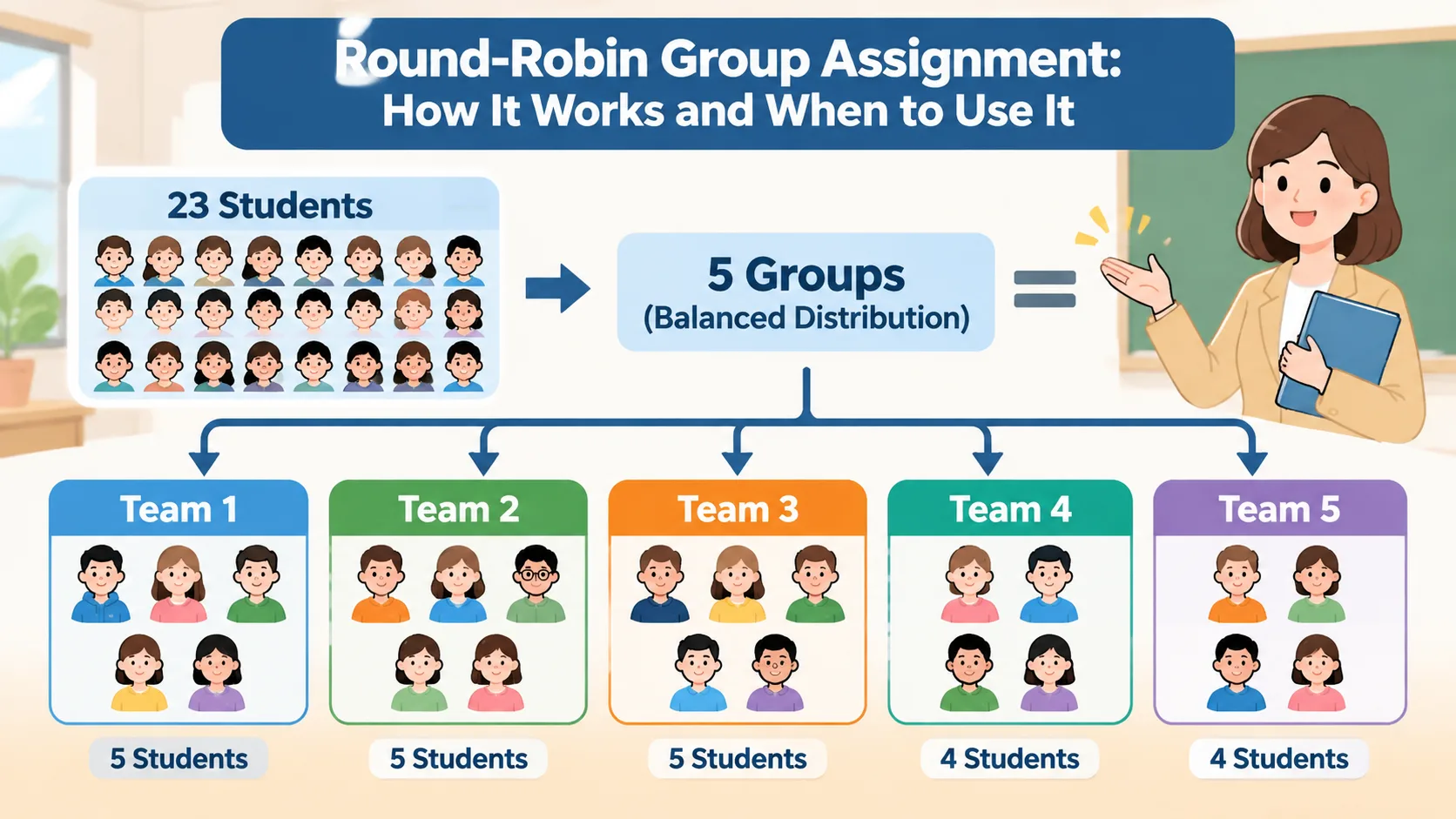
The teacher now has five teams with a maximum difference of one student between the largest and smallest groups. This makes the arrangement practical for a classroom activity without requiring additional adjustments.
The teacher can also assign responsibilities after grouping. For example, each team could have a discussion leader, a note-taker, a researcher, and a presenter. In the five-person teams, two students might share the research responsibility.
This example illustrates an important principle: round-robin distribution can balance the number of people in each group, but it does not automatically balance academic ability, experience, personality, or individual skills. Those considerations may require additional planning.
How to Calculate Balanced Group Sizes
You do not need advanced mathematics to determine the size of each team. Two simple calculations are enough.
Divide the total number of participants by the number of groups. The whole-number result tells you the minimum number of members each group can receive. The remainder tells you how many groups will receive one additional person.
For example, suppose you have 31 employees and want six project teams.
- Total participants: 31.
- Number of groups: 6.
- Division: 31 ÷ 6 = 5 remainder 1.
- Result: One group has six members, and five groups have five members each.
The same calculation works for classrooms, workshops, training cohorts, and event activities.
| Participants | Groups | Distribution |
|---|---|---|
| 18 | 3 | 6, 6, 6 |
| 22 | 4 | 6, 6, 5, 5 |
| 27 | 5 | 6, 6, 5, 5, 5 |
| 31 | 6 | 6, 5, 5, 5, 5, 5 |
| 40 | 8 | 5, 5, 5, 5, 5, 5, 5, 5 |
A useful rule is to distribute the extra participants across different groups rather than placing all of them into one team. This helps prevent unnecessarily large differences in group size.
If your activity requires exactly the same number of members in every group, adjust the number of groups or the participant count. Alternatively, prepare an additional individual task for anyone who cannot be accommodated in an equal-sized arrangement.
When Should Teachers and Facilitators Use Round-Robin Assignment?
Round-robin group assignment is particularly useful when speed, organization, and reasonably balanced group sizes matter more than carefully controlling individual group membership.
Classroom Discussions and Collaborative Learning
Teachers can use the method to organize short discussions, reading activities, science experiments, and problem-solving exercises. It provides a predictable way to distribute students without repeatedly asking them to choose their own partners.
For example, a high school history teacher might divide 30 students into six groups for a document analysis activity. Each group receives the same historical sources and answers a different discussion question. The teacher can focus on facilitating the activity rather than negotiating group membership.
The University of Waterloo's Centre for Teaching Excellence also emphasizes the importance of explaining group activities clearly, allowing enough time for collaboration, and planning opportunities to discuss the results afterward.
Corporate Training and Workshops
Facilitators often need to create temporary teams for brainstorming, case studies, and skill-building exercises. Round-robin assignment provides a repeatable process for dividing participants without relying on informal selection.
For example, a training facilitator with 28 employees could create four groups of seven for a problem-solving workshop. After a discussion, participants could return to a larger session to share their findings.
If participants attend remotely, the facilitator can share the group lists and arrange the corresponding meeting rooms using the organization's conferencing workflow.
Repeated Classroom Activities
The method can also help when students need different teammates for several short activities. A teacher can prepare a new participant order for each session and repeat the assignment process.
However, repeating exactly the same list and group sequence may produce similar membership patterns. Shuffle the roster or deliberately change the assignment order when you want students to interact with different classmates.
Round-Robin Assignment vs. Other Grouping Methods
Round-robin distribution is not the only way to create teams. The right method depends on the purpose of the activity, the size of the class, and how much control the facilitator needs over group membership.
| Grouping method | How it works | Best suited for |
|---|---|---|
| Round-robin assignment | Distributes participants through a repeating group sequence | Balanced group sizes and organized allocation |
| Random group assignment | Randomly distributes participants into teams | Quick, varied group composition |
| Manual assignment | The teacher or facilitator selects each member | Specific skill or experience requirements |
| Self-selection | Participants choose their own teammates | Activities where participant choice is important |
| Random pair assignment | Distributes participants into pairs | Interviews, peer reviews, and partner exercises |
A random grouping approach is useful when you want to avoid predictable alphabetical or roster-based assignments. A manual approach is more appropriate when every team needs a particular combination of skills or experience.
Self-selection can be convenient, but it may lead to uneven team sizes or familiar social groups. The University of Michigan's teaching resources discuss several approaches to forming groups, including random assignment, instructor selection, and student choice. Each method has different advantages depending on the learning objective.
For educators who regularly organize different types of activities, a Random Pair Generator can help with partner-based tasks, while a stations rotation scheduler is more appropriate when students need to move between activities in a planned sequence.
Common Mistakes to Avoid
Even though the process is simple, a few mistakes can make round-robin group assignment less effective.
Assuming the assignment is automatically random. The distribution sequence and the participant order are separate decisions. If you use an alphabetical roster, the method follows that order. Shuffle the names first if you want more varied membership.
Ignoring the purpose of the activity. Equal group sizes do not necessarily create equally capable teams. A complex engineering project may require specific technical skills in every group, while a short classroom discussion may work perfectly well with random assignments.
Forgetting to account for absences. If a participant is absent, the group sizes may change. Check attendance before assigning members, particularly when the activity requires specific team sizes.
Repeating the same assignments every time. Using an unchanged roster and assignment order can create recurring membership patterns. Change the order between sessions when variety is important.
Failing to explain the instructions. Students and employees need to know where to go, what their group should accomplish, and how much time they have. Group formation is only the first part of organizing a successful collaborative activity.
Frequently Asked Questions
Is round-robin group assignment the same as random grouping?
No. Round-robin assignment describes how participants are distributed across groups in a repeating sequence. Random grouping describes how group membership is selected. You can combine the two approaches by shuffling a participant list first and then assigning people in round-robin order.
Does round-robin assignment create equal-sized groups?
Yes, or groups that are as equal in size as mathematically possible. When the total number of participants divides evenly by the number of groups, every group has the same number of members. Otherwise, some groups will have one additional participant.
Can I use round-robin group assignment for a large class?
Yes. The method works with small and large participant lists. For larger classes, use a spreadsheet or digital grouping tool to organize names and check the resulting team sizes. Make sure the final assignments are easy for students to access.
How can I make round-robin groups more random?
Shuffle the participant list before starting the assignment sequence. You can also use a digital Random Group Generator to create group assignments. Remember that randomization does not guarantee a balanced distribution of academic ability, experience, or other personal characteristics.
Is round-robin assignment suitable for online workshops?
Yes. You can prepare the groups before a session and share the results with participants. For virtual workshops, communicate the group assignments clearly and organize the corresponding breakout rooms. Check that every participant has access to the correct meeting room and activity materials.
When should I avoid round-robin group assignment?
Avoid relying on it as your only method when groups need carefully balanced skills, specific experience levels, accessibility accommodations, or particular interpersonal arrangements. In these situations, instructor-selected groups may be more appropriate. You can still use round-robin distribution as a starting point and make informed adjustments afterward.
Create Balanced Groups in Less Time
Round-robin group assignment provides a simple, repeatable way to distribute students, employees, or workshop participants. By assigning people in a repeating sequence, you can create teams with equal or nearly equal membership without manually filling each group.
The most important decisions are choosing the right number of groups, preparing an appropriate participant order, and checking the final distribution. If your activity requires random membership, shuffle the list first. If it requires specific skill combinations, consider making additional adjustments before sharing the assignments.
Ready to organize your next classroom activity or team workshop? Try the free Random Group Generator to create groups quickly and spend more time on the activity itself.
Related Tools
Pick the right generator for the job — every tool runs free in your browser.