
rolling group names
Rolling Group Names: Fair Team Names for Class and Work
Rolling group names assigns random team names to student groups or workshop teams in seconds. Step-by-step how-to, examples, and answers to common questions.

You have 30 students, six activity stations, and ten minutes before the lesson starts. The groups are easy enough to form — but the naming always eats time. Three teams want to be "The Sharks," one wants to be "Team Nothing," and someone leaves the room annoyed. Rolling group names removes that friction. Instead of letting teams argue over names, you draw each name at random and hand it to a group, the same way you would roll dice or spin a wheel.
This guide is for K-12 teachers, university instructors, corporate trainers, and event organizers who want a fast, fair, and repeatable way to name groups. You will get a five-step method, two worked examples, a comparison with alternatives, and honest notes about when random naming is the wrong fit.
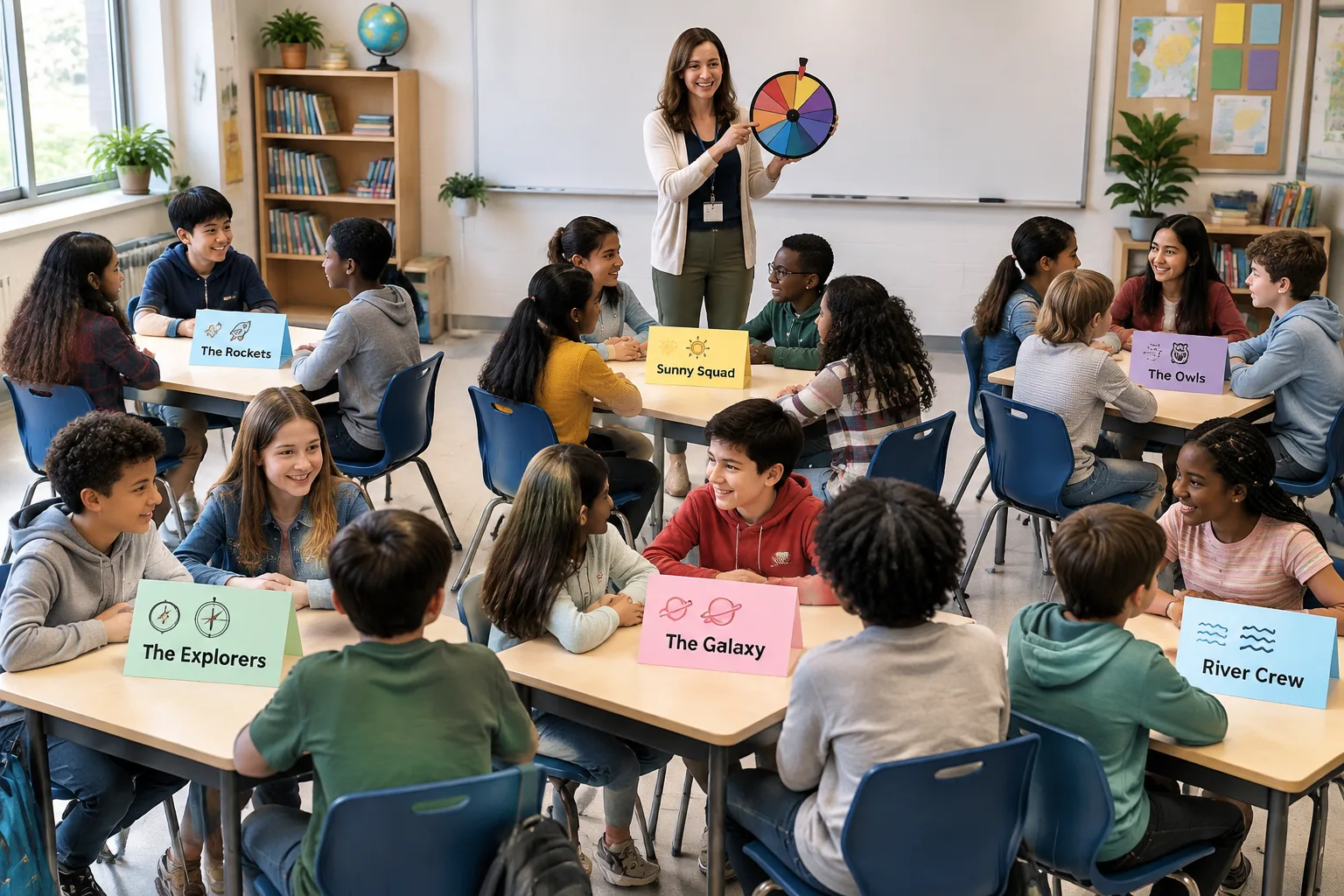
What Rolling Group Names Actually Means
"Rolling group names" means assigning a team name by random draw rather than by choice or committee. The word "rolling" comes from dice and wheel mechanics: something is generated, and everyone accepts the result. In many classrooms this phrase is also written as rolling nama kelompok, and the idea is identical — a name is rolled for a group instead of negotiated by one.
There are two common variations. In the first, your groups already exist and you roll names onto them. You have six tables of five students, and each table receives a random label: Falcons, River, Lantern, Compass, Tide, Ember. In the second, you roll both at the same time — students are drawn into groups and the group names come out of the same draw. The first version is faster and works well mid-lesson. The second is better at the start of a unit or a workshop day, when nobody has chosen a seat yet.
Both versions share one rule: the name is not a reward. It is a label that helps people talk about the group ("Hand the sheet to the Compass table") without anyone feeling ranked. That is the whole point. A neutral name makes a group easier to reference and harder to argue about.
Why a Random Draw Beats Hand-Picking Names
The case for random naming rests on three practical benefits: speed, fairness, and reduced social friction.
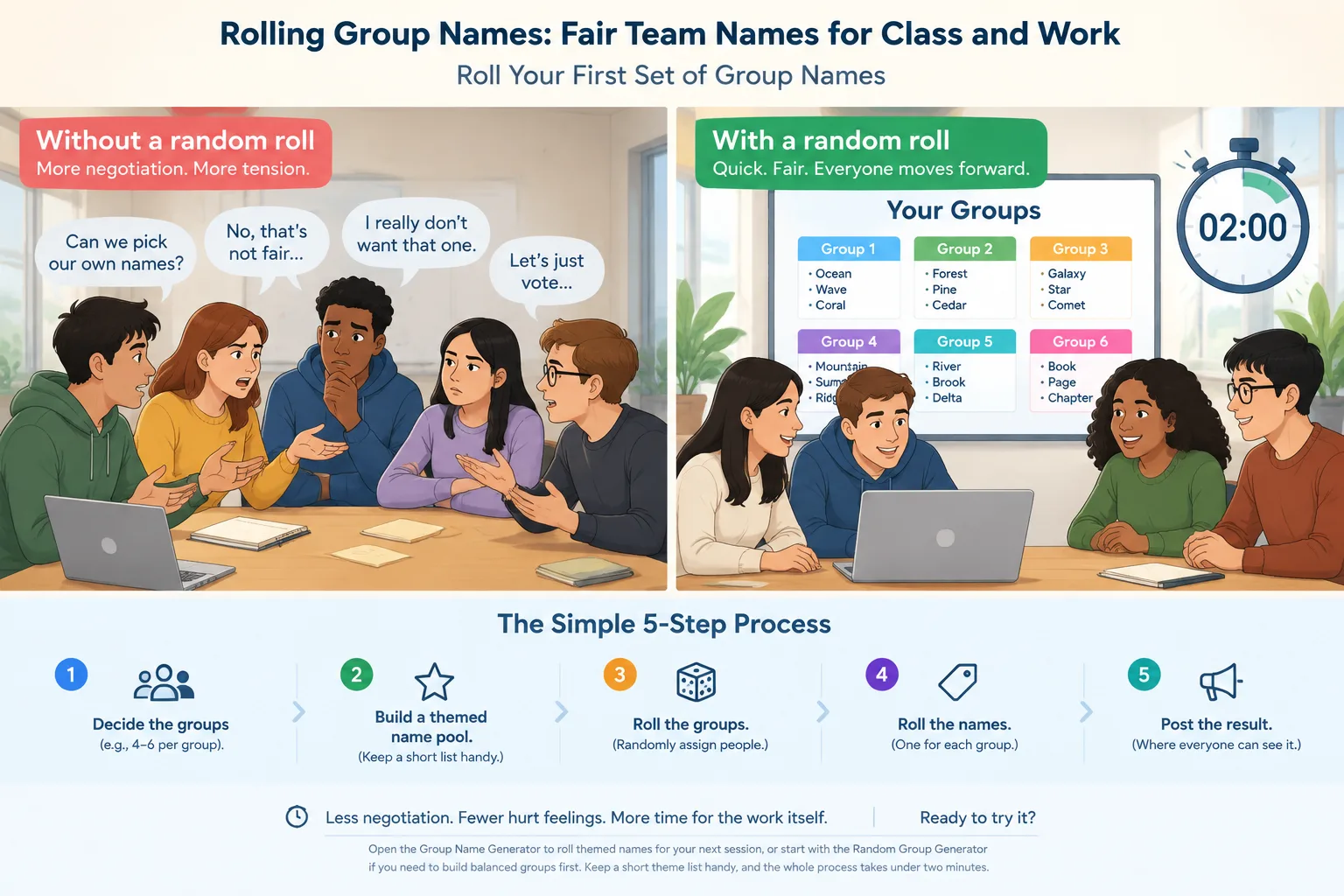
Speed is the easiest to measure. A facilitated naming debate among six groups routinely takes five to ten minutes, and it usually happens at the exact moment when you want attention on the task. A random roll takes under a minute. If you teach five sections a day, that saves roughly half an hour a week that goes back into instruction.
Fairness is subtler. When groups choose names, the first group to decide takes the most desirable option — the animal, the superhero, the inside joke. Later groups get leftovers and often notice. Random assignment means the desirable and undesirable names are distributed by chance, not by who spoke first or who is most confident. Research on cooperative learning consistently emphasizes that group formation and status cues shape how students participate (see the Cornell Center for Teaching Innovation and Carnegie Mellon's Eberly Center resources in the source list below), and a neutral label is one small way to avoid handing status to one table at the start.
Social friction is the benefit teachers notice first. When the teacher rolls the name, the teacher is not the one judging whose idea was better. Nobody had to lose a vote. That small shift is often enough to stop the naming conversation from becoming a small conflict before the actual work begins.
How to Roll Group Names in Five Steps
Here is a method that works in a classroom, a training room, or a video call.
- Decide the group structure first. Choose group size or group count before you touch names. Six groups of five is a different roll than five groups of six, and settling this first prevents a re-roll later.
- Build a name pool with a theme. Pick one theme so names feel like a set rather than a random list: planets, rivers, constellations, tools, colours, cities, mythological creatures. Ten to fifteen options for six groups gives you variety without a long list to type in.
- Roll the groups. Use the Random Group Generator to split your roster fairly. It balances group sizes automatically, so you do not end up with one group of seven and one of three.
- Roll or assign the names. Open the Group Name Generator and let it produce a themed name for each group. If you prefer a visible draw, put the theme words on a Group Wheel Spinner and spin once per group while everyone watches.
- Display and record the result. Write the group names on the board, in the shared slide, or in your LMS. A visible record ends the "wait, which group am I in?" questions that restart the debate.
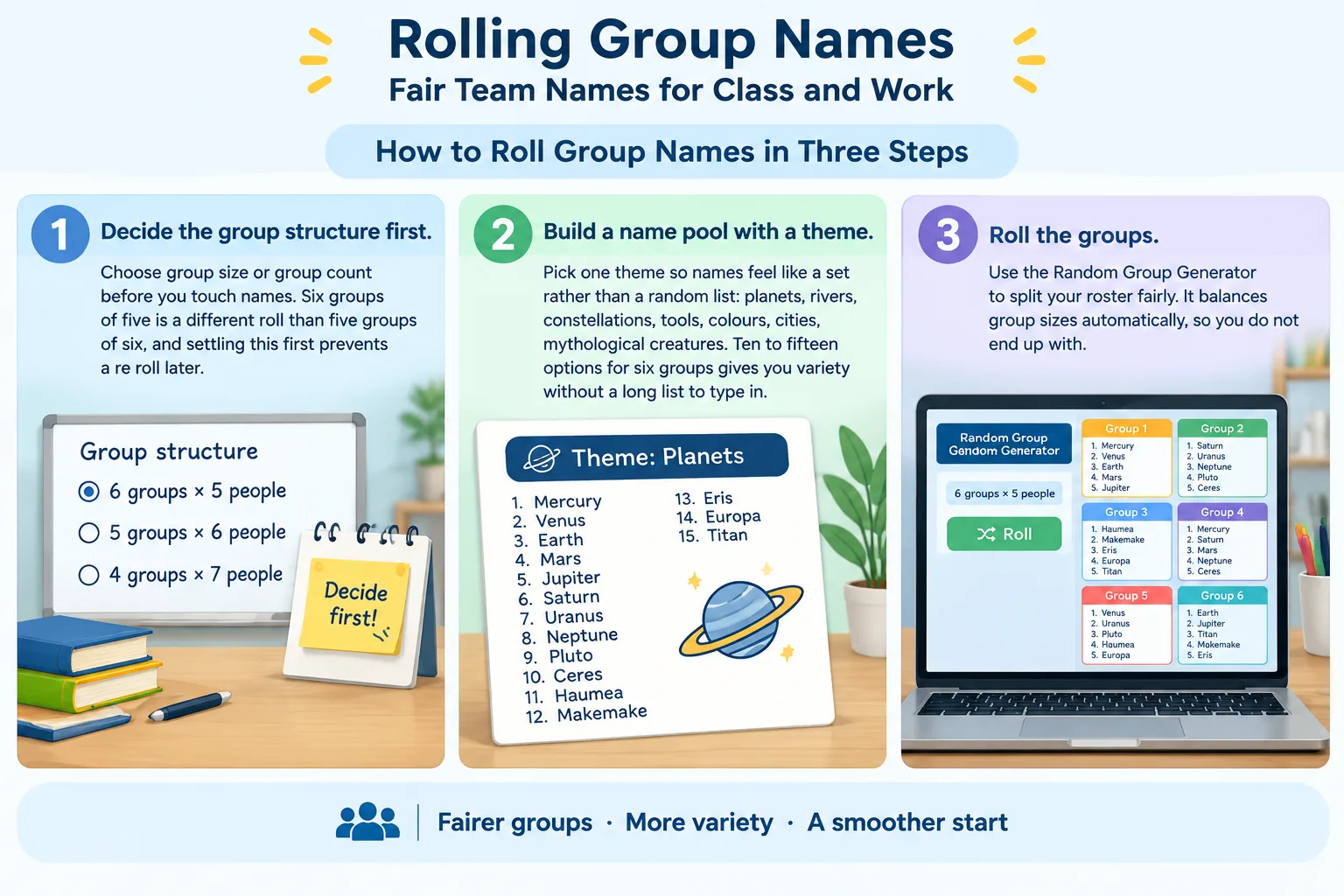
The entire sequence takes about ninety seconds once your name pool is saved. Many teachers keep a short list of themes in a notes file and rotate them weekly, which keeps the process fresh without extra preparation.
When this is not the right fit: if your class is running a semester-long project where team identity matters for motivation, a fully random name may feel hollow. In that case, roll the groups but let each team choose its own name from a shortlist you approve.
Real Example: 28 Students, One Mythology Lesson
A ninth-grade English teacher has 28 students and wants seven literature circles for a mythology unit. She decides on seven groups of four, then builds a name pool from the unit's own vocabulary: Olympus, Labyrinth, Oracle, Nectar, Titan, Hearth, Messenger.
She enters the roster into the Random Group Generator and creates seven balanced groups. She then rolls the seven names using the Group Name Generator and writes the results on the board as a simple grid: group number, member names, group name.
Two things happen that she did not plan for. First, the names do vocabulary work before the lesson begins — students ask what "Nectar" and "Labyrinth" mean, which becomes a two-minute pre-teach. Second, the group names make transitions fast: "Labyrinth table, collect your texts" is clearer and quicker than "the group with Maya and Dev."
Total time: under two minutes at the start of class, versus the six or seven minutes a naming debate usually takes. She repeats the same structure the following week with a different theme — ocean zones — and students start expecting the roll, which makes it feel like part of the routine rather than a novelty.
Rolling Team Names for Workshops, Training, and Events
Adults are not immune to naming politics. In corporate workshops, offsites, onboarding cohorts, and hackathons, the same pattern appears: the loudest table claims the best name, and everyone else settles. Rolling solves it in the same way it does in a classroom.
For a training session with 24 participants, five groups is a common structure. Roll the groups first, then roll themed names that match the session's content — for a project-management workshop, names like Milestone, Sprint, Backlog, Baseline, and Handoff do double duty as vocabulary. It also helps facilitators with remote delivery: when breakout rooms are named, you can say "Backlog room, be back in ten," and participants know exactly where to click in Zoom or Teams. If you are running a pairing activity instead, the Random Pair Generator handles two-person rotations without a separate setup.
One practical limit: in large events with self-selected tables, rolling names can feel abrupt if nobody explains why. A single sentence — "We are rolling names so no table spends ten minutes on branding" — usually gets a laugh and full buy-in. The tool also runs in nine languages, which helps in multilingual cohorts where participants read the group list in their own language.
Rolling Names vs. Letting Groups Choose
Neither approach is universally better. The right choice depends on how long the group will exist and how much identity matters.
| Situation | Rolling names | Groups choose names |
|---|---|---|
| Single lesson or short activity | Best — fast and neutral | Wastes time, adds little |
| Multi-week project team | Works, but consider a shortlist | Better for ownership and motivation |
| Workshop or offsite | Best — neutral and quick | Risky if status seeking appears |
| Competition or tournament | Best — visibly fair | Can feel like an advantage to early pickers |
| Class with strong group culture | Works as a warm-up | Often already part of the routine |
A useful middle path is the curated shortlist: you roll three candidate names for each group, and the group picks one in thirty seconds. You keep the speed and fairness, and teams still get a small sense of choice.
Common Mistakes to Avoid
Rolling twice because you dislike the result. Re-rolling teaches the room that the draw is not really random. If a name is genuinely unsuitable, remove it from the pool before the roll instead.
Names that encode ability. Avoid labels that map onto reading levels, behaviour, or ability groups — "Advanced" versus "Support" is a public ranking. Neutral nouns (tides, metals, constellations) avoid that entirely.
Reusing the same names across sections. If period two hears that period one was "Team Volcano," the second section often feels like a copy. Rotate themes by class, or change the theme weekly.
Forgetting to record the roll. If the only record is a verbal announcement, you will repeat it four times. Write it on the board or share it in the class channel. This matters even more for remote sessions, where students may join late.
Rolling groups but hand-picking who is in them. The fairness story collapses if the groups themselves are stacked. Use the same random process for membership, then roll names on top. If you have an odd number of students, check how the tool handles remainders before you announce the groups, so nobody is left without a table.
Frequently Asked Questions
What does rolling group names mean?
It means assigning a team name by random draw instead of letting groups choose or negotiate. You prepare a themed list of name options, then let a randomiser or wheel assign one name to each group. The result is a neutral label that makes groups easy to reference.
Do I need a theme, or can I roll any names?
Any list works, but a theme makes the set feel intentional and can reinforce your subject matter — planets for a space unit, tools for a design workshop, fonts for a media class. Ten to fifteen options is usually plenty, and you can save the list for next time.
Is it fair if some groups get names they like less?
Fairness here means equal chance, not equal preference. A random draw gives every group the same probability of getting any name, which is more defensible than first-come-first-served. If a specific name would genuinely upset a group, remove it from the pool before rolling rather than re-rolling afterwards.
Can I use this for remote or hybrid sessions?
Yes. Roll groups with the Random Group Generator before the call, then share your screen or post the group list and names in the chat. Named breakout rooms are easier to reference than numbered ones, and late joiners can read the list without interrupting.
How often should I change the theme?
Weekly rotation works well for classes that meet daily, and per-session rotation works for workshops. The important part is keeping the process consistent — same steps, same fairness rule — while the vocabulary changes.
Roll Your First Set of Group Names
The method is simple enough to run tomorrow: decide the groups, build a themed name pool, roll the groups, roll the names, and post the result where everyone can see it. What changes is the tone at the start of the activity — less negotiation, fewer hurt feelings, and more time for the work itself.
Ready to try it? Open the Group Name Generator to roll themed names for your next session, or start with the Random Group Generator if you need to build balanced groups first. Keep a short theme list handy, and the whole process takes under two minutes.
FAQ
What does rolling group names mean?
It means assigning a team name by random draw instead of letting groups choose or negotiate. You prepare a themed list of name options, then let a randomiser or wheel assign one name to each group. The result is a neutral label that makes groups easy to reference.
Do I need a theme, or can I roll any names?
Any list works, but a theme makes the set feel intentional and can reinforce your subject matter — planets for a space unit, tools for a design workshop, fonts for a media class. Ten to fifteen options is usually plenty, and you can save the list for next time.
Is it fair if some groups get names they like less?
Fairness here means equal chance, not equal preference. A random draw gives every group the same probability of getting any name, which is more defensible than first-come-first-served. If a specific name would genuinely upset a group, remove it from the pool before rolling rather than re-rolling afterwards.
Can I use this for remote or hybrid sessions?
Yes. Roll groups with the [Random Group Generator](https://random-group-generator.com/) before the call, then share your screen or post the group list and names in the chat. Named breakout rooms are easier to reference than numbered ones, and late joiners can read the list without interrupting.
How often should I change the theme?
Weekly rotation works well for classes that meet daily, and per-session rotation works for workshops. The important part is keeping the process consistent — same steps, same fairness rule — while the vocabulary changes.
Related Tools
Pick the right generator for the job — every tool runs free in your browser.