
randomly pair names
How to Randomly Pair Names: Free Pair Maker Guide
Learn how to randomly pair names for classrooms, workshops, and teams with a fair, simple process. Explore steps, examples, and tips for creating balanced pairs.
Teachers, trainers, and facilitators often face the same challenge: you have a list of names and need fair pairs quickly. Whether you are planning a classroom discussion, peer activity, workshop exercise, or team task, learning how to randomly pair names can save time and reduce bias. A simple pairing process helps everyone participate and gives each person an equal chance to work with someone new.
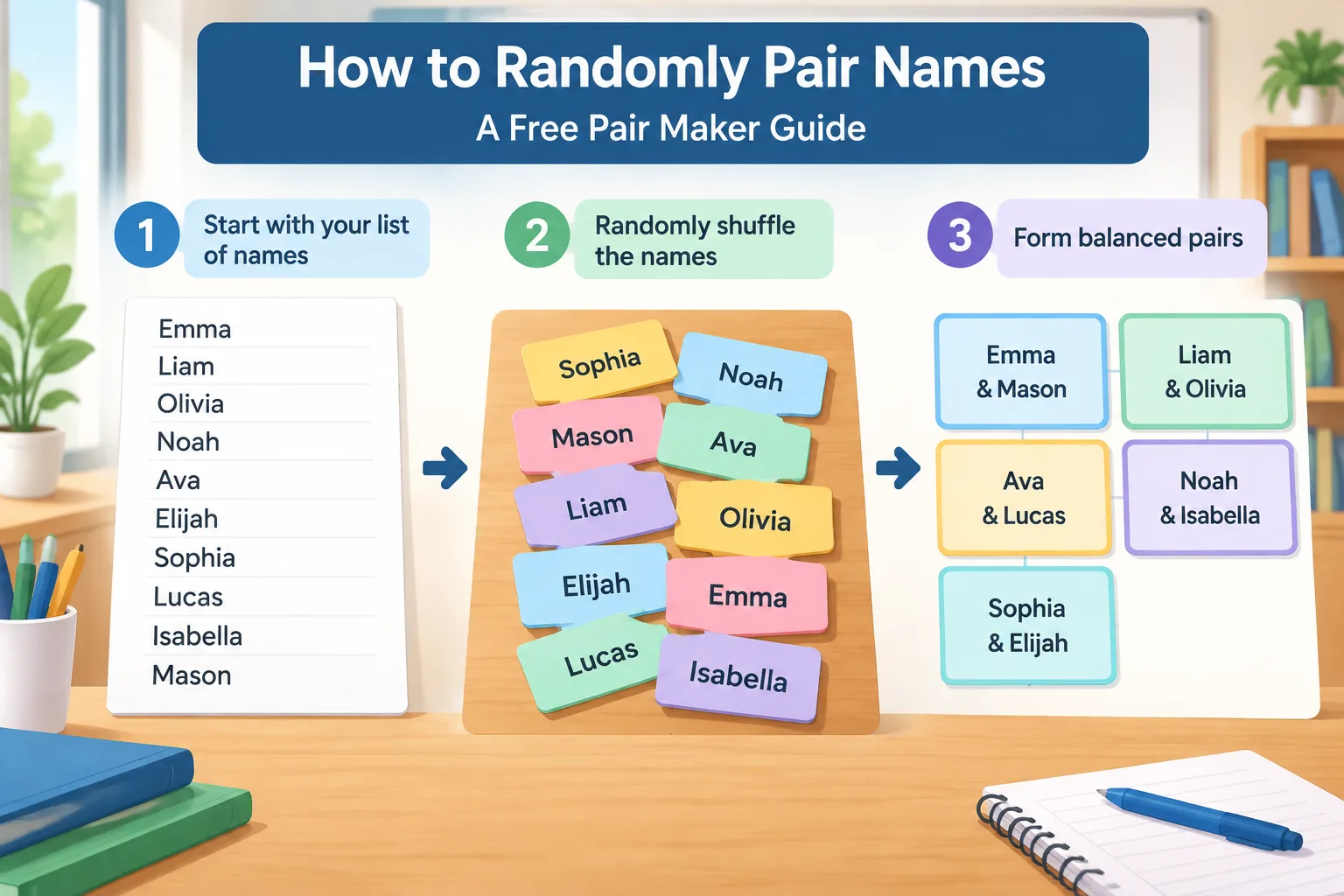
Why randomly pairing names is useful for groups
When a teacher or facilitator manually creates pairs, it is easy to repeat the same combinations, accidentally leave someone out, or spend valuable preparation time making decisions. Random pairing creates a neutral starting point. Instead of choosing based on friendship groups, seating positions, or personal assumptions, the process gives each participant a fair opportunity to connect with another person.
Random pairing is especially useful when the goal is collaboration rather than selecting specific skill combinations. For example, a middle school teacher may want students to discuss a reading assignment with a different classmate each week. A corporate trainer may want workshop participants to practice a new communication skill with different partners during each activity. In both situations, a random method keeps the activity moving without requiring the organizer to manually assign every pair.
The approach works best when the activity benefits from variety and participation. It may not be the right choice when pairs require specific expertise, accessibility considerations, or carefully matched experience levels. In those cases, a facilitator may need to create intentional pairs instead of using a fully random method.
Common challenges when you randomly pair up names
Many people start by writing names on paper slips or asking participants to choose partners. These methods can work for small groups, but they often create avoidable issues. People may select close friends, some names may be forgotten, or the organizer may need to restart the activity when the number of participants changes.
Digital tools can make the process easier because they can handle larger lists and provide a repeatable workflow. A name pairing randomizer can take a list of participants, shuffle the entries, and create pairs without requiring manual decisions. This is useful for teachers managing multiple classes or facilitators running several sessions in one day.
For example, imagine a workshop with 24 employees practicing interview techniques. The trainer could spend several minutes arranging partners, or they could randomize pairs and begin the activity immediately. The saved preparation time can be used to explain instructions and answer questions instead.
Another challenge is maintaining fairness. A good random pairing process should treat every name equally and avoid patterns that make certain participants repeatedly work together. For recurring activities, organizers can record previous pairings and adjust future sessions when needed.
How to randomly pair names step by step
A reliable process for randomizing pairs only takes a few steps. The exact method depends on your group size, activity goals, and whether you are working online or in person.
Step 1: Prepare your name list
Start with a complete list of participants. Check spelling and remove duplicate entries unless two people genuinely have the same name. If you are working with a class, you may want to copy names from your attendance system. For a workplace activity, you might use a participant registration list.
Example: A teacher preparing a science discussion has 18 students. The teacher creates one list containing all 18 names before generating pairs. This prevents missing students when the activity begins.
Step 2: Decide whether random pairing fits your goal
Before you randomize pairs, consider the purpose of the activity. Random pairs are useful for icebreakers, discussions, practice sessions, and quick collaboration tasks. They may not be ideal for projects where students need different ability levels or where employees need specific roles.
Example: A language teacher wants students to practice conversation skills. Random pairs are appropriate because the goal is speaking practice. A teacher assigning a long research project may instead choose pairs based on complementary skills.
Step 3: Use a pairing method
You can randomly pair up names manually or use a digital tool. Manual methods include drawing names from a container or shuffling a list. Digital methods provide a faster option when groups are larger or when you need to repeat the process frequently.
A tool such as the Random Pair Generator can help create pairs from a participant list. The workflow is simple: enter names, start the random process, and review the generated pairs before sharing them with the group.
Step 4: Check the results before starting
Even with randomization, take a quick look at the output. Confirm that every participant appears once and that no one is left without a partner. If you have an odd number of participants, decide whether one person will join a group of three or whether the facilitator will participate.
Example: A trainer has 11 attendees. The generated result creates five pairs and one remaining participant. The trainer decides to create one three-person practice group instead of repeating the process.
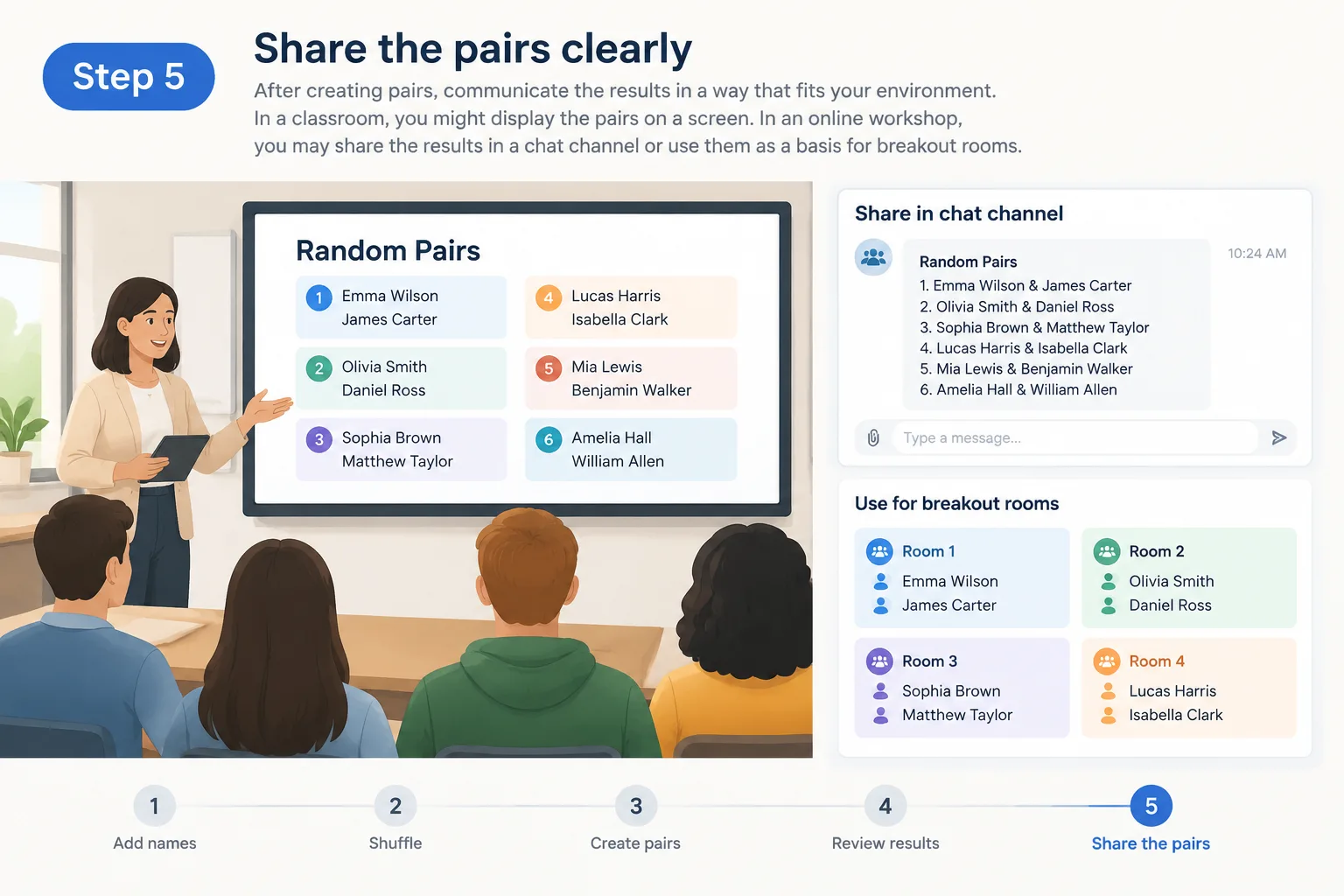
Step 5: Share the pairs clearly
After creating pairs, communicate the results in a way that fits your environment. In a classroom, you might display the pairs on a screen. In an online workshop, you may share the results in a chat channel or use them as a basis for breakout rooms.
Ways to use random name pairing in classrooms and teams
Random pairing can support many different activities because it removes the need for constant manual partner selection. The key is matching the pairing method with the activity goal.
In classrooms, teachers can use random pairs for think-pair-share discussions, peer review, vocabulary practice, problem-solving exercises, and classroom games. For example, after a history lesson, a teacher can randomly pair students to compare notes and discuss important events. Changing partners regularly can help students practice communication with different classmates.
For online learning, random pairing can support breakout activities. A facilitator can generate pairs before a session and then assign participants to rooms. This can be especially helpful for large classes where manually creating groups takes too much time.
For workplace training, random pairs can encourage networking between people who do not normally collaborate. A manager running a communication workshop might create new pairs for each exercise so employees practice with different colleagues.
The Random Group Generator can also help when an activity needs larger teams instead of pairs. For example, after a short paired discussion, a facilitator may move participants into small groups for a larger project.
Random pairing compared with choosing partners manually
Choosing partners manually gives organizers more control, but it also requires more time and careful judgment. A teacher who knows students well may intentionally create pairs based on learning needs. A trainer may match employees based on project experience. These approaches can be valuable when specific outcomes matter.
Random pairing has a different advantage: speed and neutrality. It reduces the chance that organizers repeatedly choose the same combinations or unintentionally favor certain participants. For short activities where the main goal is participation, randomization is often a practical choice.
For example, a teacher planning a five-minute discussion does not need to spend time designing perfect matches. A quick random pair process lets the class begin immediately. However, for a semester-long project, the teacher may prefer a more planned grouping strategy.
The best method depends on the situation. Random pairing is a useful tool in the facilitator’s toolkit, but it should support the learning or teamwork goal rather than replace thoughtful planning.
Tips for better random pair activities
A successful pairing activity depends on more than generating names. Clear instructions, timing, and follow-up questions help participants get value from the interaction.
First, explain the purpose of the pairing. People are more likely to engage when they understand why they are working with a new partner. For example, tell students that changing partners helps them hear different perspectives.
Second, prepare a simple task. Random pairs work best when participants know what to do immediately. A discussion question, practice prompt, or short challenge prevents awkward waiting time.
Third, consider repeating the process. If your group meets regularly, using a different pairing each time can increase interaction across the whole group.
For example, a weekly training session can create new pairs for each activity. Over several sessions, participants meet more colleagues and practice different communication styles.
Frequently asked questions about randomly pairing names
How do I randomly pair up names?
To randomly pair up names, create a complete participant list, shuffle the names, and divide the list into groups of two. A digital random pair generator can automate this process and reduce manual errors, especially for larger groups.
Can I pair students randomly for classroom activities?
Yes. Many teachers use random pairing for discussions, peer activities, and short practice tasks. It works best when the goal is participation and collaboration rather than assigning students based on specific skills.
What happens if I have an odd number of names?
If you have an odd number of participants, you can create one group of three, allow the facilitator to join a pair, or adjust the activity format. The best option depends on the activity and group size.
Is random pairing fair for teams and workshops?
Random pairing can provide a neutral way to assign partners because each participant follows the same process. However, organizers should still consider accessibility needs, experience levels, and activity requirements.
What is the easiest way to randomize pairs of names?
The easiest method is usually a digital tool where you enter names and generate pairs automatically. The Random Pair Generator provides a quick way to create pairs for classrooms, training sessions, and team activities.
Ready to create pairs without manual sorting? Use the Random Pair Generator to randomly pair names and make your next activity easier to organize.
Want to try it right away? Use the Random Group Generator to split your list into balanced teams, the Group Name Generator to name each team, and the Random Pair Generator when you need one-on-one pairings.
SponsoredExplore more resources