
randomization
Randomization in Games and Competitions: Why Fair Random Beats Fixed Order
Learn how randomization in games and competitions creates fairer teams, matchups, turns, and selections. Explore practical methods, examples, and common mistakes.
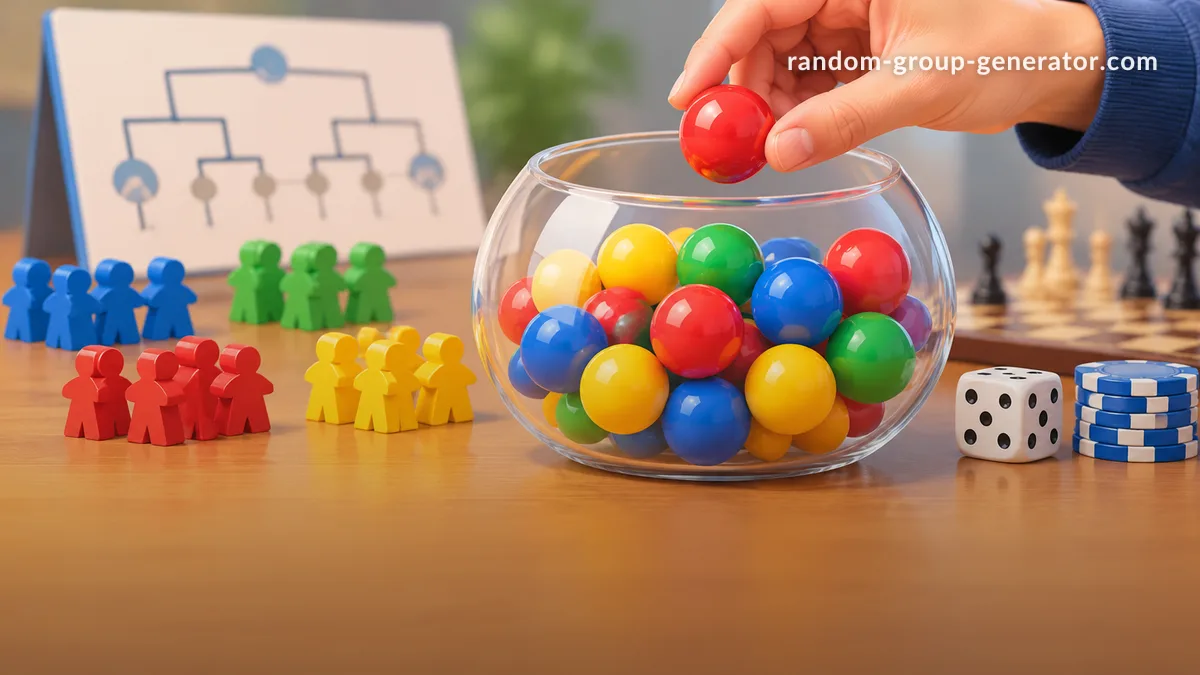
Imagine organizing a classroom quiz, a team-building challenge, or a weekend tournament. You have a list of participants, several teams to create, and a competition to start. If you always use the same order, some people may consistently receive the first turn, face familiar opponents, or end up in predictable groups. Even when nobody intends to create an advantage, the process can appear unfair.
Randomization in games and competitions offers a practical way to reduce predictable selection patterns. By using chance to determine teams, matchups, starting positions, or participation order, organizers can give participants a more transparent process. However, randomness does not automatically guarantee fairness. The rules, participant pool, selection method, and competition format still matter.
This guide explains how randomization works, why it matters, when to use it, and how teachers, event organizers, and team facilitators can introduce it into their activities.
1. What Does Randomization Mean in Games and Competitions?
Randomization is the process of using chance to determine an outcome rather than allowing a person to choose it manually or follow a predetermined sequence. In a game, this could mean randomly selecting the first player, drawing teams, assigning opponents, or deciding which participant answers a question.
The important feature is that the outcome is not decided by personal preference. Participants are included in a defined selection process, and chance determines the result according to the rules. For example, if a teacher has 24 students and wants four teams, a random selection method can distribute the students without relying on friendship groups, seating positions, or the order of names on a register.
Randomization is also different from simply changing the order of a list. Reversing a list, rotating names, or alternating between two groups may make an activity look different, but the outcome still follows a predictable rule. A random process introduces uncertainty into the selection itself.
In statistics, random assignment has a more precise meaning. The National Library of Medicine explains that strict random selection requires eligible participants to have an appropriate chance of being selected. The exact probability depends on the selection design. This distinction matters because a process that looks mixed or unpredictable is not necessarily statistically random.
For everyday activities, organizers do not need to perform advanced statistical calculations. They do need to define who is eligible, what is being randomized, and whether any restrictions apply.
2. Why Randomization Matters for Fair Competition
Fairness is one of the main reasons to introduce randomization. When an organizer manually assigns every participant, people may question whether personal preferences, friendships, experience, or previous results influenced the decision. Even a well-intentioned organizer can unintentionally create patterns that favor certain participants.
A consistent random selection process provides a neutral starting point. Everyone can understand that the selection follows the same stated rules rather than depending on the organizer's personal choices. This can improve confidence in the process, especially when participants do not know one another well.
Consider a workplace activity with 20 employees. If managers repeatedly choose teams themselves, employees might suspect that colleagues with similar roles or experience are being grouped together deliberately. Random assignment provides another approach: put all eligible names into one selection pool and distribute them according to a predetermined team size.
There are several practical benefits:
- Reduced personal influence: Organizers do not need to choose participants individually.
- Less predictable outcomes: Participants cannot rely on a familiar selection order.
- Greater transparency: The process can be explained before the activity begins.
- More varied interactions: Participants may work with colleagues or classmates they would not normally choose.
- Simpler administration: A defined randomization process reduces repeated manual decisions.
These benefits should not be confused with a guarantee that every resulting team will be equally skilled. Random assignment distributes participants by chance, not necessarily by ability. If competitive balance is essential, additional rules may be needed.
3. Random Selection Versus Fixed or Seeded Order
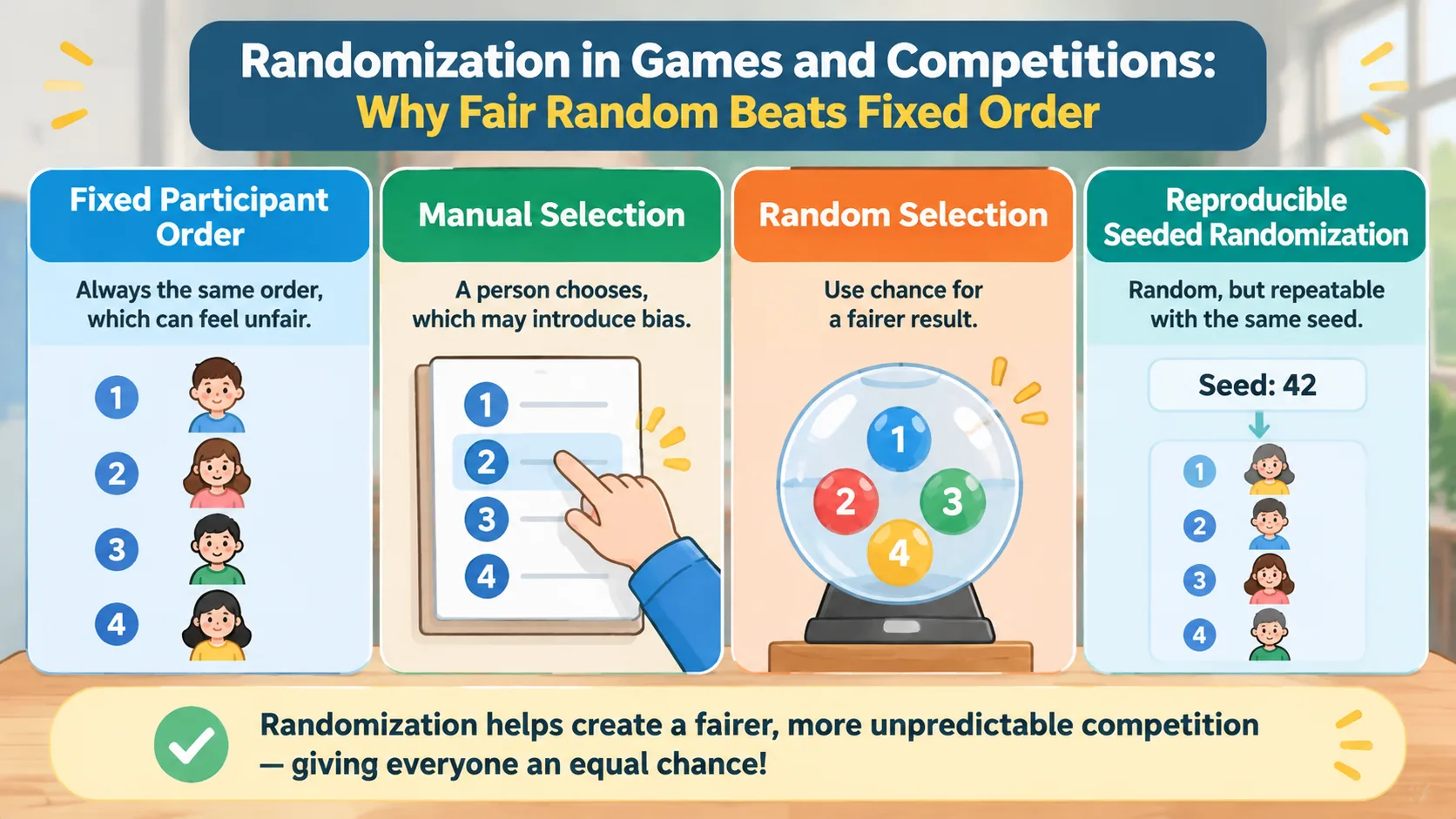
One common source of disagreement in games is the difference between random selection and predictable order. A fixed order follows an established sequence, such as alphabetical names, registration time, seating position, or a rotating list. It is easy to understand, but it can repeatedly produce the same advantages and disadvantages.
For example, suppose a classroom has eight students participating in a weekly quiz. If the teacher always starts with the first name on the attendance register, some students will consistently answer earlier. If the first position carries a special advantage, the fixed arrangement can influence the competition before anyone answers a question.
A random selection method changes the starting participant each time. It does not mean that every student must receive the first turn in every individual round. Rather, each selection is determined using the same defined process.
Seeded randomization requires a little more explanation. A random number generator can use an initial value, called a seed, to produce a reproducible sequence. If the same generator and seed are used again, the sequence can be reproduced. This is useful for testing, demonstrations, and situations where organizers need to verify or repeat a result.
A seeded process is not automatically unfair. A seed can support transparency when it is selected and documented in advance, and the procedure cannot be changed after organizers see the outcome. However, a fixed sequence reused without disclosure may create predictable patterns. A seed chosen or changed strategically after seeing possible results can also undermine trust.
| Method | How it works | Practical consideration |
|---|---|---|
| Fixed order | Participants follow a predetermined sequence | Easy to manage but predictable |
| Manual selection | An organizer chooses participants | Flexible but potentially subjective |
| Random selection | Chance determines the outcome | Reduces personal selection influence |
| Seeded randomization | A seed produces a reproducible sequence | Useful for repeatable and auditable processes |
| Balanced random assignment | Randomization operates within predefined constraints | Requires clear rules and additional preparation |
The right method depends on the activity. For a casual classroom game, straightforward random selection may be sufficient. For a formal tournament, organizers should document the draw procedure, eligibility requirements, and any restrictions before generating the results.
4. Where Randomization Is Used in Games and Competitions
Randomization is useful in more situations than choosing a winner. It can determine several parts of an activity, from the first participant to the structure of a tournament. Identifying exactly what needs to be randomized helps organizers select the right method.
Team formation
Team formation is one of the most common applications. Teachers can use random assignment to create groups for discussions, science projects, classroom challenges, and collaborative learning activities. Corporate facilitators can use it to mix employees across departments or create temporary workshop teams.
For example, a facilitator has 30 participants and needs six teams of five. Instead of asking participants to form their own groups, the facilitator enters the eligible names into a random group generator. Each participant is assigned to one of the six teams. The process takes the decision away from individual preferences and makes it easier to begin the activity.
Organizers who need pairs rather than larger teams can use a Random Pair Generator. This is particularly useful for interview practice, peer review, language exercises, and short discussion activities.
Matchups and tournament draws
Randomization can determine which competitors meet in the first round of a tournament. This is useful for school competitions, office games, board-game events, and informal sports tournaments.
Suppose 16 participants enter a knockout competition. An organizer can conduct a random draw to determine the first-round matchups. However, if some participants receive byes or competitors must be separated into different brackets, those rules should be established before the draw.
Random matchups do not guarantee equal skill levels. They determine who competes against whom, not whether each matchup has the same difficulty.
Turn order and participation
Random selection can also determine who starts a game or answers a question. This is especially useful when a teacher wants to distribute participation opportunities without always choosing the same volunteers.
For example, a teacher can place 25 student names into a selection tool and draw one name for each question. If repeated selection is allowed, a student may be selected more than once. If everyone must participate before anyone is selected again, the organizer should use a no-repeat selection process.
A dedicated Random Student Picker can help teachers manage this type of activity without manually scanning a class list.
Game roles and challenges
Some games require participants to receive different roles, tasks, or challenges. Random assignment can distribute these roles without making the organizer responsible for choosing who receives each one.
For example, a workshop might have discussion leader, note-taker, presenter, and timekeeper roles. Participants can be assigned roles randomly at the beginning of each session. Rotating the process between sessions can also give everyone opportunities to try different responsibilities.
5. How to Use Randomization Without Creating Unfair Results
Randomization works best when organizers think about the rules before generating an outcome. A poorly designed selection process can still produce confusion, unequal opportunities, or unsuitable groupings.
Use the following steps to prepare a fair and understandable activity.
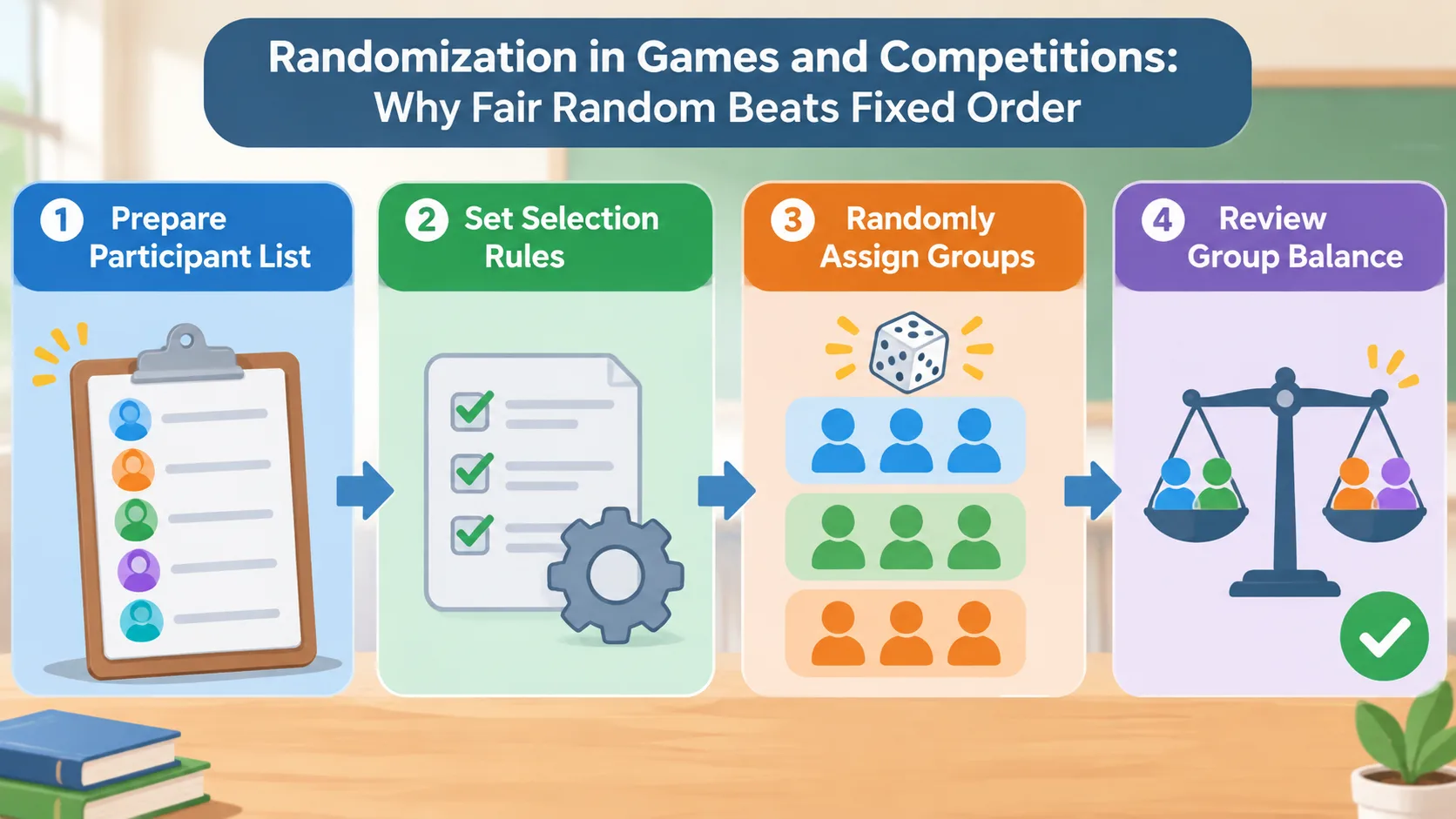
- Define the purpose. Decide whether you are selecting teams, assigning opponents, choosing a starting player, or distributing roles. Each purpose may require a different selection method.
- Create the participant list. Include everyone who is eligible and remove duplicate names. Check spelling and confirm that nobody has been accidentally excluded.
- Set the rules. Decide team sizes, repeat-selection rules, eligibility restrictions, and any necessary accommodations before starting.
- Choose the randomization method. Use a simple random selection process for ordinary activities. Consider constrained random assignment when specific balance requirements must be respected.
- Generate and review the result. Confirm that all eligible participants have been included and that the output follows the rules.
- Explain the process. Tell participants how the selection was conducted and what rules were applied.
Consider a teacher organizing a class debate with 24 students. The teacher wants four groups of six but needs to keep certain students in different groups because of a classroom accommodation.
The teacher should not simply randomize the full list and ignore the restriction. Instead, the teacher should define the required separation before assigning groups, use an appropriate constrained process, and check the final result. If the tool does not support that restriction, the teacher may need to prepare eligible pools or make a carefully documented adjustment.
This example highlights an important principle: fairness depends on both the randomization process and the rules surrounding it.
6. Can Randomization Create Balanced Teams?
A common misconception is that random teams are automatically balanced teams. Random assignment can distribute participants without personal bias, but it does not guarantee equal experience, ability, physical strength, or specialist knowledge.
Imagine a football activity with 12 experienced players and 12 beginners. If 24 participants are divided randomly into four teams, one team might receive more experienced players than another. This is a possible outcome of randomization, not necessarily a sign that the process has failed.
Organizers should first decide what fairness means for their particular activity. For a social icebreaker, equal team sizes may be enough. For a competitive event, differences in experience or ability may matter much more.
There are several ways to approach this:
- Pure random assignment: Use when the main priority is neutral selection and varied interactions.
- Random assignment with restrictions: Use when certain combinations must be avoided or specific conditions must be met.
- Balanced assignment: Use available information, such as experience levels, to create teams with more comparable compositions.
- Rotating participation: Change teams or roles between rounds to distribute opportunities over time.
The Institute of Education Sciences explains that random assignment in research can use approaches such as blocked and matched-pair assignment. These methods show that randomization does not always require treating every participant as part of one unrestricted pool.
For everyday facilitators, the practical lesson is simple: use pure randomization when neutral selection is the goal, and add clearly stated constraints when the activity has legitimate balancing requirements. Do not describe a constrained process as completely unrestricted randomness.
7. Common Randomization Mistakes to Avoid
Even a simple game can become frustrating when the selection process is unclear. Most problems arise because organizers begin generating results before deciding what fairness means or checking the participant list.
One frequent mistake is changing the rules after seeing the result. For example, an organizer might dislike a particular matchup and redraw until a preferred combination appears. Although each individual draw may be random, repeatedly drawing until the organizer likes the outcome introduces personal judgment into the overall process.
Another mistake is confusing equal group sizes with equal competitive strength. Four teams containing six people each may look balanced, but their experience levels could be very different. Organizers should explain what the random process is designed to achieve rather than promising more than it can deliver.
Other issues include:
- Entering the same participant twice and accidentally giving that person two opportunities.
- Forgetting eligible participants or including people who cannot take part.
- Using a selection method that allows repeated winners when repeats are not intended.
- Failing to explain restrictions before the draw.
- Assuming a computer-generated result is automatically suitable for a high-stakes competition.
- Reusing a known sequence when participants expect a fresh selection.
For a casual game, a quick review may be enough. For an important competition, document the participant list, selection rules, timing, and final result. If participants need to verify the draw independently, consider a documented procedure with an agreed seed or an independently witnessed selection process.
The National Institute of Standards and Technology provides technical guidance on random bit generation, including deterministic generation methods and entropy sources. Its work also illustrates why the word random can have different meanings in everyday games and technical systems. A classroom group draw does not need cryptographic security, but a prize allocation or high-value competition may require stronger safeguards.
8. Practical Examples for Teachers and Team Facilitators
The best way to understand randomization is to apply it to activities people already organize. Different settings have different requirements, but the basic approach remains consistent: define the eligible participants, establish the rules, select a method, and communicate the outcome.
Example 1: A classroom collaboration activity
A teacher has 28 students and wants seven groups of four for a science activity. The teacher prepares the class list, checks for duplicate entries, and uses a random group generator to create the teams.
The teacher then displays the results and explains that the purpose is to encourage students to collaborate with different classmates. If the activity continues over several weeks, the teacher can generate new groups for each project. If particular accommodations are required, those should be addressed before the selection takes place.
Example 2: A corporate team-building challenge
A human resources facilitator is organizing a workshop for 36 employees from different departments. The aim is to encourage conversations between people who do not usually work together.
The facilitator creates nine groups of four using a random selection process. Before generating the groups, the facilitator checks whether any team-size or department-separation requirements apply. The final groups are shared with participants, who can then begin their challenge without spending time negotiating teams.
Example 3: A friendly tournament
An event organizer has eight participants entering a board-game tournament. Each participant should play one opponent in the opening round.
The organizer prepares the complete participant list and conducts a random matchup draw. The resulting four pairs are published before the games begin. If the event includes rankings, seeded participants, or protected matchups, those requirements should be announced before the draw rather than introduced afterward.
Example 4: A weekly classroom quiz
A teacher wants to involve students who do not usually volunteer. Instead of asking for raised hands, the teacher uses random student selection to choose an answerer for each question.
The teacher explains whether students can be selected more than once. If the objective is to give everyone an opportunity, the teacher can use a no-repeat approach until the class list has been exhausted. This makes the participation rules easier to understand and apply consistently.
Across all four examples, randomization reduces the need for individual selection decisions. It does not remove the organizer's responsibility to create suitable rules, monitor the activity, and address practical exceptions.
9. Frequently Asked Questions About Randomization in Games and Competitions
What is the main purpose of randomization in games and competitions?
The main purpose is to use chance to determine outcomes such as teams, matchups, starting positions, or participant selection. It reduces dependence on personal choices and predictable ordering. It can also make the process easier to explain to participants.
Does randomization guarantee a fair competition?
No. Randomization helps create a neutral selection process, but it does not guarantee equal skill levels, resources, or opportunities. Organizers must establish appropriate eligibility and competition rules before using it.
Is seeded randomization unfair?
Not necessarily. A seeded random process can produce repeatable results, which is useful for testing and verification. It becomes a concern when organizers manipulate the seed or change the procedure after seeing possible outcomes.
What is the difference between random teams and balanced teams?
Random teams are formed through chance, while balanced teams are designed to meet specific criteria, such as comparable experience or ability. A random result may be balanced by chance, but that outcome is not guaranteed. If competitive equality is important, organizers may need a constrained or balanced assignment method.
How can teachers use randomization in classroom games?
Teachers can use it to create discussion groups, assign project partners, select quiz participants, and distribute game roles. Before starting, they should check the student list, explain the selection rules, and consider any necessary classroom accommodations.
Can random selection choose the same person more than once?
Yes, depending on the selection method. Some processes allow repeated selections, while others remove a selected participant from the pool until everyone has had a turn. Organizers should choose the appropriate method and explain the rule before the activity begins.
When should organizers avoid pure randomization?
Pure randomization may not be appropriate when participants have specific accessibility needs, when teams must meet safety requirements, or when a formal competition requires skill-based seeding. In these situations, organizers should define the necessary restrictions and use a suitable assignment process instead.
Make Your Next Game or Competition Easier to Organize
A good selection process saves time and helps participants understand how decisions are made. Whether you are preparing classroom activities, workplace challenges, or friendly competitions, randomization offers a practical alternative to fixed order and manual selection.
Start by deciding what needs to be randomized, checking your participant list, and setting clear rules. Then use a suitable tool to generate the results and communicate the process to everyone involved.
Ready to organize your next activity? Try the Random Group Generator to create groups without manually assigning every participant. It is a straightforward way to introduce random team selection into classrooms, workshops, and group competitions.
Related Tools
Pick the right generator for the job — every tool runs free in your browser.