
random vs balanced group generator
Random vs Balanced Group Generator: Which Grouping Mode Should You Use?
Learn the difference between a random vs balanced group generator, when to use each mode, and how educators and facilitators can create fair teams.
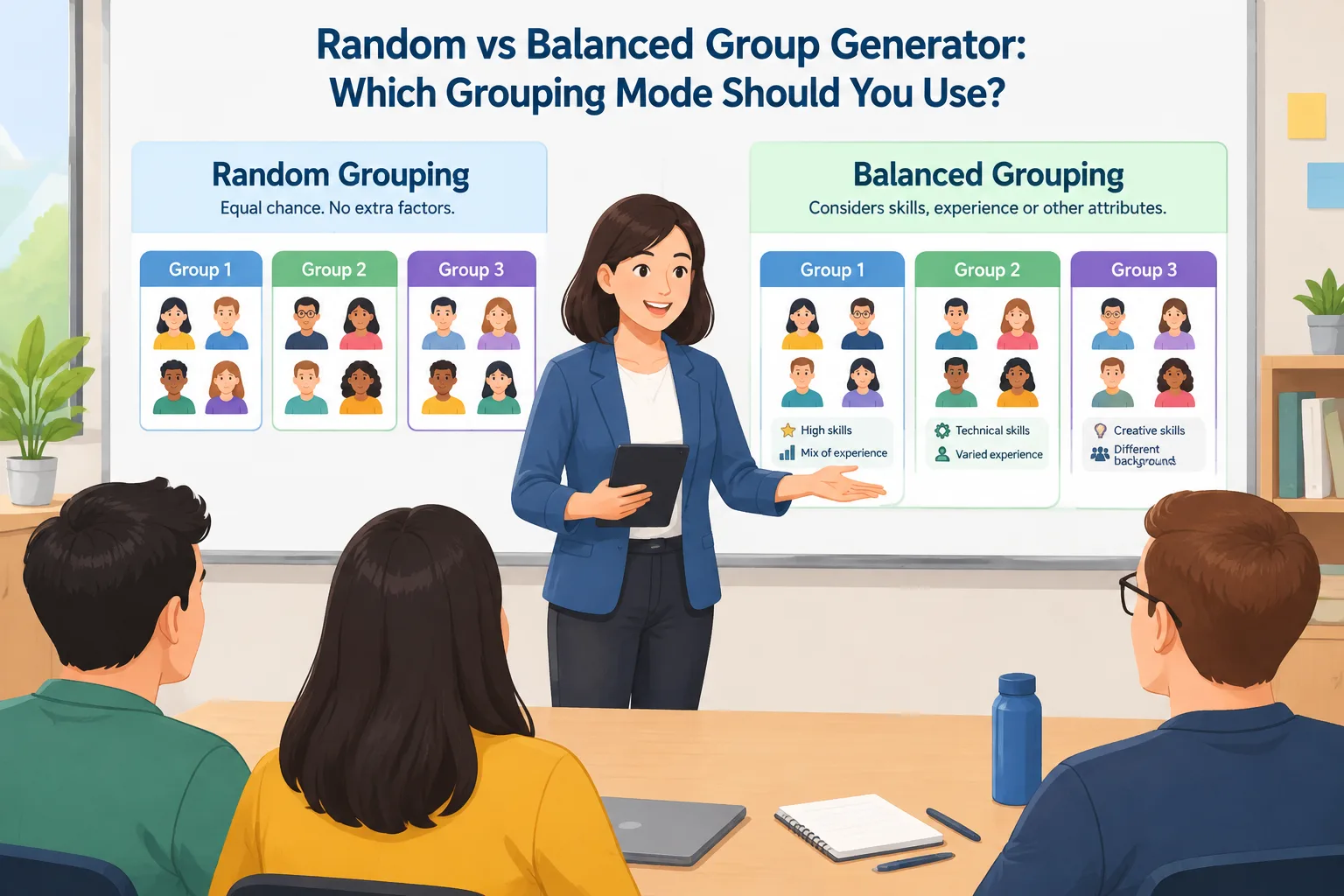
Teachers, trainers, and event facilitators often face the same challenge: how do you divide people into groups without wasting time or creating unfair teams? A random vs balanced group generator helps solve this problem by offering two different approaches. Random grouping focuses on equal chance, while balanced grouping considers factors such as skills, experience, or other attributes to create more evenly distributed teams.
Choosing the right method depends on your goal. A quick icebreaker, prize draw, or casual activity may benefit from pure randomness. A project team, classroom assignment, or competitive exercise may require a balanced group generator that spreads important characteristics across teams. Understanding the difference helps you create groups that feel fair and support better collaboration.
What a random group generator does and when it works best
A random group generator assigns participants to teams using chance rather than personal preferences or measured characteristics. This approach is useful when everyone should have the same opportunity of being selected and the group goal does not depend on a specific mix of abilities.
For example, a teacher running a five-minute discussion activity may simply need four groups of students. A corporate trainer starting a workshop may want participants to meet new colleagues without creating carefully designed teams. In these cases, randomness removes unnecessary decision-making and prevents the facilitator from appearing to favor certain people.
A pure random process is also useful for activities where fairness means equal probability. Prize drawings, classroom review games, and icebreakers often work better when nobody can predict or influence the outcome. The focus is not on creating the strongest team but on making the selection process transparent.
The underlying idea is similar to a shuffled deck of cards. A properly randomized order gives each participant a fair chance of appearing in any group position. A Fisher-Yates shuffle is a common method for creating an unbiased random order when implemented correctly.
However, randomness has limits. Equal chances do not guarantee equal results. If participants have different skills, experience levels, or roles, a random assignment can accidentally place many similar people together.
For a quick activity where attributes do not matter, use the Random Group Generator to create groups quickly and fairly.
What a balanced group generator changes
A balanced group generator uses additional information about participants to distribute selected characteristics across teams. Instead of only asking “Who should go together by chance?”, it asks “How can each group receive a fair mix of the qualities we need?”
Common balancing factors include skill levels, subject knowledge, experience, or assigned categories. Educators may want skill balanced teams for collaborative projects. Trainers may want groups with a mixture of departments or experience levels. Some activities may also use gender balanced groups when that is relevant to the learning goal and participant information is available.
Balanced grouping does not mean creating identical teams in every possible way. Real people have many different strengths, and no simple system can measure every factor. Instead, a balanced group generator focuses on the attributes that matter most for the activity.
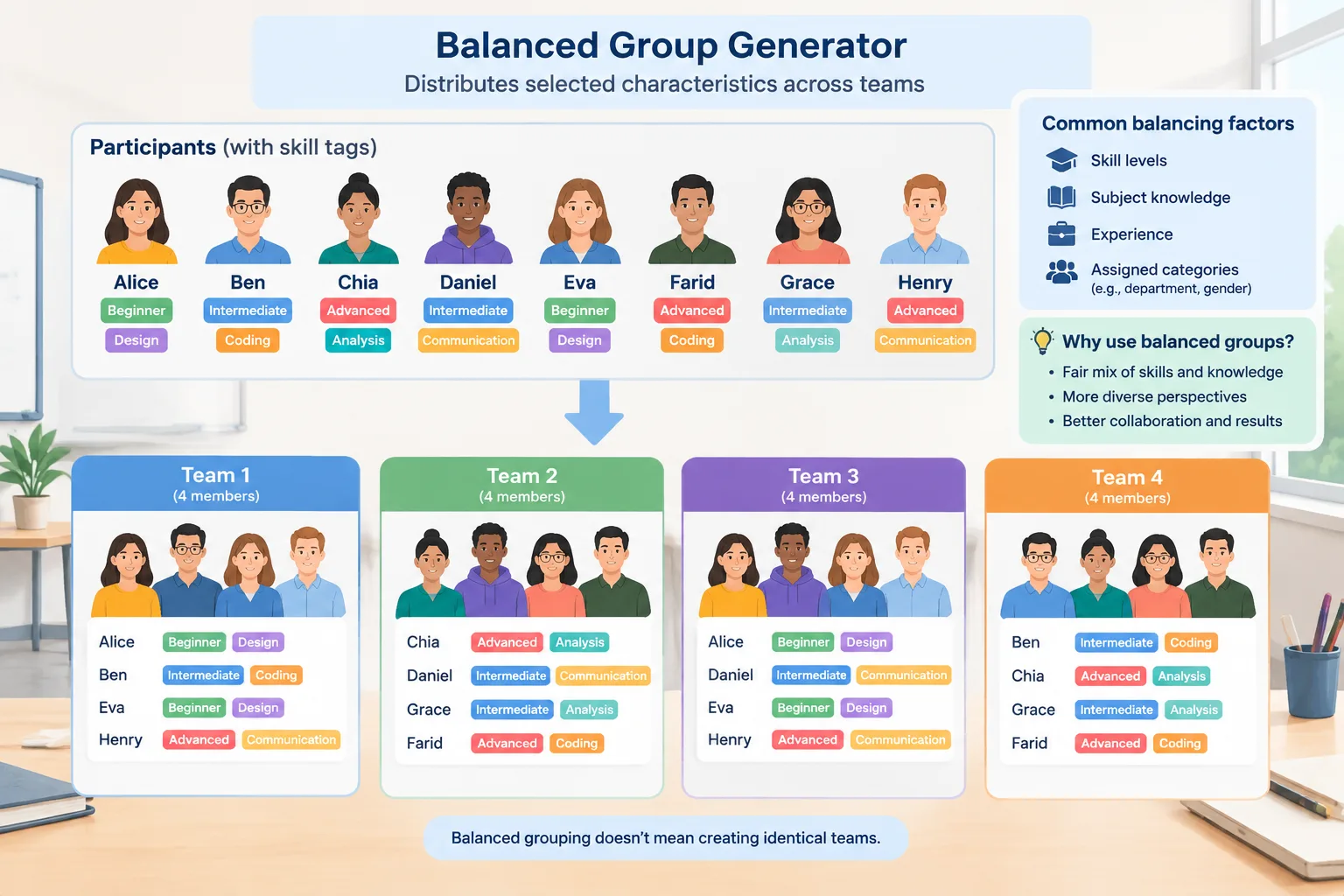
A practical example is a science classroom project with 24 students divided into four groups. If students have different experience levels, random assignment might create one group with many advanced students and another group needing more support. A balanced approach can spread experience levels so each team has a better chance of working independently.
This is also useful for professional workshops. If a facilitator creates teams for a problem-solving exercise, placing all experienced employees together may reduce learning opportunities for others. A balanced group generator can help mix perspectives.
You can also use related tools such as the Random Pair Generator when the activity requires partners instead of larger teams.
Random vs balanced grouping: the fairness difference
The main difference between random and balanced grouping is the type of fairness each method provides. Random grouping creates procedural fairness: everyone receives the same chance of being assigned anywhere. Balanced grouping creates distribution fairness: important characteristics are spread more evenly between groups.
A simulation of a 24-person roster divided into four groups of six shows this distinction clearly. In repeated pure-random draws, every participant and pair had opportunities consistent with chance. No individual was systematically favored. However, random results sometimes created concentrated groups where several participants with the same tag ended up together.
In the same study setup, pure random grouping produced at least one group with three or more participants sharing a single skill tag in 93.5% of draws. This does not mean random grouping is unfair in a general sense. It means randomness alone cannot guarantee a balanced distribution of characteristics.
A balanced mode addresses this specific issue. A tag-balanced approach distributes categories through an organized assignment method, limiting how many participants with the same tag appear in one group. This makes it useful when the composition of teams matters.
| Situation | Better choice | Reason |
|---|---|---|
| Classroom icebreaker | Random grouping | Speed and equal chance matter most |
| Long-term project teams | Balanced grouping | Skills and roles need distribution |
| Prize drawing | Random grouping | Every person should have equal odds |
| Competitive practice teams | Balanced grouping | Teams need comparable ability |
| Casual networking | Random grouping | Variety happens naturally |
The best choice is not always the most complex one. A fair team picker should match the purpose of the activity.
How to choose the right grouping mode step by step
Before creating teams, identify what fairness means for your situation. The following process helps teachers and facilitators choose between random and balanced grouping.
- Define the purpose of the groups.
Ask whether the activity needs equal opportunity or balanced performance. A discussion circle usually needs simple assignment. A graded project may require more thoughtful team design.
- Decide whether participant attributes matter.
If skills, experience, or roles affect the outcome, use a balanced group generator. If those factors are irrelevant, random grouping is usually enough.
- Select the smallest number of important criteria.
Avoid trying to balance everything at once. Too many rules can make teams complicated and may create unrealistic expectations. Choose the one or two factors that directly support the activity.
- Explain the method to participants.
Transparency builds trust. Tell students or employees whether teams were created randomly or balanced by selected criteria. People are more likely to accept group assignments when they understand the reason behind them.
- Review the results before starting.
A tool can organize assignments, but the facilitator still understands the real situation. Check whether the groups make sense for the activity and adjust only when there is a clear reason.
For example, a trainer preparing a customer service workshop may need groups with different job backgrounds. They can use balanced grouping for the main exercise, then use the group picker wheel for a later energizer where chance is the goal.
Common mistakes when creating balanced teams
One common mistake is balancing too many factors. A facilitator may try to consider skill, personality, schedule, experience, and preferences at the same time. This can make the process difficult to explain and may reduce the clarity of the final teams.
Another mistake is repeatedly rerolling random groups until preferred people appear together. Although this may feel harmless, it removes the fairness advantage of random selection. If a random method is chosen, the result should normally be accepted unless there is a practical issue.
A third mistake is assuming balanced teams guarantee success. Group performance depends on communication, clear instructions, and the quality of the activity design. A balanced group generator supports better starting conditions, but it does not replace good facilitation.
For educators who frequently assign classroom groups, combining grouping tools with student selection workflows can save preparation time. The Random Student Picker can help choose speakers or participants separately from team creation.
Real examples: choosing the best mode for different situations
In a physical education class, a teacher creating teams for a competitive activity may want balanced teams because different abilities affect the experience. Mixing skill levels can make the activity more engaging and reduce one-sided matches.
In an online training session, a facilitator may use random groups for breakout discussions because the goal is networking. The facilitator might later use balanced groups for a case study where each team needs different perspectives.
In an esports practice session, balanced grouping is usually more important because team strength directly affects the quality of practice. Creating evenly matched teams allows participants to improve through realistic competition.
For workplace gift exchanges or social activities, random selection is often the better choice because the goal is equal opportunity rather than performance. A spin wheel group generator can add a visible and engaging selection process for events.
FAQ about random vs balanced group generators
Is a random group generator fair?
Yes, when the goal is equal chance, random grouping is a fair method. It gives participants the same probability of being assigned to available groups, but it does not guarantee that every group will have the same mix of skills or characteristics.
When should I use a balanced group generator?
Use a balanced group generator when team composition affects the activity. Examples include academic projects, skill-based workshops, and competitions where different abilities should be distributed across groups.
Are gender balanced groups always necessary?
Not always. Gender balanced groups may be useful when the activity benefits from representation or when avoiding a specific imbalance is part of the goal. The facilitator should consider the purpose of the activity and handle participant information responsibly.
Can random grouping create unequal teams?
Yes. Random grouping can create uneven results by chance. It is equal in process, but the final groups may not have equal skill levels or experience.
Should I always choose balanced teams instead of random teams?
No. The best choice depends on the situation. Simple activities often work well with random groups, while structured projects usually benefit from balanced teams.
Choose the grouping method that matches your goal
Random and balanced grouping solve different problems. Random selection is valuable when equal opportunity and simplicity matter. Balanced grouping is valuable when team composition influences learning, collaboration, or competition.
When you need a fast way to create fair groups, choose the method that fits your activity and use the right tool for the job. Try the Random Group Generator to create your next set of teams with a clear and practical approach.
Related Tools
Pick the right generator for the job — every tool runs free in your browser.