
random soccer club generator
Random Soccer Club Generator: Pick a Football Club
Discover how a random soccer club generator works, explore football clubs worldwide, and create fair random club selections for games, quizzes, classroom activities, and football challenges.

Choosing a football club can be surprisingly difficult when you have hundreds of options. Perhaps you are organizing a football quiz, assigning clubs for a friendly competition, planning a classroom activity, or simply looking for a team to follow for a day. A random soccer club generator makes the decision easier by selecting a club from a prepared list instead of relying on personal preferences. You can use random selection to discover unfamiliar teams, create entertaining challenges, and make football activities more unpredictable.
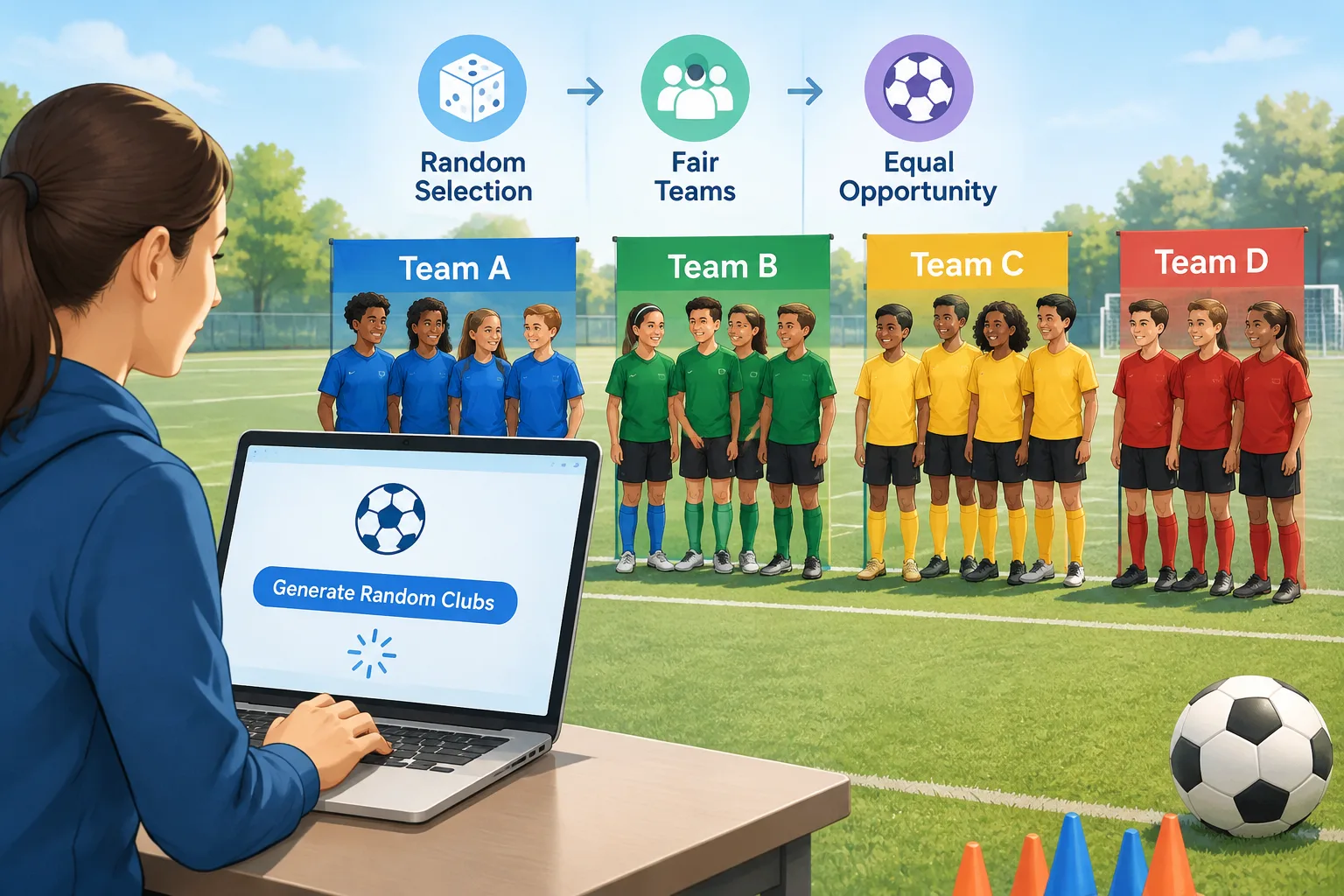
What Is a Random Soccer Club Generator?
A random soccer club generator is a selection method that chooses a football club from a list without requiring someone to make the decision manually. Instead of repeatedly debating whether to choose a famous European team, a local club, or an unfamiliar international side, you let a random selection process decide.
The basic idea is straightforward. Create a list of eligible football clubs, enter or organize the names in a selection tool, and generate a result. Depending on your activity, you can select one club, generate several clubs, or repeat the process to build a complete list of teams.
A useful random football club generator should also make it easy to define which clubs are included. For example, a list containing only English Premier League teams produces a different experience from one containing clubs across Europe, Africa, Asia, North America, and South America.
The wider football landscape offers plenty of possibilities. FIFA recognizes national member associations across six continents, while continental organizations administer their own football competitions. This makes international club selection an interesting way to explore football beyond the teams that receive the most attention. You can consult FIFA's member associations directory when building a geographically diverse list.
Why Use a Random Soccer Club Generator?
Random selection is useful whenever the goal is to make a decision quickly and consistently. Football fans often have strong preferences, and those preferences can influence which club gets selected. A random process gives every eligible entry an opportunity to be chosen, provided the selection method treats entries equally.
For teachers and trainers, this approach can turn football knowledge into an interactive learning activity. Students can receive different clubs and research their country, stadium, history, players, and competition. Corporate facilitators can use the same idea for informal team-building exercises, while event organizers can create football-themed challenges without spending time assigning teams manually.
Here are some practical situations where random club selection works well:
- Football quizzes: Assign a club to each participant and ask questions about its history or home country.
- Friendly competitions: Give participants different clubs to follow during a tournament.
- Classroom research: Ask students to investigate clubs from different continents.
- Football prediction games: Assign clubs before participants make their predictions.
- Fan challenges: Select an unfamiliar team and learn something new about it.
- Social activities: Use randomly selected clubs as conversation starters among football fans.
For example, a teacher organizing a geography lesson could give students clubs from different countries. One student might receive Ajax from the Netherlands, another Flamengo from Brazil, and another Al Ahly from Egypt. Each student researches the club and locates its country on a map. The random assignment creates a starting point for learning rather than requiring the teacher to choose every example.
How to Generate a Random Football Club
You do not need a complicated system to select a football club randomly. The most important step is preparing a suitable list. Once your choices are clearly defined, a random selection tool can handle the decision.
Follow these steps to organize your selection:
- Decide what kind of clubs you want. Choose professional clubs, local teams, international clubs, women's teams, or a combination.
- Create your club list. Add the names of all eligible teams. Check spelling and remove duplicate entries.
- Choose the number of results. Decide whether you need one club for an individual challenge or several clubs for a group activity.
- Use a random selection tool. Enter your prepared choices into a suitable randomizer and generate the result.
- Review the selection. Check that the chosen clubs meet your activity's rules and geographical requirements.
- Record or share the results. Keep a list if you are organizing a tournament, quiz, or longer activity.
For example, imagine that four friends want to choose clubs for a weekend football challenge. They prepare a list of 20 eligible clubs, enter the names into a random selection tool, and generate four results. Each friend receives a different club and follows its next match or researches its recent history.
The Random Order Generator can help when you already have a list of club names and want to arrange them in a randomized sequence. This is especially useful when you need several clubs assigned in an order rather than selecting only one winner.
Remember that the selection is only as broad as the list you provide. If your list contains only popular English teams, the generator cannot select a club from Japan or Argentina. The quality of your result depends on the quality and variety of your starting entries.
What Clubs Should You Include in Your Random Club Generator?
A balanced club list should reflect the purpose of your activity. If you are organizing a competition for dedicated football fans, you might prefer established professional clubs. If you are introducing beginners to international football, a geographically diverse selection is usually more interesting.
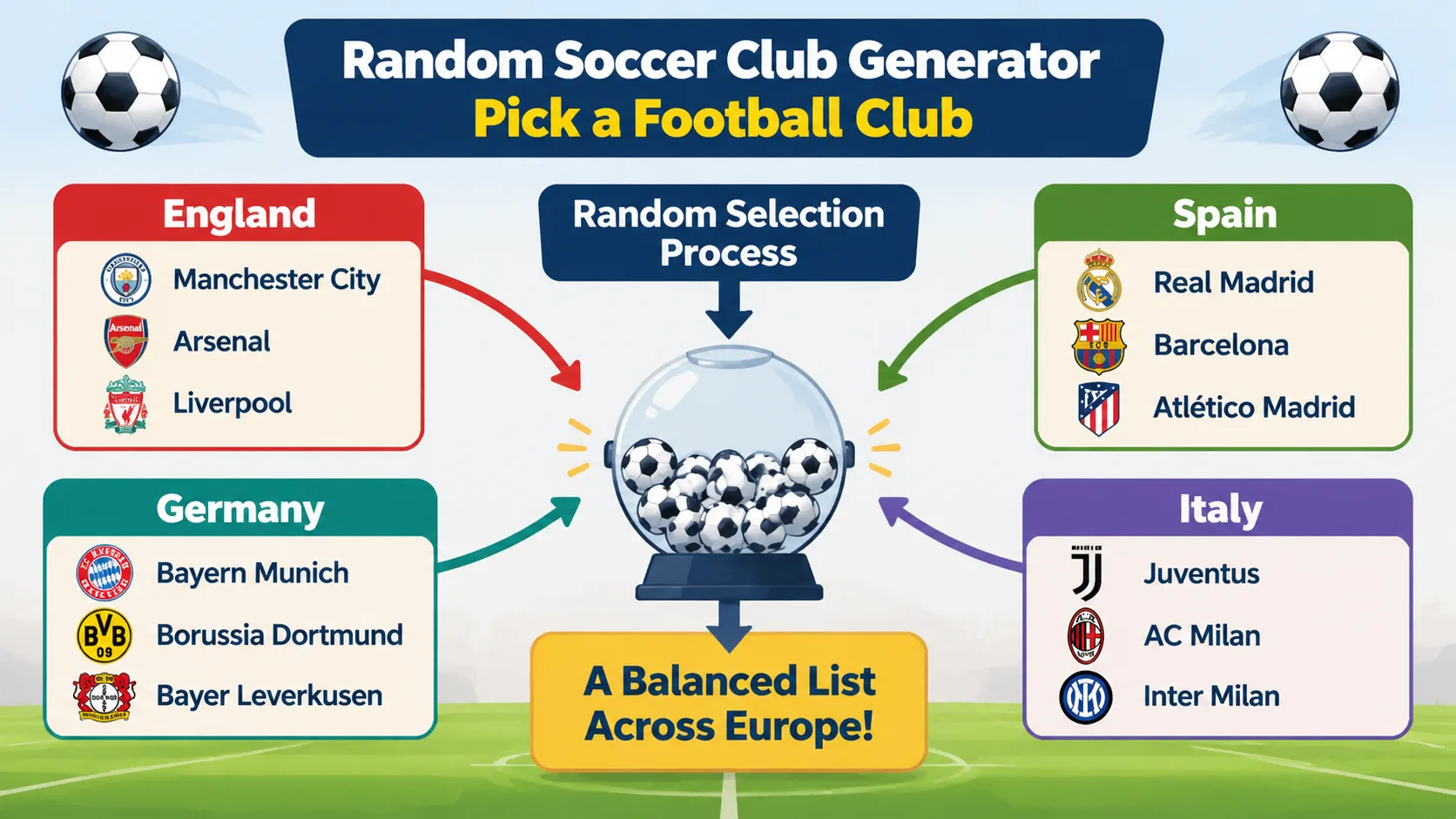
Consider organizing your choices into regional categories. This makes it easier to create themed selections and prevents a list from becoming dominated by one country or league.
Some useful categories include:
| Region | Example football clubs |
|---|---|
| England | Manchester City, Arsenal, Liverpool |
| Spain | Real Madrid, Barcelona, Atlético Madrid |
| Germany | Bayern Munich, Borussia Dortmund, Bayer Leverkusen |
| Italy | Juventus, Inter Milan, AC Milan |
| France | Paris Saint-Germain, Marseille, Lyon |
| South America | Flamengo, River Plate, Boca Juniors |
| North America | LA Galaxy, Inter Miami, Club América |
| Asia | Urawa Red Diamonds, Al Hilal, Gamba Osaka |
| Africa | Al Ahly, Wydad AC, Mamelodi Sundowns |
These examples are starting points rather than a complete or current ranking of clubs. Club participation, competition status, and team names can change, so check official competition and club websites when accuracy matters.
You can also build specialized lists. For example, a women's football activity might include clubs from the Women's Super League, Liga F, the National Women's Soccer League, and other domestic competitions. A youth activity might focus on clubs familiar to the students or teams in their local area.
Random Club Selection Ideas for Teachers and Football Fans
A random football club generator becomes more useful when you connect the result to a specific activity. Instead of treating the selected name as the end of the process, use it as the beginning of a challenge, discussion, or learning task.
1. International football research challenge
Give each student a randomly selected club. Ask them to identify its country, home stadium, domestic league, club colors, and one notable achievement. Students can present their findings in a short report or classroom presentation.
For instance, one student might receive Borussia Dortmund while another receives Urawa Red Diamonds. Their research introduces different football cultures and encourages them to compare how clubs operate in different countries.
2. Football trivia competition
Select one club for each participant or team. Prepare questions about the clubs, such as their home countries, stadiums, historical achievements, and competition appearances. Award points for correct answers and use another random selection if you need a new round.
3. Weekend club-following challenge
Participants receive a random club and learn about its next scheduled match. They can research the opponent, competition, and recent results. If you use real fixtures, check an official source because match schedules and kick-off times can change.
4. Football-themed group activities
Teachers and event organizers can assign different clubs to small groups. Each group researches its team and creates a short presentation, poster, or quiz. If you need to distribute participants into balanced teams before assigning clubs, the Random Group Generator can help organize the people first.
5. Club identity challenge
Ask participants to invent a supporter chant, design a fictional fan poster, or describe what makes their assigned club distinctive. Keep the activity focused on creativity rather than requiring detailed knowledge of professional football.
For a class of 24 students, a teacher could create six groups of four, assign each group a different club, and give everyone 15 minutes to prepare a short presentation. Each group then shares three interesting facts about its team. This combines football, geography, research, and communication skills in one manageable activity.
Random Club Generator vs. Manual Selection
You can choose football clubs manually, use a spreadsheet, or rely on a random selection tool. Each method has advantages, and the right choice depends on how many clubs you need and how important consistency is.
Manual selection is convenient when you have only a few choices and specific preferences. For example, a teacher might deliberately choose clubs from countries currently being studied in geography. However, manual selection can introduce personal bias, especially when the same person repeatedly chooses the teams.
A spreadsheet offers more control for larger projects. You can organize clubs by country, league, or competition and use a random sorting function to create an order. This approach works well when you need to maintain a reusable club database, but it requires some preparation and familiarity with spreadsheet functions.
A random selection tool is generally more convenient for quick activities. You prepare the list, generate the result, and continue with your event. It is particularly practical when participants need to see that the selection was not simply decided by the organizer.
For activities involving several participants, you can also combine different tools. Use a Random Pair Generator to create pairs, or the Random Group Generator to organize larger teams. Then assign each group a football club from your prepared list.
One important distinction is that random club selection does not automatically create balanced football teams. Selecting clubs and distributing players according to ability are different tasks. If your activity requires equal playing ability, experience, or specific positions, you will need additional information and a separate balancing process.
Tips for Making Your Random Football Club Selection Fair
Random selection is only fair when the list and selection rules are appropriate. A tool cannot correct a biased list automatically. If you include 30 clubs from one country and only two from another, the first country will naturally dominate the possible results.
Start by defining eligibility. Decide whether your list includes professional clubs only, whether women's clubs are included, and whether teams from lower divisions are eligible. Clear rules help participants understand what can be selected.
Next, consider duplicate entries. A club appearing twice has twice as many opportunities to be selected if every list entry has an equal chance. Remove duplicates unless you intentionally want to assign different weights to particular clubs.
For a more balanced international activity, you could divide clubs into regional lists and select one club from each region. This produces a different outcome from drawing all clubs from one combined list. Neither approach is automatically better; the right method depends on whether you want completely unrestricted selection or regional representation.
Finally, decide how to handle repeated results. If participants must receive different clubs, remove each selected club before generating the next result, or use a selection method that supports sampling without replacement. If repeats are allowed, keep the original list unchanged.
For example, an organizer running a five-round quiz can use the same club list for every round if repeated clubs are acceptable. If every participant must research a unique club, the organizer should track previous selections and exclude them from later draws.
Frequently Asked Questions
What is a random soccer club generator used for?
A random soccer club generator helps choose a football club from a prepared list without manual selection. It is useful for football quizzes, classroom research, fan challenges, informal competitions, and group activities. The result depends on which clubs are included in the list.
Can I generate a random football club from any country?
Yes, provided your selection list contains clubs from the countries you want to include. You can combine teams from Europe, Asia, Africa, North America, South America, and Oceania. For reliable club information, consult national football associations and official competition websites.
How do I select multiple random soccer clubs without duplicates?
Prepare a list of eligible clubs and remove each selected entry before making the next selection. Alternatively, use a random ordering tool to shuffle the complete list and take the required number of names from the beginning. This approach prevents the same list entry from appearing twice in one selection round.
Is a random football club generator suitable for classroom activities?
Yes. Teachers can use random club assignments for geography lessons, research projects, presentations, and football trivia. Give students clear research questions and allow them to explore the selected club's country, stadium, history, and competition.
Does random club selection guarantee a balanced football competition?
No. Random selection gives eligible entries an opportunity to be chosen, but it does not measure club strength, player ability, or competitive balance. If you are organizing an actual tournament, consider seeding, competition rules, and other balancing requirements separately.
Can I use a random club generator for a football quiz?
Absolutely. Assign each participant or team a club and create questions around its history, location, stadium, players, and achievements. You can generate new clubs for additional rounds to keep the activity varied.
Start Your Next Football Challenge
Choosing a football club should not take longer than the activity itself. Whether you are planning a classroom research project, organizing a friendly football challenge, or looking for an unfamiliar team to follow, random selection gives you a simple starting point.
Prepare a list that matches your interests, check that the entries are eligible, and use a randomized order to make your selection. For activities involving multiple participants, combine club assignments with group or pair creation to keep the process organized.
Ready to organize your participants? Try the free Random Group Generator to create groups, or use the Random Order Generator to shuffle your prepared football club list and start your next challenge.
Related Tools
Pick the right generator for the job — every tool runs free in your browser.