
random sampling teams
Random Sampling Teams: A Practical Guide for Organizations
Learn how random sampling teams work, when to use random team selection, and how to create fair, balanced groups for workplace projects, training, and research.

When managers organize workplace projects, training sessions, workshops, or employee research, deciding who works with whom can be surprisingly difficult. Familiar colleagues often choose each other, quieter employees may be overlooked, and managers can unintentionally favor certain individuals. Random sampling teams offer a practical way to make selection more transparent and introduce new working relationships across an organization.
Random sampling teams use a random selection process to select participants or distribute people into working groups. The approach can help organizations reduce personal bias, encourage wider participation, and make group formation easier. However, selecting a representative sample for research and randomly assigning employees to teams are two different processes. Understanding that distinction helps managers choose the right method for their goals.
What Are Random Sampling Teams?
Random sampling teams are groups formed through a selection process in which chance determines who participates or how individuals are distributed. Instead of allowing employees to select only their preferred colleagues, an organizer uses a defined pool of participants and a random method to make assignments.
The term can describe two related organizational practices. The first is random sampling, where an organization selects a subset of employees from a larger workforce to participate in a survey, interview, assessment, or research project. The second is random team assignment, where a group of available participants is divided into smaller working teams. The first determines who enters a study or activity; the second determines who works together.
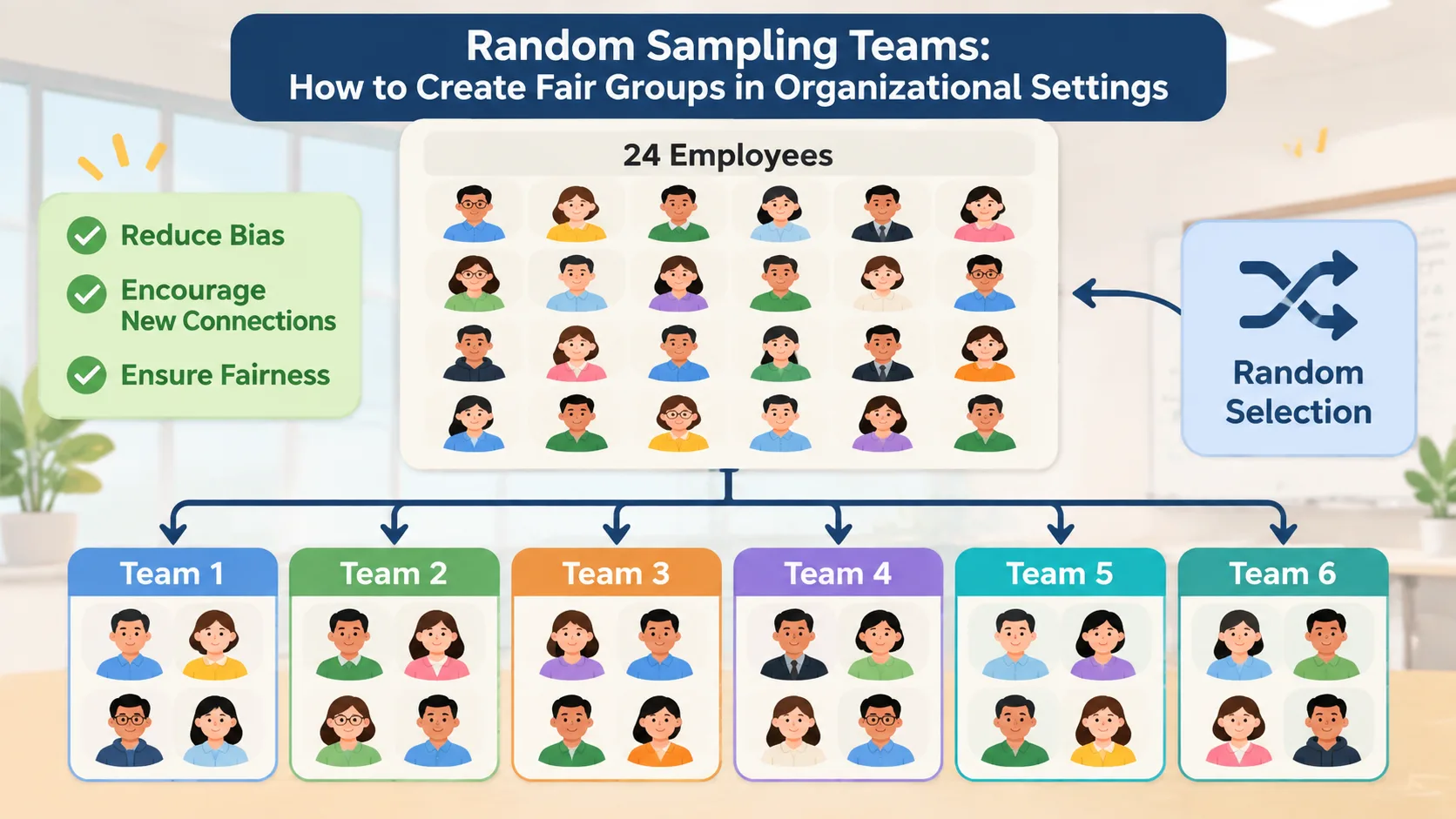
For example, a company with 120 employees might randomly select 24 people to participate in a workplace culture survey. Alternatively, a training manager might take 24 workshop participants and distribute them into six teams of four. Both processes involve random selection, but they solve different problems.
The National Institute of Standards and Technology describes random sampling as a method in which each sample has an equal chance of selection. This principle provides a useful foundation for designing transparent selection procedures. In practice, organizations should also define the eligible participant pool and the selection rules before beginning.
Why Organizations Use Random Team Selection
A common problem in workplace collaboration is that people naturally gravitate toward colleagues they already know. Although familiar relationships can make communication easier, repeatedly working with the same people may limit opportunities to exchange ideas with other departments or experience different working styles.
Random team assignment introduces an alternative. When participants do not control every group decision, employees may have opportunities to collaborate with colleagues they would not normally approach. This can be particularly useful for cross-functional workshops, professional development activities, and short-term project exercises.
Another advantage is procedural transparency. If everyone understands that the same selection rules apply, managers have a straightforward explanation for why particular people were selected. Random selection can reduce concerns about favoritism, especially when participation opportunities are limited.
Consider a company organizing a leadership development workshop. Managers want employees from different departments to participate, but personally selecting attendees could create questions about favoritism. A documented random selection process within eligible employee categories provides a clearer procedure.
Randomization does not guarantee better performance or automatically create balanced teams. Research on team formation shows that the effects of random assignment and self-selection can depend on the task and the way contributions are distributed. Organizations should therefore consider both fairness and the practical demands of the work.
Different Methods of Random Sampling Teams
There is no single random selection method suitable for every organizational situation. The right approach depends on whether the objective is to select participants, create teams, or ensure representation from different employee groups.
1. Simple Random Sampling
Simple random sampling gives eligible individuals an equal chance of being selected. It works well when the organization has a defined participant list and does not need to prioritize particular characteristics.
For example, a company wants 15 employees to test a new internal training program. The HR coordinator creates a list of all eligible employees, assigns each person a number, and uses a random number generator to select 15 participants.
This method is relatively straightforward and easy to explain. However, a small random sample may not include employees from every department, location, or experience level. Equal selection chances do not guarantee that every subgroup will appear in the final sample.
2. Stratified Random Sampling
Stratified random sampling divides a population into relevant subgroups before selecting people randomly within each subgroup. These categories might include departments, office locations, job levels, or employment types.
Imagine an organization with employees across four departments. The company wants a research group that includes participants from each department. Rather than selecting everyone from one combined list, the HR team separates the employee list into four departmental groups and randomly selects participants from each one.
This approach is useful when representation matters. It can help prevent smaller departments from being missed simply because they contain fewer employees. The organization must decide how many people to select from each category and whether selection should be proportional to the size of each group.
The US Environmental Protection Agency explains how stratified sampling uses prior information to divide a population into groups before selecting samples independently. The same general principle can help organizations plan employee participation more deliberately.
3. Random Assignment to Teams
Random assignment distributes available participants into smaller groups rather than selecting a sample from a larger population. It is especially useful for workshops, training exercises, brainstorming sessions, and temporary project teams.
For example, a facilitator has 32 participants and needs eight teams of four. Each participant is entered once into the selection process, and the assignment method distributes all 32 people into eight groups.
This method is easy to understand and reduces the need for managers to make subjective pairing decisions. It is also useful when participants should have similar opportunities to collaborate with different colleagues over several activities.
4. Random Pairing
Some activities work better with pairs than larger teams. Random pairing uses the same general selection principle but creates groups of two.
A corporate trainer might use random pairs for peer feedback, short interviews, communication exercises, or mentoring discussions. Changing pairs between sessions can help employees interact beyond their usual professional circles.
For activities that require two-person assignments, a dedicated Random Pair Generator can simplify the process.
How to Create Random Sampling Teams Step by Step
A successful random selection process starts before anyone is assigned. Organizers should establish the objective, define who is eligible, and decide whether the final result needs equal-sized groups or representation across specific categories.
Follow these steps to create a practical and transparent process.
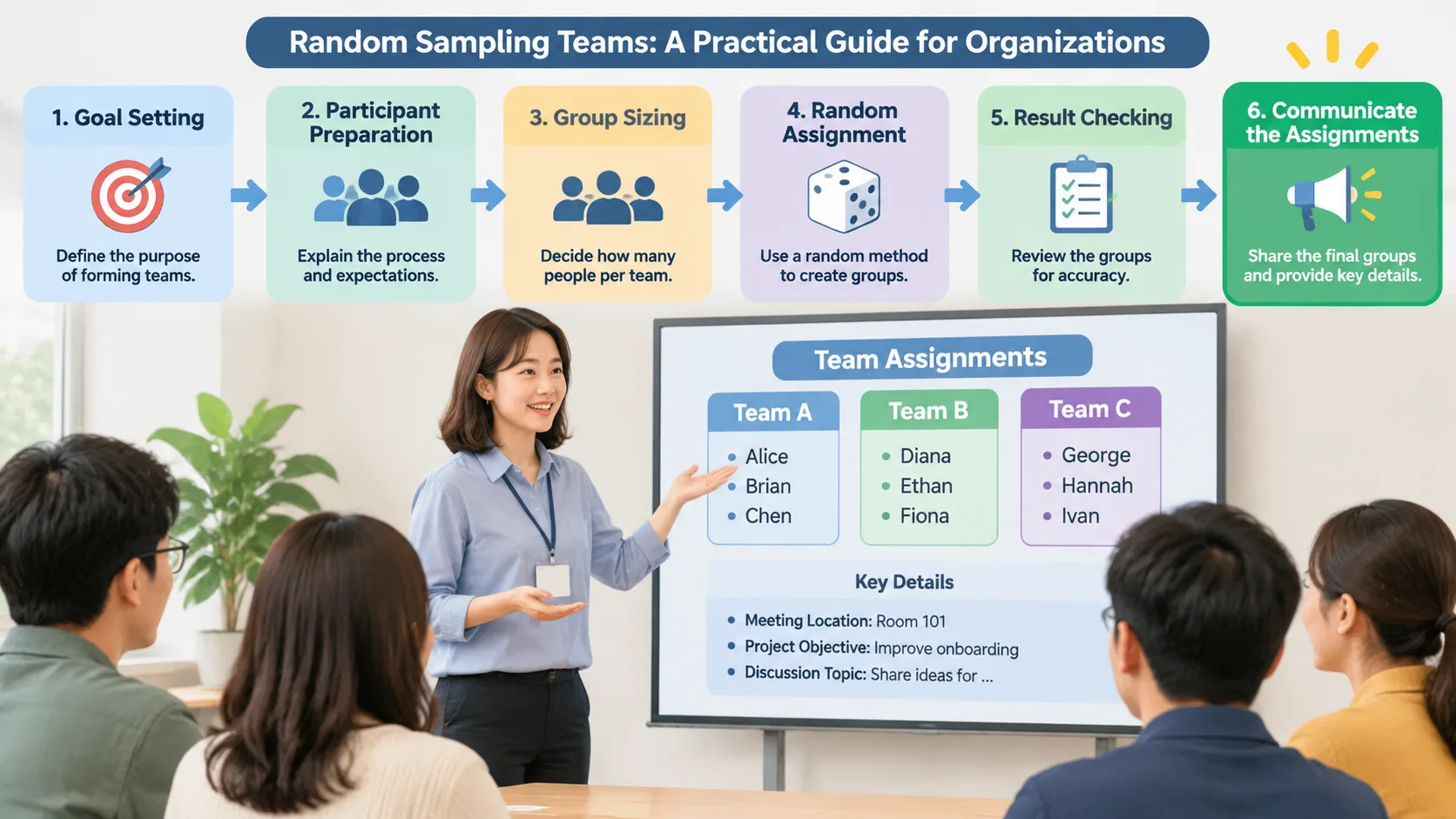
Step 1: Define the Purpose
Start by deciding what the organization wants to achieve. Is the goal to select employees for a survey, create workshop groups, distribute project responsibilities, or encourage cross-department collaboration?
The purpose determines the method. A research survey may require a representative sample, while a training activity may simply need equally sized teams. These goals should not be treated as interchangeable.
Step 2: Prepare the Participant List
Create a complete list of eligible participants. Check for duplicate names, outdated employee records, and individuals who cannot attend the activity.
If the organization is selecting a sample, the list should cover the intended population as accurately as possible. If the organizer is creating teams from workshop attendees, include only confirmed participants.
For example, a facilitator preparing a session for 28 employees should verify the attendance list before generating seven groups of four. Otherwise, last-minute changes could leave a group incomplete.
Step 3: Decide on Group Size
Determine how many people each group should contain. Smaller groups generally make it easier for every participant to contribute during a short discussion, while larger groups can accommodate activities that require several different responsibilities.
Divide the participant count by the desired group size. If the numbers do not divide evenly, decide whether one or more groups should have an additional participant or whether the total number of groups should change.
For instance, 29 participants could form seven groups of four and one group of five. Alternatively, the organizer might create six groups and distribute the extra participants more evenly. The appropriate choice depends on the activity.
Step 4: Choose the Randomization Method
Select a method that fits the requirements. A simple random generator works for general team assignments, while a stratified process is more appropriate when departments or other categories must be represented.
For a basic workshop, a digital Random Group Generator can distribute a participant list into groups without requiring the organizer to assign every individual manually.
Step 5: Generate and Review the Results
Run the selection process and check the output. Confirm that everyone appears exactly once when all participants must be assigned, that group sizes match the agreed rules, and that no eligible person has been accidentally excluded.
Reviewing the results is not the same as changing assignments to favor particular people. If an important constraint has been missed, document the reason for an adjustment and apply the same rule consistently.
Step 6: Communicate the Assignments
Share the final groups through an appropriate communication channel. Explain the purpose of random selection and provide any relevant instructions, such as meeting locations, project objectives, or discussion topics.
A short explanation can prevent confusion. For example, a facilitator might say that groups were generated randomly to give everyone an opportunity to work with different colleagues during the workshop.
Real-World Examples of Random Sampling Teams
Random sampling teams can support different organizational activities. The method should change according to the situation rather than being applied identically to every task.
Employee Training Workshops
A company runs a communication workshop for 40 employees from several departments. The facilitator wants participants to exchange perspectives instead of remaining with familiar coworkers.
The organizer prepares a list of all 40 attendees and uses a random group generator to create eight teams of five. Each group receives the same discussion question and a fixed amount of time to prepare its response.
The facilitator can repeat the process for a later activity to create new working relationships. This is particularly useful when the objective is broad participation rather than producing a permanent project structure.
Employee Feedback and Research
An HR department wants feedback about a new flexible working policy. Interviewing every employee may be impractical, so the team needs a smaller participant sample.
The organization first identifies the employee population covered by the policy. It then divides employees into relevant categories, such as department or location, and randomly selects participants within those categories.
This approach helps the research team include different parts of the organization. However, the sample size, response rate, selection process, and possible nonresponse bias still matter when interpreting the findings. Random selection alone does not guarantee that respondents will represent every employee's views.
Cross-Functional Project Activities
A facilitator organizing an innovation session wants employees from finance, marketing, operations, and customer support to collaborate.
The organizer can use a stratified approach to ensure that the participant pool includes people from each department, followed by random assignment into working teams. This combines representation requirements with random group formation.
For example, each team might receive a different customer experience problem to solve. Participants can contribute knowledge from their own departments while learning how other functions approach the same challenge.
These examples demonstrate an important principle: randomization provides a selection process, while the organizer still needs to define the activity, participation requirements, and desired team structure.
How to Balance Fairness and Team Composition
Random assignment and balanced team composition are related but different goals. Random selection treats eligible participants according to defined chance-based rules. Balanced grouping may also require consideration of skills, experience, roles, or other characteristics.
A completely random process can produce uneven results. One team might contain several experienced employees while another includes mostly new starters. Another team might have multiple people with the same technical specialty, leaving a different group without that expertise.
Organizations can address these concerns by using a structured approach. First, identify which characteristics genuinely matter for the task. Next, establish appropriate categories or constraints. Finally, randomize within those boundaries rather than making unrestricted manual assignments.
For example, a company running a technical problem-solving exercise might want each team to include someone familiar with the software being tested. The facilitator could first organize participants by relevant experience and then use a random process to distribute people within those categories.
However, not every characteristic should become a selection rule. Personal information should only be used when necessary, appropriate, and consistent with organizational policies. Avoid collecting sensitive employee data simply to make groups appear balanced.
It is also important to distinguish temporary learning activities from high-stakes operational assignments. A random group generator is useful for a workshop, but permanent teams responsible for critical business functions may require a more detailed assessment of expertise, responsibilities, availability, and accountability.
Random Assignment vs. Self-Selected Teams
Managers often need to decide whether participants should choose their own groups or receive randomly assigned teams. Both approaches have advantages, and neither is universally suitable.
Self-selection allows people to work with colleagues they trust or whose skills they already understand. This can be helpful for complex projects where participants need strong coordination from the beginning. However, it may also reinforce existing workplace networks and leave some employees without preferred partners.
Random assignment offers a more consistent selection procedure and can create opportunities for new interactions. Research published in Experimental Economics examines how the relative performance of randomly assigned and self-selected teams depends on task characteristics. Its findings highlight why organizations should avoid assuming that one team formation method always produces better outcomes.
A practical comparison can help managers make the decision:
| Consideration | Random assignment | Self-selection |
|---|---|---|
| Selection process | Determined by chance | Determined by participants |
| Familiar working relationships | Less predictable | More likely |
| Opportunity for new connections | Often greater | May be more limited |
| Organizer involvement | Requires a defined random process | Requires coordination and oversight |
| Suitable activities | Workshops, rotations, short exercises | Established projects and specialist collaboration |
| Main limitation | May produce uneven skill distribution | May reinforce existing social groups |
For a short training exercise, random assignment is often a practical starting point. For a complex project with strict technical requirements, intentional team formation may be more appropriate.
Common Mistakes to Avoid
Even a straightforward randomization process can create problems when the organizer overlooks important details.
One common mistake is confusing a random sample with random team assignment. Selecting 20 employees from a workforce of 200 is not the same as distributing all 20 employees into five groups. The first selects participants; the second organizes them.
Another mistake is assuming that random means automatically representative. A small random sample can still contain an uneven number of people from different departments. If subgroup representation matters, consider stratified sampling and define the selection proportions in advance.
Organizers should also avoid repeatedly regenerating teams simply because they dislike the outcome. Doing so introduces personal judgment into a process intended to be random. If a result violates a genuine requirement, identify the issue and use a documented adjustment rule.
Finally, do not ignore practical constraints. Participants may have scheduling conflicts, accessibility requirements, role restrictions, or legitimate reasons they cannot complete a particular assignment. Randomization should support an effective process, not override reasonable operational needs.
A reliable approach combines clear rules, accurate participant information, appropriate randomization, and a final administrative review.
Frequently Asked Questions
What Are Random Sampling Teams Used For?
Random sampling teams can be used to select employees for workplace research, create groups for training, organize workshop activities, and distribute participants across temporary projects. The appropriate method depends on whether the organization needs a representative sample or simply wants to form random working groups.
Are Random Sampling Teams Fairer Than Manually Selected Teams?
Random selection can make the selection procedure more transparent because participants are chosen according to predefined rules rather than personal preference. However, fairness also depends on eligibility criteria, group size, accessibility, and whether relevant representation requirements are considered. Randomization is a useful fairness mechanism, not a guarantee that every outcome will be equally suitable.
How Many People Should Be in Each Random Team?
There is no universal ideal team size. Four or five participants can be a practical starting point for many discussion-based workshops, while larger or smaller groups may suit different activities. Consider the task, available time, and how much individual participation is expected before deciding.
Can Random Sampling Teams Include Employees From Different Departments?
Yes. Organizations can create a participant pool containing employees from multiple departments and randomly distribute them into teams. If every team must include particular departments, use a stratified or constrained assignment approach rather than relying entirely on unrestricted randomization.
What Is the Difference Between Random Sampling and Random Assignment?
Random sampling selects individuals from a larger population to participate in a study or activity. Random assignment distributes participants among different teams, conditions, or activities. Sampling determines who is included, while assignment determines where selected participants are placed.
Can a Random Group Generator Create Workplace Teams?
Yes. A random group generator can help organizers distribute a participant list into smaller groups without manually assigning every person. It is particularly useful for workshops, training exercises, and temporary collaboration activities. For specialized projects requiring specific skills or qualifications, organizers should establish those requirements before generating assignments.
Make Workplace Group Formation Simpler
Creating effective organizational teams does not need to involve lengthy discussions about who should work with whom. A clear participant list, an appropriate randomization method, and consistent selection rules can make group formation easier to explain and manage.
Whether you are organizing an employee workshop, facilitating a training session, or creating cross-department discussion groups, random assignment can provide a practical starting point. Consider your objectives, account for essential constraints, and review the results before sharing them with participants.
Ready to organize your next workplace activity? Try the Random Group Generator to divide participants into groups quickly and create a more transparent team formation process.
Related Tools
Pick the right generator for the job — every tool runs free in your browser.