
random group tournament bracket
Random Group Tournament Bracket: How to Create Fair Teams and Tournament Draws
Learn how to create a random group tournament bracket, divide participants fairly, choose a tournament format, and organize matches for schools, sports, and events.

Organizing a tournament sounds simple until you have to divide participants into teams, decide who plays whom, and build a schedule that everyone understands. Whether you are planning a school sports day, a classroom competition, a gaming event, or a workplace challenge, a random group tournament bracket can help you organize the competition without manually assigning every participant. The key is to separate the process into two parts: creating fair groups and deciding how those groups advance through the tournament.
A good tournament setup gives participants clear expectations, reduces unnecessary arguments about matchups, and makes the organizer's job easier. This guide explains how to create random tournament groups, choose the right bracket format, handle uneven participant numbers, and turn the results into an organized competition.
What Is a Random Group Tournament Bracket?
A random group tournament bracket combines random participant assignments with a structured competition format. Instead of allowing an organizer to choose every team or matchup manually, participants are distributed using a random selection process. The resulting groups or teams then compete according to predefined tournament rules.
There are two related ideas worth understanding. Random group generation determines which participants belong together. Tournament bracket generation determines which teams compete against one another and how winners progress. These processes can work together, but they are not interchangeable. A random team assignment does not automatically create a complete tournament schedule, and a bracket does not necessarily randomize the original participants.
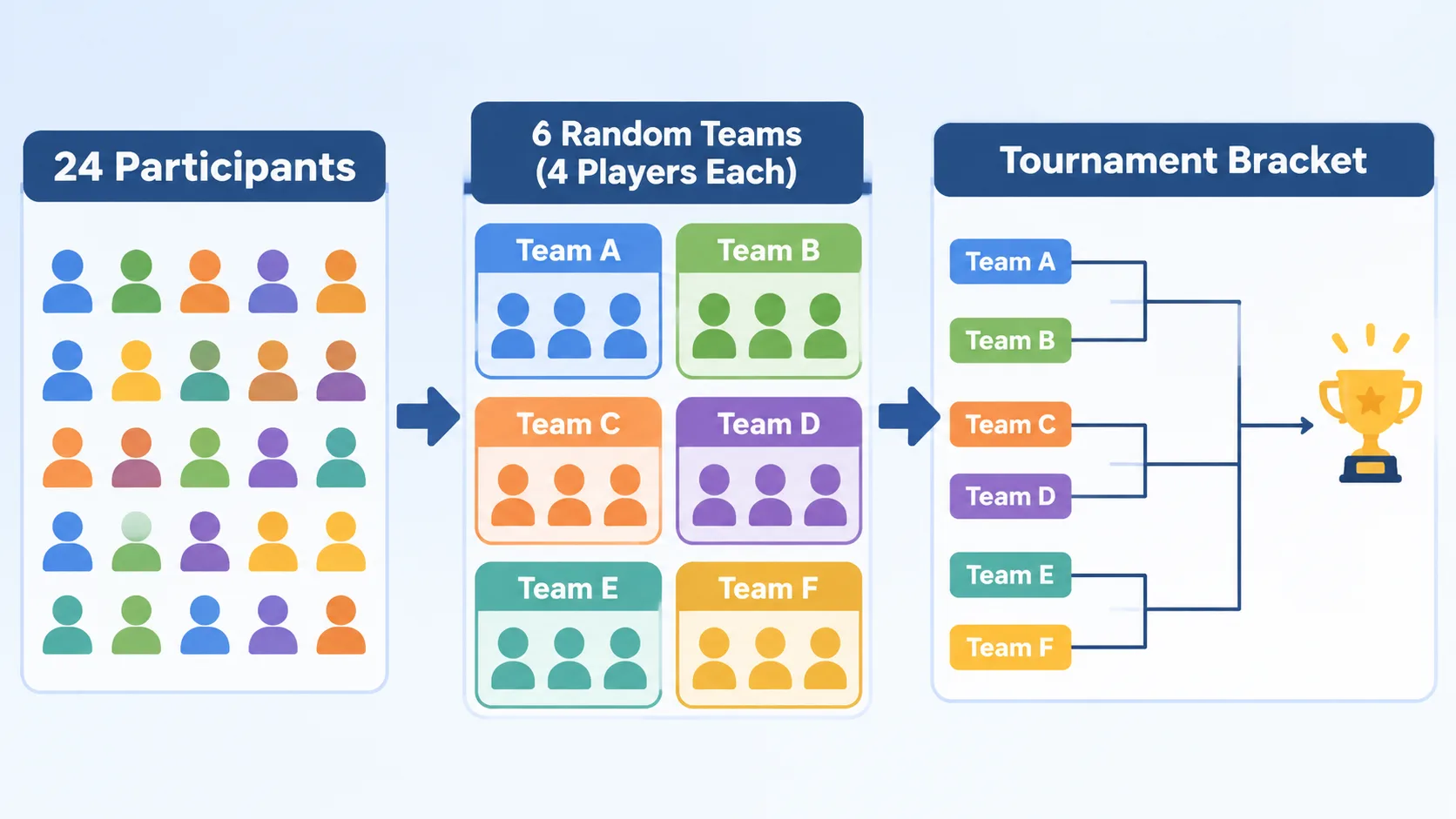
For example, imagine a teacher organizing a classroom basketball tournament with 24 students. The teacher could divide the class into six teams of four using a random group generator. Those six teams could then compete in a group stage before the leading teams enter a knockout bracket.
This approach is also useful for corporate training activities, recreational leagues, gaming competitions, and community events. Whenever organizers need an impartial starting arrangement, randomization can provide a practical alternative to assigning participants by hand.
Why Use Random Groups Before a Tournament?
Manually assigning tournament teams can create problems, even when organizers have good intentions. Participants may believe that certain people received easier opponents, that friends were deliberately grouped together, or that the organizer favored particular competitors. These concerns can distract from the actual event.
A random group tournament bracket provides a transparent starting point. When participants understand that everyone entered the same selection process, it becomes easier to explain how the initial teams were formed. Random assignment also saves time when the participant list is large or changes shortly before the competition.
However, random does not automatically mean competitively balanced. A completely random draw might place several experienced players in one group and beginners in another. For a casual classroom activity, that may be acceptable. For a serious competition, organizers should consider skill-based seeding or another balancing method before finalizing the draw.
Consider a workplace trivia competition with 32 employees. Manually choosing eight teams of four could take time and create questions about favoritism. Random assignment provides a straightforward starting point, while a facilitator can separately check whether teams need adjustments for accessibility or participation requirements.
The best approach depends on the event's purpose. If the goal is social interaction, unrestricted randomization may be ideal. If the goal is identifying the strongest competitor, randomization may need to be combined with published seeding rules.
How to Create a Random Group Tournament Bracket
You do not need complicated tournament software to get started. A clear participant list, a suitable grouping method, and a written set of competition rules are enough for many small events.
Follow these steps to create a practical tournament arrangement.
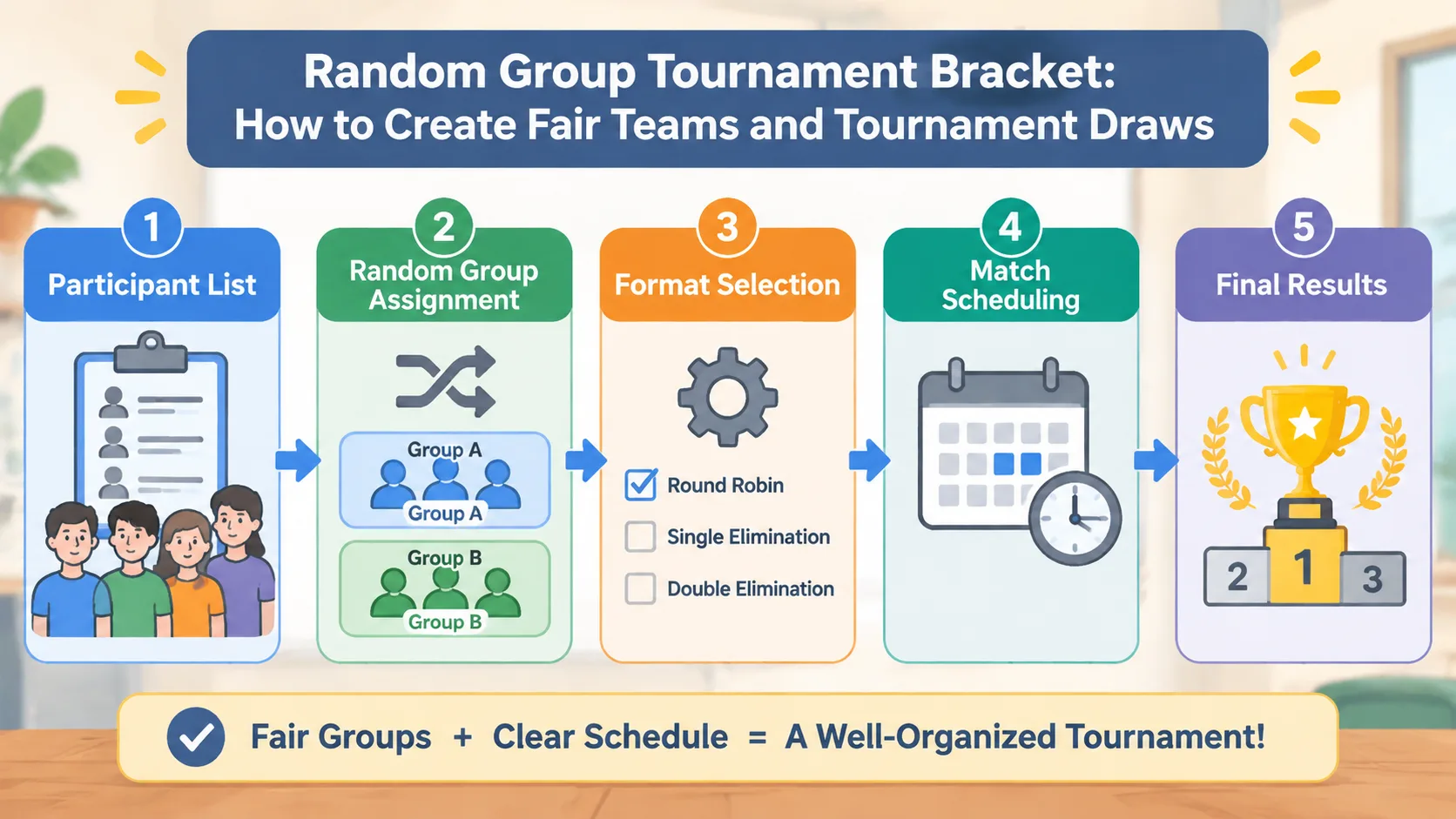
Step 1: Prepare the participant list
Collect the names of every player, student, team representative, or competitor who will participate. Remove duplicate entries and confirm that everyone has registered. If people are competing in pairs or established teams, decide whether the random draw should assign individuals or keep existing partnerships together.
For example, a teacher organizing a volleyball tournament might collect 28 student names. Before generating groups, the teacher should confirm attendance and decide whether students will compete individually or in teams.
Step 2: Decide how many groups you need
Choose the number of teams and the number of participants per team. Your decision should reflect the available space, event duration, match rules, and number of organizers.
Suppose you have 24 participants and want teams of four. You need six groups. If you have 25 participants, you must decide whether to create one larger group, use a different team size, or leave one participant as a substitute. Do not make this decision after the tournament has started.
Step 3: Randomize the assignments
Enter the participant names into a Random Group Generator. Set the desired number of groups or participants per group, depending on the available options, and generate the assignments.
Review the results to make sure every participant appears once and that the group sizes match your plan. If you need two-person teams instead, the Random Pair Generator is a useful alternative.
Step 4: Choose your tournament format
Decide whether teams will compete in a knockout bracket, double-elimination competition, round-robin stage, or group-stage playoff. The best option depends on how many matches participants should receive and how much time you have available.
Write down the rules before announcing the draw. Include scoring, match duration, tie-break procedures, advancement criteria, and any rules about substitutions.
Step 5: Build and publish the match schedule
Create the matchups and assign time slots, playing areas, or online rooms. Make sure participants know where to go and how results will be reported.
For a six-team event, for instance, you might schedule two groups of three, followed by semifinals and a final. Publish the group assignments and the advancement rules together so participants can understand the complete competition.
Which Tournament Format Should You Choose?
The format determines how participants compete after the initial random assignment. There is no single best option for every event. Consider the number of teams, available match time, and whether participants should receive another opportunity after losing.
Single-elimination tournament
In single elimination, a team leaves the competition after one loss. Winners progress through successive rounds until one champion remains. This format is easy to explain and works well when organizers have limited time or facilities.
For example, an eight-team school competition requires seven matches to determine a champion, assuming no additional placement games. However, losing teams do not receive another chance to advance. This may be disappointing when participants have traveled or prepared extensively for the event.
Double-elimination tournament
Double elimination gives each team an opportunity to lose once without being immediately eliminated. A second loss removes the team from the competition. This format can feel more forgiving, but it requires additional matches and more detailed scheduling.
It is useful for gaming tournaments, recreational sports, and events where participants expect more than one opportunity to compete. Organizers should explain how the winners' bracket and losers' bracket work before the first match.
Round-robin tournament
In a round-robin format, every participant or team in a group plays against every other member of that group. Final standings are determined using the agreed scoring and tie-break rules.
This works particularly well for smaller groups. For example, four teams in a classroom competition can each play three matches. Everyone gets comparable opportunities to compete, although the schedule requires more matches than a simple knockout.
Group stage followed by knockout
This combined format is often a practical choice for larger events. Participants are divided into smaller groups, compete within those groups, and then the leading teams advance to a knockout bracket.
Imagine a 16-team tournament with four groups of four. Each team plays the other three teams in its group. The top two teams from each group advance to an eight-team knockout bracket. This creates a competition with a group stage and a clear championship pathway.
Before the event begins, decide how many teams advance and how ties will be resolved. Do not assume that participants will understand the qualification rules automatically.
| Format | Best suited for | Main consideration |
|---|---|---|
| Single elimination | Short competitions | One loss means elimination |
| Double elimination | Competitive events | More matches and scheduling work |
| Round robin | Small groups | Everyone plays everyone |
| Groups plus knockout | Larger mixed-format events | Advancement rules must be clear |
How to Handle Uneven Team Numbers and Tournament Byes
One of the most common tournament planning problems occurs when the number of teams does not fit a standard bracket. Knockout brackets are easiest to arrange when the number of competitors is a power of two, such as four, eight, or sixteen. Other numbers require additional planning.
A bye is an advancement to the next round without playing a match in the current round. It allows an uneven field to fit a larger bracket. For example, a 12-team single-elimination tournament can use a 16-team bracket structure, with four teams receiving first-round byes.
Although byes are a normal tournament feature, organizers should explain how they are assigned. Randomly allocating byes may be appropriate for an informal event. In a seeded competition, byes are often assigned according to the published seeding policy instead.
Consider a community table tennis event with 11 registered teams. The organizer could place the teams into a 16-slot knockout structure and arrange the necessary byes. Alternatively, the organizer could use smaller round-robin groups before the knockout stage. The second option may provide more playing opportunities but requires additional scheduling.
Use these practical checks when the numbers are uneven:
- Count the confirmed teams rather than relying on initial registrations.
- Calculate how many bracket positions are needed.
- Decide whether byes, substitutes, or unequal group sizes are appropriate.
- Publish the bye allocation and advancement rules.
- Check that no team receives an unexplained scheduling advantage.
The goal is not to force every tournament into an identical structure. It is to choose a format that participants can understand and that the available facilities can support.
How to Make Random Tournament Groups Fairer
Random assignment creates an impartial starting draw, but organizers should think about fairness throughout the competition. In particular, the difference between a random draw and a balanced competition should be clear to participants.
If participants have very different experience levels, consider using a seeding process. For example, a school chess tournament could divide students into experience categories before drawing groups. A workplace sports event might consider previous team experience when designing its initial pools.
There is also a difference between fairness and identical outcomes. Random groups can have slightly different sizes when the participant total does not divide evenly. This is not necessarily a problem, provided the rules account for the difference. For example, organizers can use points per match rather than total points when teams play different numbers of games.
Use the following practices to improve transparency:
- Explain whether assignments are completely random or include skill-based seeding.
- Confirm the participant list before generating the final groups.
- Avoid changing group assignments after seeing the results unless there is a clear administrative reason.
- Publish tie-break and advancement rules before the competition.
- Keep a record of the final draw and match results.
- Provide a clear process for reporting mistakes or missing participants.
For a serious tournament, it is also important to have a person responsible for confirming match results and resolving disputes. A random group generator handles participant distribution, not the full responsibility of tournament administration.
Real-World Examples of Random Group Tournament Brackets
Different organizers can use the same basic process while adapting the tournament format to their needs.
School sports competition
A physical education teacher has 24 students and wants to organize a short football tournament. The teacher creates six random teams of four and divides them into two groups of three. Each team plays the other teams in its group. The leading teams advance to the semifinals, followed by a final.
The teacher publishes the group assignments, match times, and tie-break rules before the first game. This makes the event easier to manage and gives every team several opportunities to play.
Corporate team-building event
An HR facilitator has 40 employees attending a company event. Instead of allowing colleagues to choose their own teammates, the facilitator uses random assignments to create eight teams of five. The teams compete in a series of short challenges, with points recorded on a shared scoreboard.
A round-robin or points-based format may be more appropriate than elimination because the goal is participation and interaction rather than removing teams after one loss.
Online gaming competition
A gaming organizer has 16 teams and needs a straightforward championship format. Participants are assigned to the tournament groups, and the organizer chooses either a direct knockout or group-stage qualification depending on the event schedule.
For online events, match links and reporting instructions should be shared before each round. The organizer should also establish how disconnects, incomplete matches, and disputed results will be handled.
These examples show why the initial random draw and the tournament format should be planned together. The same group assignments can support very different competition experiences depending on the rules that follow.
Random Group Generator vs. Manual Tournament Assignments
Organizers can create groups using spreadsheets, paper slips, or dedicated online tools. Each method can work, but the right choice depends on the size of the event and how often assignments change.
Paper draws are useful for small events where participants enjoy watching names being selected. However, they become harder to manage when the participant list is long or the organizer needs to make several different group arrangements.
Spreadsheets provide more control over participant information and schedules. They are especially useful when organizers need custom scoring tables or detailed match records. However, creating and checking random assignments manually can require extra work.
A dedicated Random Group Generator offers a simpler starting point for distributing participants. Organizers can then use a spreadsheet or tournament management system for more advanced scheduling, score tracking, and standings.
For two-person competitions, a Random Pair Generator can help create initial partnerships. If an event also needs a random participant selection for demonstrations or individual activities, the Random Student Picker serves a different purpose.
The important distinction is that group assignment tools and tournament management systems solve related but separate problems. Choose the tool that handles your immediate task, and do not assume a group generator automatically manages match results or championship progression.
Frequently Asked Questions
What is a random group tournament bracket?
A random group tournament bracket combines randomly assigned participants or teams with an organized competition structure. Participants are first distributed into groups or matchups, then compete according to rules such as round robin, single elimination, or group-stage qualification.
How do I create a random tournament bracket for 16 teams?
Start by confirming all 16 teams and deciding whether you want direct elimination or a group stage. For direct elimination, place the teams into an eight-match opening round, followed by quarterfinals, semifinals, and a final. For a group-stage competition, create four groups of four and decide how many teams will advance.
Can I create a fair tournament with an uneven number of teams?
Yes. You can use byes in a knockout bracket or create groups with slightly different sizes. Make sure you publish the rules for advancement, scoring, and tie-breaks before the competition begins.
Is random group assignment better than seeding?
Neither method is automatically better. Random assignment is useful when everyone should have an equal chance of receiving any initial matchup. Seeding is more appropriate when organizers want to account for known skill differences or previous performance. Some tournaments combine both methods.
Can I use a random group generator for school and workplace tournaments?
Yes. Random group generation is useful for classroom games, school sports, training activities, office competitions, and community events. The organizer should choose group sizes and competition rules that fit the participants, available time, and purpose of the event.
Does a random group generator automatically create tournament matches?
Not necessarily. A group generator distributes participants into teams or groups, while a tournament bracket determines matchups and advancement. You may need a separate bracket or scheduling tool to organize matches, record scores, and identify the winner.
Create Your Tournament Groups and Get Started
A successful tournament begins with a clear participant list, a suitable competition format, and transparent rules. Random assignments can make the initial grouping process easier, while a carefully planned bracket gives everyone a clear path through the event.
Whether you are organizing a classroom competition, a company activity, a recreational sports event, or an online gaming tournament, start by deciding how many teams you need and how participants should advance. Then use the Random Group Generator to create your groups and prepare your tournament schedule. A little planning before the first match can make the entire competition easier to run.
Related Tools
Pick the right generator for the job — every tool runs free in your browser.