
random group generator language learning
Random Group Generator for Language Learning: Build Better Pairs
Learn how to use a random group generator for language learning to create balanced pairs, encourage speaking practice, rotate partners, and improve classroom interaction.
You have planned a speaking activity, prepared conversation prompts, and given your students time to review vocabulary. But when it is time to choose partners, the same students sit together again. Some learners rarely speak with anyone outside their usual circle, while others feel uncomfortable approaching unfamiliar classmates. A random group generator for language learning offers a practical way to create fresh partnerships, organize speaking exercises, and give everyone opportunities to communicate with different people.
Whether you teach English as a second language, a foreign language, or a multilingual classroom, changing partners can make everyday activities more varied. Instead of spending valuable lesson time organizing pairs manually, you can generate groups in seconds and focus on what matters: meaningful communication and active language practice.
Why Use Random Grouping in Language Learning?
Language learning involves more than remembering vocabulary and understanding grammar rules. Students also need opportunities to express ideas, ask questions, listen carefully, and respond to other people. These skills develop through meaningful interaction, making pair and small-group activities useful parts of a language lesson.
The British Council's guidance on pair and group work highlights practical advantages such as giving learners more speaking time, helping them interact with different classmates, and allowing teachers to monitor conversations. These benefits are particularly relevant when a class contains students with different confidence levels and communication styles.
However, students do not always choose partners who challenge them to use new language. Friends may naturally fall into familiar conversations, while quieter learners can become overlooked during partner selection. Random grouping introduces variety without requiring the teacher to negotiate every pairing.
A random group generator for language learning can help teachers:
- Introduce new conversation partners regularly.
- Avoid relying on the same self-selected pairs.
- Organize speaking activities without lengthy classroom transitions.
- Give students opportunities to hear different speaking styles and perspectives.
- Create small teams for collaborative vocabulary, reading, and writing tasks.
- Make partner selection more transparent.
For example, an English teacher with 24 intermediate learners can create 12 pairs for a five-minute conversation exercise. During the next lesson, the teacher can generate new partnerships rather than asking students to sit with their usual friends.
Random selection does not automatically create equal language proficiency or guarantee productive conversations. Teachers still need to choose suitable activities, provide clear instructions, and monitor participation. The generator handles the organization; the teacher remains responsible for the learning experience.
How to Use a Random Group Generator for Language Learning
You do not need a complicated classroom routine to introduce random partnerships. A simple grouping process works for most language classes, whether students are learning English, Spanish, French, German, Japanese, or another language.
Follow these steps to organize your next activity:
- Prepare your student list. Write down the names of everyone participating. Check attendance first so absent learners are not included in the activity.
- Open the grouping tool. Visit the Random Group Generator and prepare your participant list.
- Choose your group arrangement. Decide whether students should work in pairs or larger teams. For conversation practice, pairs are often a useful starting point.
- Generate the groups. Use the tool to create a random arrangement and review the results.
- Display or share the assignments. Give students clear instructions about where to move and what their task involves.
- Start the activity. Set a reasonable time limit and encourage everyone to use the target language.
- Review and regroup. After the activity, collect feedback and generate new partnerships for another exercise if appropriate.
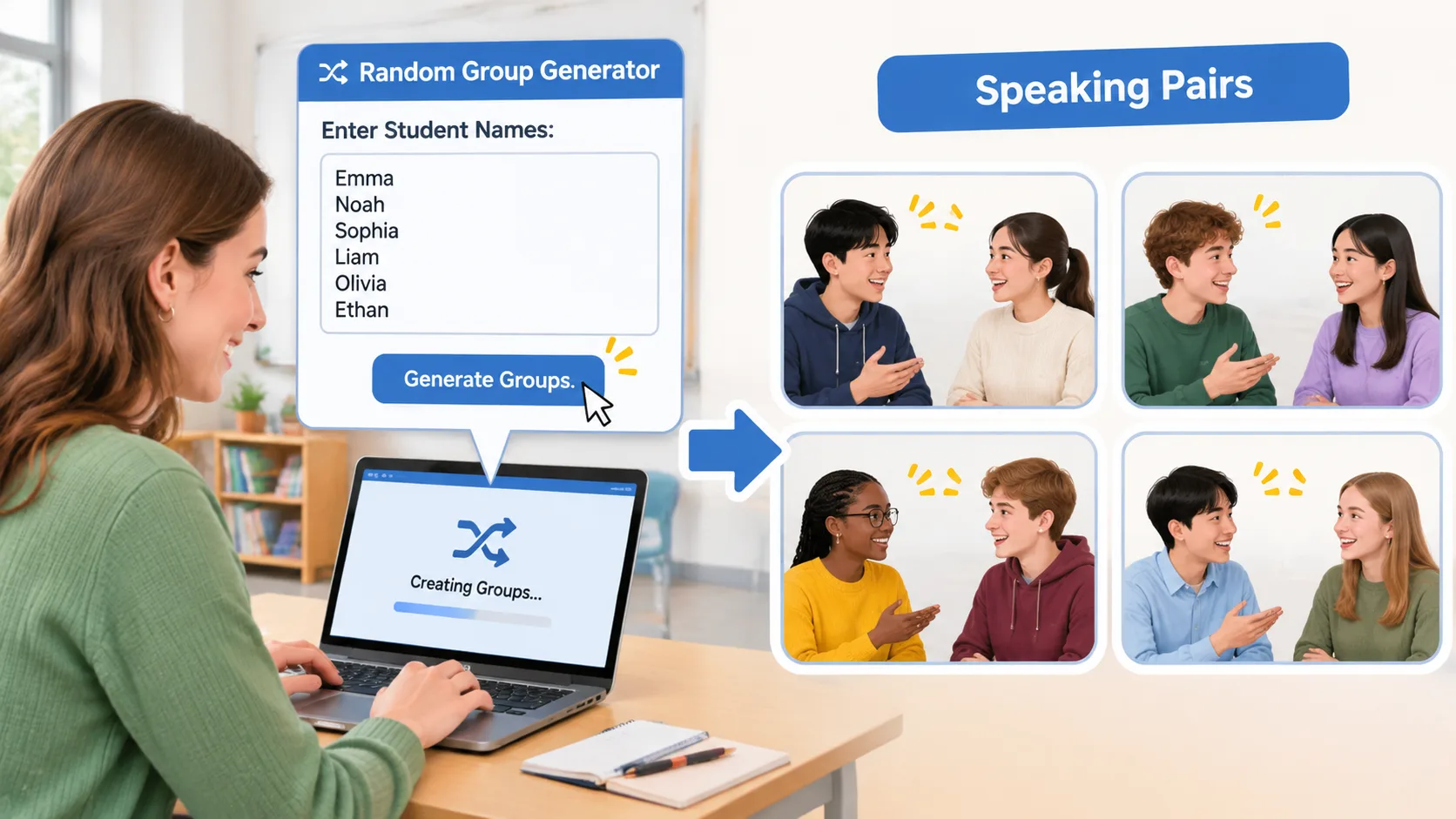
Consider a class of 20 Spanish learners preparing for an oral assessment. The teacher wants students to practice introducing themselves and asking about hobbies. After generating 10 pairs, each student receives a conversation prompt. They practice for four minutes, switch speaking roles, and then discuss which expressions they found useful.
The same process can be repeated in the next lesson with different partners. Students get another opportunity to practice familiar expressions while responding to a new conversation partner.
Five Language Learning Activities That Work Well With Random Groups
A new group arrangement becomes valuable when it supports a clear communication goal. Rather than grouping students simply to keep them busy, connect each arrangement to a specific language skill.
Here are five practical activities that teachers can introduce with randomly generated pairs or teams.
1. Conversation Question Exchange
Prepare cards containing open-ended questions related to the current topic. Students work in pairs, taking turns asking questions and developing their answers.
For an intermediate English class, prompts might include:
- What would you change about your hometown?
- Which skill would you like to learn and why?
- What is something you enjoyed doing as a child?
Give each pair a few minutes to discuss each question. Encourage follow-up questions such as "Why do you think that?" and "Can you give an example?" This helps students move beyond short, memorized answers.
2. Vocabulary Explanation Challenge
Divide students into groups of three or four. Give each team a collection of vocabulary words from the current unit. Students take turns explaining a word without using the word itself.
For example, a student might describe "umbrella" as something people use when it rains. Other team members must identify the correct word. This activity encourages paraphrasing, listening, and active vocabulary recall.
3. Information Gap Conversations
Give each student a different worksheet containing incomplete information. Their goal is to ask their partners questions and exchange missing details without showing each other their sheets.
A French class could use two different daily schedules. One student knows the morning activities, while the other has the afternoon information. They must communicate to complete a shared timetable.
This activity is especially useful because students have a genuine reason to ask questions, clarify information, and confirm what they hear.
4. Collaborative Storytelling
Create groups of three or four and give each team a story prompt. One student begins the story, the next adds a new event, and another introduces a problem or unexpected development.
For example, a Japanese language class might receive the opening prompt: "You arrive at a train station in a city you have never visited." Each student adds two or three sentences before passing the story to the next person.
Students practice sequencing, descriptive vocabulary, verb forms, and listening to the contributions of others.
5. Debate and Opinion Sharing
Use randomly generated teams for short, low-pressure discussions. Choose accessible topics such as online learning, school uniforms, travel, or environmental habits.
Give students time to prepare their opinions before beginning. Assign a speaker, a questioner, and a note-taker when working in larger groups. Rotate responsibilities so that different students practice different communication skills.
The American Council on the Teaching of Foreign Languages (ACTFL) recommends communicative tasks that involve exchanging information, expressing opinions, and supporting ideas through interpersonal communication. These activities provide practical ways to put that principle into classroom practice.
Choosing Between Random Pairs and Larger Groups
Not every language activity requires the same group size. A useful approach is to select the arrangement according to the amount of speaking time each learner needs and the complexity of the task.
Pairs are particularly helpful for activities where every student needs to speak regularly. Examples include pronunciation practice, question-and-answer exercises, role-play conversations, and listening checks. With only two participants, students have fewer opportunities to remain silent while someone else completes the task.
Groups of three or four are often more suitable for collaborative projects, discussions, vocabulary games, and problem-solving activities. Larger teams can provide different perspectives, but teachers should establish clear responsibilities to prevent one confident speaker from doing all the work.
Here is a practical comparison:
| Activity | Suggested arrangement | Main language focus |
|---|---|---|
| Pronunciation practice | Pairs | Speaking and listening |
| Interview questions | Pairs | Question formation |
| Vocabulary guessing | Groups of 3–4 | Vocabulary and paraphrasing |
| Storytelling | Groups of 3–4 | Fluency and sequencing |
| Opinion discussions | Groups of 3–4 | Expressing and supporting ideas |
| Role-play | Pairs | Everyday communication |
| Information gap | Pairs | Asking and clarifying questions |
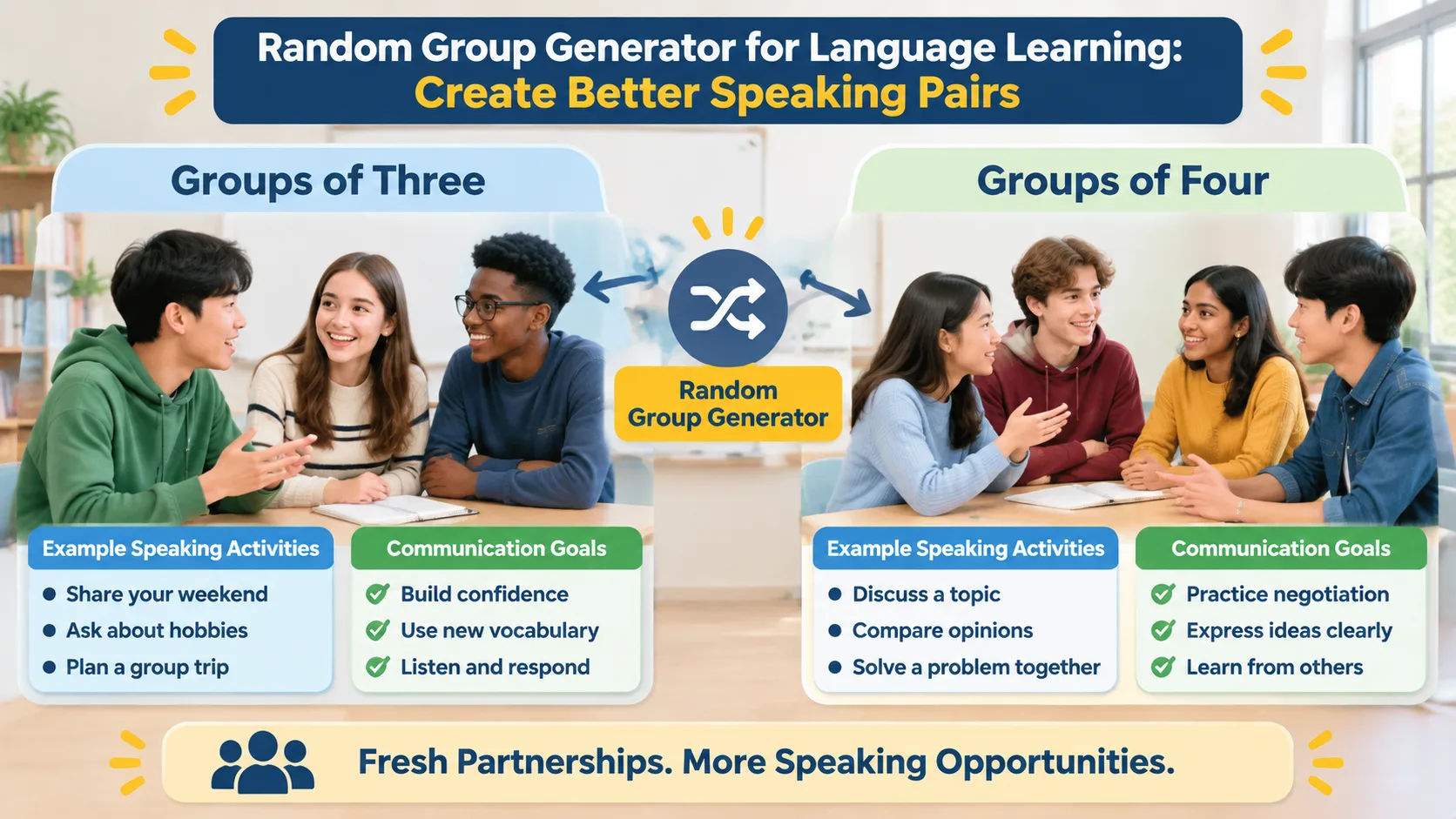
If your class has an odd number of students, you may need one group of three when organizing pairs. This is not necessarily a disadvantage. One student can observe and record useful expressions while the other two practice, then everyone rotates roles.
For example, a class of 25 English learners could work in 11 pairs and one group of three. The teacher can ask the third student to monitor useful vocabulary during the first round and then rotate responsibilities in the next exercise.
How to Make Random Groups More Balanced and Inclusive
Random selection creates variety, but it does not always produce the ideal learning arrangement. A class might have beginners, intermediate learners, and advanced speakers. Some students may also need additional time to prepare their responses or feel comfortable speaking in front of others.
Start by identifying the purpose of the activity. If students are practicing basic greetings, random partnerships can work well without extensive preparation. If they are preparing for a challenging debate, you may want to consider proficiency levels and communication needs before deciding how to organize the class.
These practical strategies can help:
- Change partners regularly. Avoid allowing students to work with the same classmates for every speaking exercise.
- Use clear instructions. Demonstrate the task before generating groups, especially when students are unfamiliar with the activity.
- Give preparation time. Beginners may benefit from reviewing vocabulary or writing down a few useful expressions before speaking.
- Rotate responsibilities. In groups, assign different roles such as speaker, questioner, recorder, and timekeeper.
- Monitor participation. Move around the classroom and notice whether everyone has an opportunity to contribute.
- Provide feedback. Discuss successful expressions and common communication difficulties after the activity.
For example, a teacher working with mixed-level German learners might provide sentence starters such as "Ich denke, dass..." and "Was meinst du?" before a group discussion. Randomly assigned partners then have language support that makes participation more manageable.
There are also situations where fully random grouping is not appropriate. Students with specific accessibility requirements, sensitive interpersonal conflicts, or highly specialized learning needs may require teacher-directed arrangements. A random group generator should support professional judgment rather than replace it.
Make Partner Rotation Part of Your Language Lesson
One of the most useful ways to introduce random grouping is to make it a regular classroom routine. Students quickly become familiar with the process when partner changes happen at predictable points during a lesson.
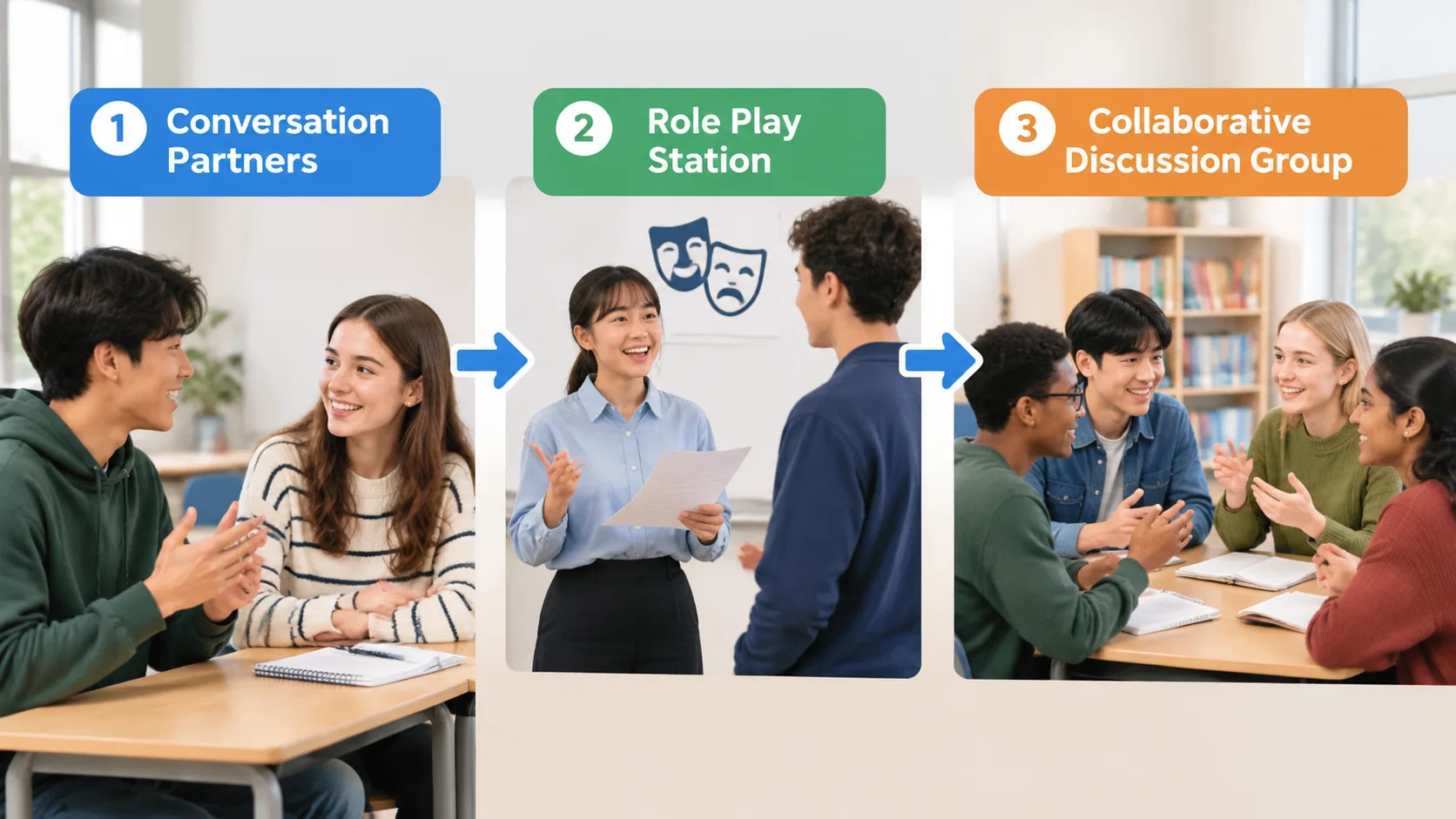
For example, an English lesson about travel could include three rounds of practice. Students first discuss their favorite destinations with one partner. Next, they join a new partner to role-play booking a hotel. Finally, they work in groups of four to plan a weekend itinerary.
Each round has a different communication objective, but the overall topic stays consistent. This helps students reuse vocabulary in new situations instead of treating each conversation as an isolated exercise.
Teachers can also combine grouping with other classroom tools. The Random Pair Generator is useful when the activity specifically requires two-person partnerships. For choosing one student to demonstrate a conversation or answer a question, the Random Student Picker provides a separate selection workflow. If teams need memorable labels, the Group Name Generator can provide creative names for collaborative activities.
For online language classes, teachers can use the same planning approach. Prepare participant names, create pairs or teams, and communicate the assignments before sending learners into breakout rooms. For corporate language training, the process can also help participants practice professional conversations with colleagues outside their usual working relationships.
Remember that a grouping tool does not automatically create Zoom, Teams, or Google Classroom meetings. Check the available sharing and platform features in your actual workflow, and arrange breakout rooms separately when necessary.
Frequently Asked Questions
1. Is a random group generator useful for language learning?
Yes. It helps teachers organize new partnerships and small teams without selecting every student manually. It is particularly useful for speaking exercises, vocabulary games, interviews, and collaborative tasks. The quality of the learning experience still depends on the activity and the teacher's instructions.
2. Should language learners work in pairs or groups?
It depends on the learning objective. Pairs are useful when every learner needs regular speaking practice, while groups of three or four can support discussions, collaborative storytelling, and problem-solving. Both arrangements can be effective when students have clear responsibilities.
3. How often should teachers change language learning partners?
There is no universal schedule. Some teachers change partners during every lesson, while others keep groups together for longer projects. A practical starting point is to introduce new partners for each major speaking activity and observe whether the changes improve participation.
4. Can beginners use random groups for speaking practice?
Absolutely. Beginners can work with randomly selected partners when the task includes simple vocabulary, sentence starters, and clear examples. Short conversations about greetings, hobbies, family, and daily routines are suitable starting points. Teachers should provide enough preparation time to help learners participate comfortably.
5. What happens when a class has an odd number of students?
You can create one group of three while keeping the remaining students in pairs. The third student can take an observer or vocabulary recorder role before rotating into the conversation. This approach allows everyone to participate without excluding anyone.
6. Does random grouping guarantee balanced language proficiency?
No. Random selection distributes students without necessarily considering proficiency, confidence, or individual learning needs. If an activity requires a particular mix of abilities, teachers should review the generated arrangement and make adjustments where appropriate.
Create Your Next Language Learning Groups
Better language practice starts with opportunities to communicate. Giving students different partners can introduce new conversations, encourage them to listen to unfamiliar speaking styles, and make routine classroom activities more engaging.
A random group generator for language learning makes the organizational part easier, leaving teachers with more time to prepare useful prompts, monitor conversations, and provide meaningful feedback. Start with a short speaking activity, observe how students respond, and adjust your grouping approach as the class develops.
Ready to organize your next conversation activity? Try the free Random Group Generator to create student groups, introduce new partnerships, and bring more variety to your language lessons.
Related Tools
Pick the right generator for the job — every tool runs free in your browser.