
random picker party games
Random Picker Party Games: Easy Ideas for Any Group
Learn how to use a random picker for party games, choose participants fairly, create exciting challenges, and keep guests engaged with simple activities.

You have invited everyone, prepared the snacks, and planned a few activities. Then comes the difficult question: who goes first? Choosing players for party games can take longer than expected, especially when several guests want a turn or nobody wants to volunteer. Random picker party games offer a simple way to make these decisions. Instead of asking people to choose themselves or selecting participants manually, you can use a random picker to select players, assign challenges, and organize activities. Whether you are hosting a birthday party, a family gathering, a school celebration, or a workplace event, a little randomness can make participation easier and more enjoyable.
1. Why Use a Random Picker for Party Games?
Traditional party games often depend on someone volunteering, drawing names from a bowl, or taking turns around a room. These approaches can work, but they sometimes create awkward pauses. A quiet guest may never volunteer, while an enthusiastic participant may end up playing several times before everyone else gets involved.
A random picker provides a straightforward alternative. You enter the names of eligible participants and let the tool make a selection. Everyone follows the same process, so the host does not have to make individual decisions. This can be especially helpful when guests do not know one another well or when a group includes different ages and personalities.
Another advantage is flexibility. A random selection can determine who answers a question, performs a challenge, chooses the next song, or starts a team activity. You can also use separate lists for different rounds. For example, a family party might have one list for children and another for adults when the activities require different abilities.
The important point is that randomness supports participation; it does not replace good hosting. You should still explain the rules, make activities optional where appropriate, and ensure that every challenge is suitable for the people attending.
2. How to Set Up Random Picker Party Games
You do not need complicated equipment or a long list of rules. A participant list, a few prepared activities, and a random selection tool are usually enough to get started.

Follow these steps to prepare your game:
- Choose the activity. Decide whether you are selecting individual players, creating teams, assigning questions, or choosing challenges.
- Prepare the participant list. Write down the names of everyone who wants to participate. Check spelling and remove duplicate entries.
- Set participation rules. Decide whether a selected person can be selected again or whether each participant gets one turn before anyone repeats.
- Open a random picker. Use the Random Group Generator for group selection or a suitable random selection method for individual turns.
- Explain the process. Tell guests how names will be selected and what happens after someone is chosen.
- Run the activity. Make the selection, announce the result, and give the participant time to respond.
- Continue until the round ends. Update the participant list if necessary and repeat the process.
For example, imagine you are organizing a birthday party with 12 guests. You prepare a list of names and create a collection of 12 lighthearted challenges. Each round, the picker selects a participant, and that person chooses or receives a challenge. If you want everyone to participate once, remove each selected name from the eligible list until the first round is complete.
Before starting, decide how to handle guests who prefer to pass. Allowing a person to skip a challenge without embarrassment makes the activity more comfortable for mixed groups.
3. Five Fun Random Picker Party Games to Try
The best activities are easy to explain and do not require extensive preparation. Random selection works particularly well when you want to keep the order unpredictable or give everyone an opportunity to participate.
Name Picker Challenge
Add every participating guest to a name list. Select one person at a time and give them a simple challenge, such as naming three favorite movies, describing an imaginary holiday, or answering a funny question.
This activity works well at birthdays, family gatherings, and informal celebrations. For a group of 15 people, you can prepare 15 questions in advance and give each selected participant one question. If you want everyone to answer before repeating a name, remove selected participants from the active list.
Random Dance Challenge
Prepare a list of short, optional dance prompts. Examples include dancing like a robot, inventing a two-step movement, or performing a slow-motion dance. Use a random picker to choose who gets the next prompt.
This activity can work at school celebrations, youth events, and family parties. Keep the movements accessible and let participants choose another activity if they do not want to dance. The aim is shared entertainment, not putting anyone under pressure.
Mystery Question Game
Create a list of conversation questions and use random selection to choose who answers next. Questions might include: What fictional place would you visit? Which skill would you like to learn? What food could you eat every week?
This is especially useful when guests are meeting for the first time. Instead of relying on spontaneous conversation, the picker provides a simple starting point. Participants can also choose to pass on questions they do not want to answer.
Guess Who or What?
Prepare a list of familiar objects, animals, fictional characters, or everyday activities. Randomly select one item for a player to describe without naming it. Other guests try to guess the answer.
For example, if the selected item is a bicycle, the player might describe its wheels, pedals, and typical uses. You can make the game easier for children by choosing familiar objects and harder for adults by using more unusual topics.
Random Team Challenge
Some activities are more enjoyable when guests work together. Instead of selecting one player at a time, use a group generator to divide participants into small teams. Give each team the same puzzle, creative task, or timed building challenge.
For example, a gathering with 16 guests could be divided into four groups of four. Each group receives the same materials and has a limited amount of time to complete a simple creative task. This format gives guests a reason to collaborate rather than compete individually.
4. Choosing the Right Random Picker for Your Party
Not every activity needs the same selection method. Choosing a tool based on the game format can save time and prevent confusion once the party begins.
A name picker is suitable when you need one participant for a question, challenge, or individual turn. A group generator is more appropriate when you want to divide a larger guest list into balanced teams. A pair generator is useful for partner activities, while a wheel-style picker can make individual selections more visible and entertaining.
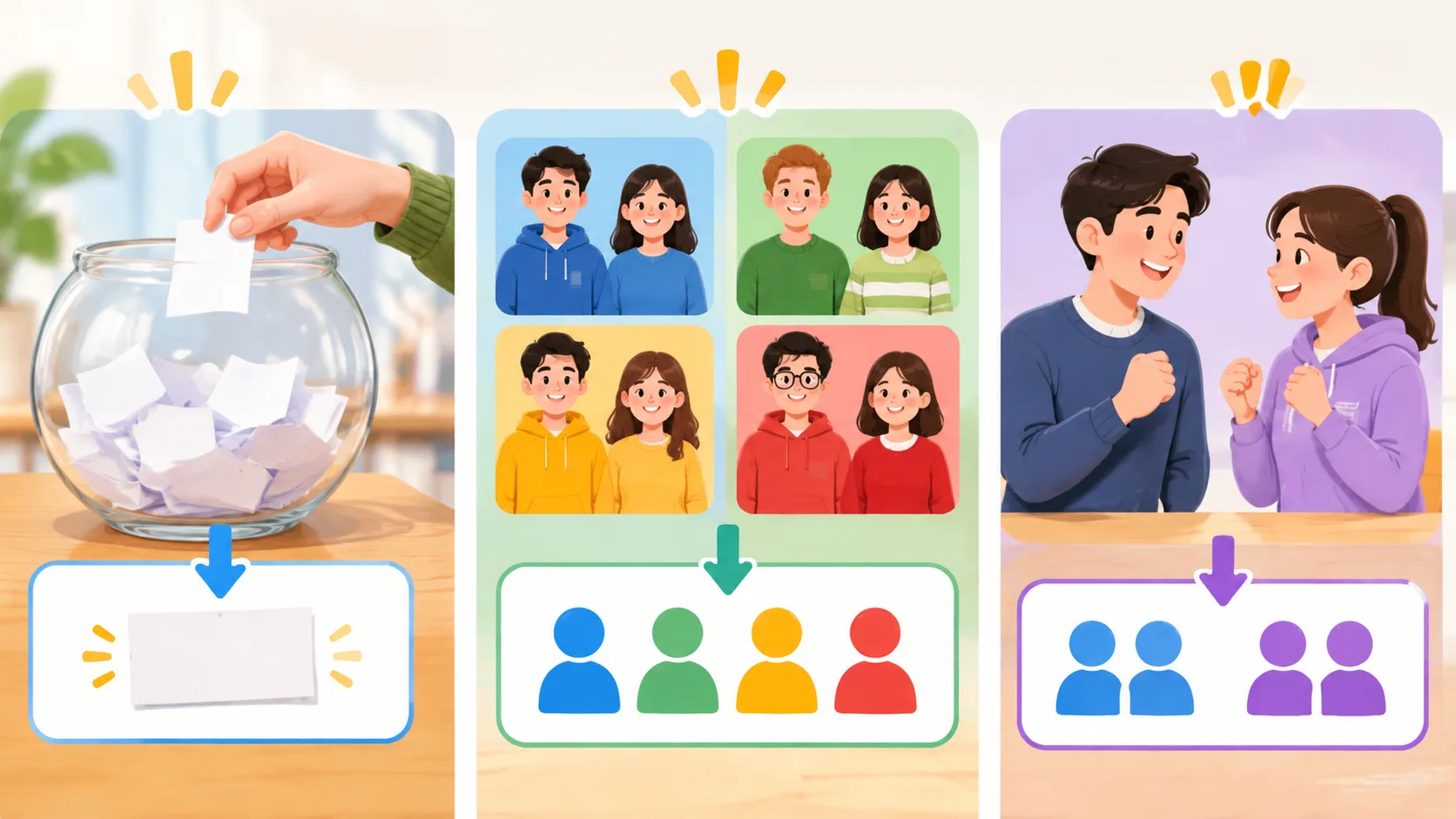
Here is how to choose:
| Party activity | Suitable selection method | Example |
|---|---|---|
| Individual challenges | Random name selection | Choose the next player |
| Team competitions | Random group generator | Create four teams |
| Partner conversations | Random pair generator | Match guests for introductions |
| Visual selection rounds | Group picker wheel | Spin to select a participant |
For individual selections, the group picker wheel can add a visual element to the activity. If your guests are working in pairs, the Random Pair Generator can help create partner combinations without asking people to choose their own partners.
There are practical limits to consider. A random picker does not automatically know whether two guests should avoid being paired together, whether a participant has accessibility needs, or whether someone has already completed a particular challenge. Review the list and adjust eligibility before running the activity. For activities involving special requirements, manually define suitable participants first and then randomize within that group.
5. Making Random Picker Party Games Fair and Inclusive
A random result is not necessarily a fair experience unless the rules are fair too. For instance, if one guest appears several times on the participant list, that person has more opportunities to be selected. Similarly, if some participants are removed from the list without a clear reason, others may question the process.
Start by giving every eligible participant one entry. Explain whether names will be removed after selection and whether repeat turns are possible. For a game where everyone should have one opportunity, use a no-repeat approach until the entire list has been selected. For a casual activity where people can participate multiple times, keep the original list and explain that repeat selections are possible.
Consider these practical guidelines:
- Use accurate participant lists. Check that each person appears the intended number of times.
- Make participation voluntary. Give guests an easy way to decline a challenge.
- Adapt activities to the group. Avoid tasks that require physical abilities, personal disclosures, or specialist knowledge unless participation is appropriate.
- Explain the selection rules. Tell everyone whether the picker allows repeat selections.
- Provide alternative roles. Guests who do not want to perform can keep score, read questions, or help the host.
For example, at a company celebration, some employees may enjoy performing a funny challenge while others prefer a conversation game. You can prepare two activity lists and let participants choose the type of activity they are comfortable with before using random selection. This preserves an element of surprise without forcing everyone into the same experience.
Remember that a random picker can distribute opportunities according to the list and selection settings, but it cannot guarantee that every game outcome will feel fair. Clear rules and thoughtful activity design remain the host's responsibility.
6. Real-World Examples for Different Events
The same selection method can support very different gatherings. The key is to match the activity to the group's size, purpose, and comfort level.
Birthday Parties
For a birthday party with 10 to 20 guests, prepare a list of short challenges and use random selection to determine the order of participation. Keep each challenge brief so that guests do not spend too much time waiting. You might include guessing games, storytelling prompts, or simple team activities.
If younger children are attending, use familiar topics and avoid complicated instructions. An adult can manage the participant list and explain each round before making a selection.
Classroom Celebrations
Teachers can use random selection for end-of-term celebrations, review games, or classroom social activities. A teacher might prepare a list of students who want to participate and select players for a quick question round. For group challenges, the Random Group Generator can organize students into teams.
For classroom use, consider learning needs, established classroom rules, and student comfort. Random selection should not be used to embarrass students or force public participation. A student who prefers not to answer can receive another role, such as keeping score or choosing the next question.
Corporate Events and Team Socials
Workplace events often bring together employees from different departments who may not interact regularly. Random pairs can encourage conversations between colleagues, while small teams can work together on a creative challenge.
For instance, a facilitator organizing a 24-person team social could create six groups of four. Each team might receive a problem-solving activity or a short presentation prompt. The random assignment reduces the need for employees to form their usual groups, although the facilitator should still account for accessibility and any relevant team constraints.
Family Gatherings
Family gatherings often include different generations and activity preferences. A random question game can give relatives a simple way to share stories, while a team activity can encourage cooperation between younger and older family members.
Use questions that are suitable for everyone and avoid topics that might create uncomfortable conversations. A short list of lighthearted prompts is often enough for a relaxed evening.
7. Common Mistakes to Avoid When Using a Random Picker
Even a simple game can become confusing when the selection rules are unclear. Most problems can be prevented with a little preparation before guests arrive.
One common mistake is starting with an incomplete participant list. If someone is left out, the host may have to stop the activity and restart the selection. Check the list in advance, especially when guests arrive at different times. If new participants join later, explain how they will enter the next round.
Another mistake is allowing the same person to be selected repeatedly when the intention is to give everyone a turn. Decide on the repeat rule before the first selection. For a one-turn-per-person game, remove each selected name or use a selection process that tracks completed turns.
It is also easy to prepare activities that are too complicated. Long explanations interrupt the pace of a party. Aim for rules that can be explained in a few sentences, and demonstrate one example if needed. Keep a backup activity ready in case the original game does not suit the group.
Finally, do not treat a random result as a reason to ignore personal boundaries. A participant should be able to decline a question or challenge. Random selection helps decide who gets an opportunity; it should not remove someone's choice about how to participate.
8. Frequently Asked Questions
What Are Random Picker Party Games?
Random picker party games use a selection method to choose players, assign activities, or organize participants. Instead of relying entirely on volunteers or a predetermined order, the host uses a participant list or activity list to make selections. They can be adapted for birthdays, classrooms, family gatherings, and workplace events.
How Do I Choose Someone Randomly for a Party Game?
Create a list of eligible participants and enter their names into a random picker. Run the selection and announce the chosen participant. If everyone should have one turn, remove each selected name before choosing again.
Can I Use a Random Picker to Divide Guests Into Teams?
Yes. A random group generator can divide a participant list into smaller teams. For example, you can enter 20 names and create five groups of four. Review the resulting teams if you need to account for accessibility, existing relationships, or other event requirements.
How Can I Make a Random Picker Game Fair?
Start with an accurate list and give each eligible participant the intended number of entries. Explain whether repeat selections are allowed and use the same rules throughout the activity. Also make sure that guests can decline challenges without being embarrassed.
What Are Good Random Picker Games for Large Groups?
Large groups can enjoy team challenges, random question rounds, partner introductions, and guessing games. Dividing participants into smaller teams can reduce waiting time and give more people a chance to contribute. Choose activities that are easy to explain and do not require expensive equipment.
Can I Use Random Picker Party Games at Work or School?
Yes. They can support icebreakers, classroom celebrations, team-building activities, and informal group events. Choose age-appropriate or workplace-appropriate activities, explain the rules, and provide alternatives for anyone who does not want to participate in a particular challenge.
Make Your Next Party Game Easier to Organize
A good party game does not need complicated equipment or elaborate preparation. A clear participant list, simple rules, and a suitable selection method can help you organize activities with less hesitation and more opportunities for guests to join in.
Start with one short activity, decide whether repeat selections are allowed, and adjust the format to suit your guests. When you are ready to organize teams, select participants, or create a new round of activities, try the Random Group Generator. It is a practical starting point for turning a long guest list into an organized and enjoyable group activity.
Related Tools
Pick the right generator for the job — every tool runs free in your browser.