
group rotation
How to Set Up Group Rotations with a Random Generator
Learn how to organize fair group rotations with a random group generator. Follow practical steps for classroom stations, collaborative activities, and team workshops.
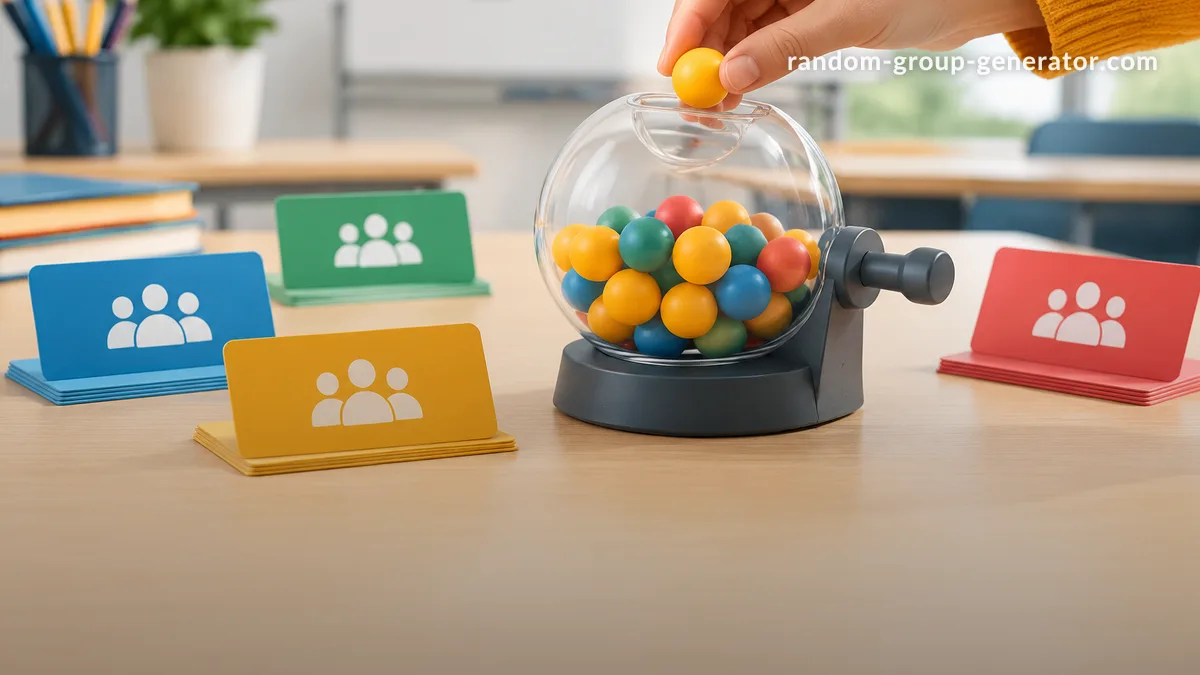
Imagine planning a classroom activity with 24 students and four learning stations. You want everyone to work with different classmates, visit each station, and have enough time to complete every task. However, manually assigning groups for every round takes time and can lead to repeated pairings or uneven group sizes. A group rotation random generator makes this process easier by helping teachers and facilitators create new groups quickly. With a clear rotation plan, you can spend less time organizing people and more time supporting meaningful collaboration.
What Is a Group Rotation Random Generator?
A group rotation random generator is a practical way to create changing teams for activities that involve several rounds of collaboration. Instead of asking participants to choose their own partners or manually rearranging everyone after each activity, you use random group assignments to organize participants into new teams.
The approach is useful in classrooms, training sessions, workshops, and team-building events. Teachers can use it for reading discussions, science experiments, problem-solving exercises, and learning stations. Corporate facilitators can use similar arrangements for brainstorming, skill-sharing, and small-group discussions.
Random grouping and group rotation are related but different processes. Random grouping determines who works together in a particular round. Rotation determines how participants move between groups or activities over time. A successful plan considers both. Simply generating new groups does not automatically guarantee that everyone meets different people or visits every station.
For example, a teacher with 20 students might create five groups of four. Each group starts at a different learning station. After completing the first task, students move to another station according to a prepared schedule. The group rotation random generator helps establish the initial teams, while the teacher's rotation plan controls the sequence of activities.
Why Use Random Group Rotations?
Keeping the same groups throughout a semester can make classroom routines predictable, but it can also limit opportunities for students to collaborate with other classmates. Students may become comfortable working with familiar friends and miss opportunities to hear different perspectives. Changing group membership gives participants more chances to communicate with people outside their usual circles.
Random assignments can also reduce the time spent negotiating group membership. Instead of waiting for everyone to choose partners, a teacher can prepare assignments before class and display them when an activity begins. This is especially helpful when a lesson includes several short activities or when a facilitator needs to organize a large group quickly.
There are several practical reasons to introduce group rotations:
- More varied interactions: Participants have opportunities to exchange ideas with different people.
- Less administrative work: Random assignments reduce repetitive manual grouping.
- Flexible group sizes: Teachers can organize pairs, trios, or larger teams according to the activity.
- Clearer classroom routines: A prepared rotation schedule helps participants understand where to go next.
- More opportunities to contribute: Changing partners can give quieter participants new opportunities to share their ideas.
Consider a professional development workshop with 30 employees. The facilitator wants participants to discuss three business challenges with different colleagues. Creating new groups between rounds provides a simple structure for exchanging perspectives without requiring the facilitator to organize every team by hand.
However, random grouping is not always the right choice. Activities involving confidential information, specialist responsibilities, accessibility requirements, or carefully balanced skill sets may need facilitator-selected teams. A random tool should support instructional decisions rather than replace professional judgment.
How to Set Up Group Rotations with a Random Generator
A successful rotation starts with a clear activity plan. Before generating groups, decide what participants will do, how many rounds you need, and whether everyone should move together or rotate between stations.
Follow these steps to build a manageable system.
Step 1: Decide on the Number of Participants and Groups
Start by counting the participants. Then determine how many people should work together in each group. Your decision should reflect the task rather than an arbitrary preference.
Smaller teams are useful for discussions where everyone needs an opportunity to speak. Larger teams may be appropriate for projects that require several ideas or different responsibilities. Cornell University's teaching guidance recommends considering groups of two to five students for many in-class collaborative activities.
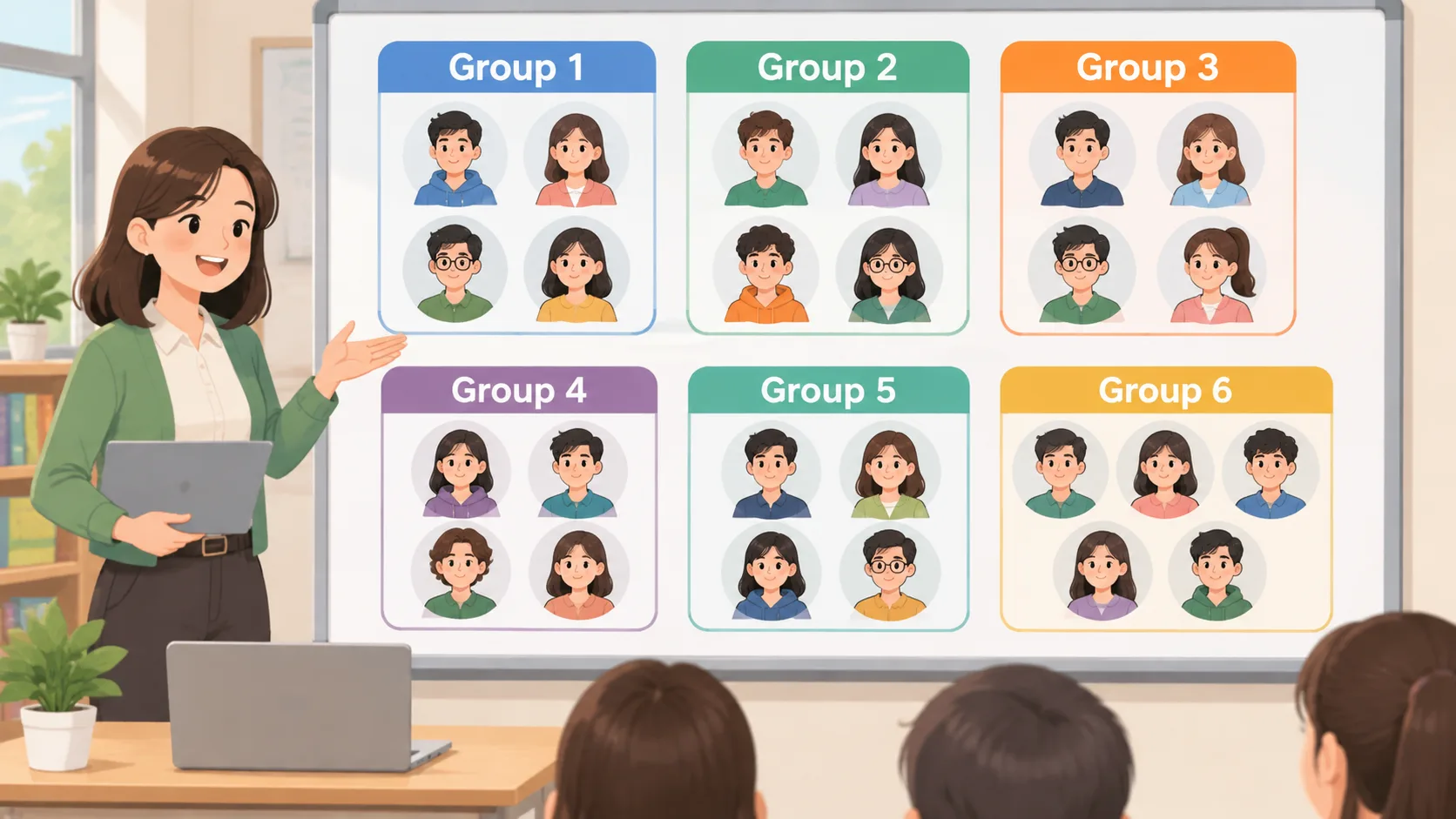
For example, if you have 24 students and want teams of four, you need six groups. If your activity works better with three students per team, you need eight groups instead.
Before generating assignments, check whether the total number divides evenly. When it does not, decide whether one group can have an additional member or whether pairs and trios would work better.
Step 2: Generate the Initial Groups
Open the Random Group Generator and prepare your participant list. Enter each participant's name or identifier, choose the grouping arrangement, and generate the assignments.
Review the result before sharing it. Check that every participant appears once, group sizes are suitable, and any special requirements have been considered. If your activity requires specific combinations of skills or experience, adjust the assignments where necessary.
For example, a class of 25 students might be divided into six groups. Five groups contain four students, while the remaining group contains five. This small difference is often manageable for a discussion or brainstorming task, although a practical activity requiring equal equipment access may need another arrangement.
Step 3: Plan the Rotation Sequence
Next, determine how participants will move between activities. A rotation schedule should show where each group starts, what they do, how long they have, and where they go next.
For a six-group classroom, you might prepare six stations. Each group begins at a different station and moves forward after completing the task. This arrangement allows all groups to work simultaneously without gathering around the same activity.
A simple rotation plan might look like this:
- Round 1: Group 1 starts at Station A, Group 2 at Station B, and so on.
- Round 2: Each group moves to the next station.
- Round 3: Groups continue following the same direction.
- Final round: Groups complete the remaining activity and prepare to share their findings.
For activities that do not use physical stations, you can generate new groups for each discussion round instead. The important distinction is that a new random assignment is not necessarily the same as a carefully planned station rotation.
If you want a dedicated planning option, explore the station rotation scheduler to organize station-based activities.
Step 4: Set Time Limits and Transition Rules
Every rotation needs a clear time limit. Without one, some groups may finish early while others struggle to complete their tasks. Participants also need to know when to stop, where to move, and what materials to bring.
For example, a 40-minute classroom session might include four activity rounds of eight minutes each, with two minutes between rounds. The remaining time can be used for instructions and a final discussion. These timings are an example rather than a universal recommendation. Adjust them to the age of your participants and the difficulty of the activities.
Explain the transition rules before the first round. You might use a visual timer, a classroom announcement, or a projected schedule. For younger students, clear station labels and simple movement instructions can reduce confusion.
A useful practice is to run one short demonstration before beginning the full rotation. This allows participants to learn the routine before they need to manage several activities independently.
Step 5: Assign Roles and Explain Expectations
Even a well-organized group can struggle if participants do not understand their responsibilities. Assigning simple roles helps everyone know how to contribute.
Depending on the activity, roles might include:
- Facilitator: Keeps the discussion focused and makes sure everyone has a chance to contribute.
- Recorder: Writes down important ideas and decisions.
- Timekeeper: Watches the clock and reminds the group about transitions.
- Reporter: Shares the group's conclusions with the class or workshop.
Rotate these responsibilities between rounds so that the same person does not always lead or record. Washington University's teaching guidance also emphasizes establishing expectations and rotating group responsibilities to support productive collaboration.
For instance, a student who records the group's science observations in the first round might become the reporter in the second round. This gives participants experience with different parts of the collaborative process.
Step 6: Review the Results and Adjust
After the activity, ask participants how the rotation worked. Did every group have enough time? Were the instructions understandable? Did anyone repeatedly work with the same classmates?
Use the answers to improve the next session. You may need to change group sizes, reduce the number of stations, or provide clearer transition instructions. If the objective is to expose participants to different perspectives, review the group combinations rather than assuming that random assignments automatically created enough variety.
A group rotation random generator is most useful when it is part of an organized process that includes planning, communication, and review.
Practical Group Rotation Examples for Classrooms and Workshops
The best rotation method depends on the activity. A science experiment, a language discussion, and a workplace brainstorming session have different requirements. The following examples show how to adapt random grouping to common situations.
Example 1: Elementary School Learning Stations
Imagine a teacher has 24 elementary students and six learning stations. The stations cover reading, mathematics, science, vocabulary, creative writing, and independent practice.
The teacher creates six groups of four using a random group generator. Each team starts at a different station. After the activity period, groups move to the next station in a clockwise sequence.
At the reading station, students discuss a short passage. At the mathematics station, they solve problems together. At the science station, they record observations. The teacher provides instructions and checks progress while students work independently at the other stations.
To make the system easier for younger learners, the teacher uses color-coded station signs and a visible rotation chart. Each group knows its starting point and next destination. This reduces the need for repeated verbal instructions.
Example 2: College Discussion Rotations
A university instructor wants students to discuss different interpretations of a reading assignment. Instead of keeping the same discussion partners throughout the lesson, the instructor organizes students into pairs for several rounds.
The Random Pair Generator can help prepare the initial partnerships. Students receive a question, discuss it with their partner, and write down one important conclusion. For subsequent rounds, the instructor creates new pairings or uses a planned partner-rotation method.
For example, students might discuss the author's main argument in the first round, examine supporting evidence in the second, and consider alternative interpretations in the third. Each discussion builds on the previous one while introducing new perspectives.
This format is especially useful when the goal is to encourage broad participation rather than develop one long-term project team.
Example 3: Corporate Team-Building Workshop
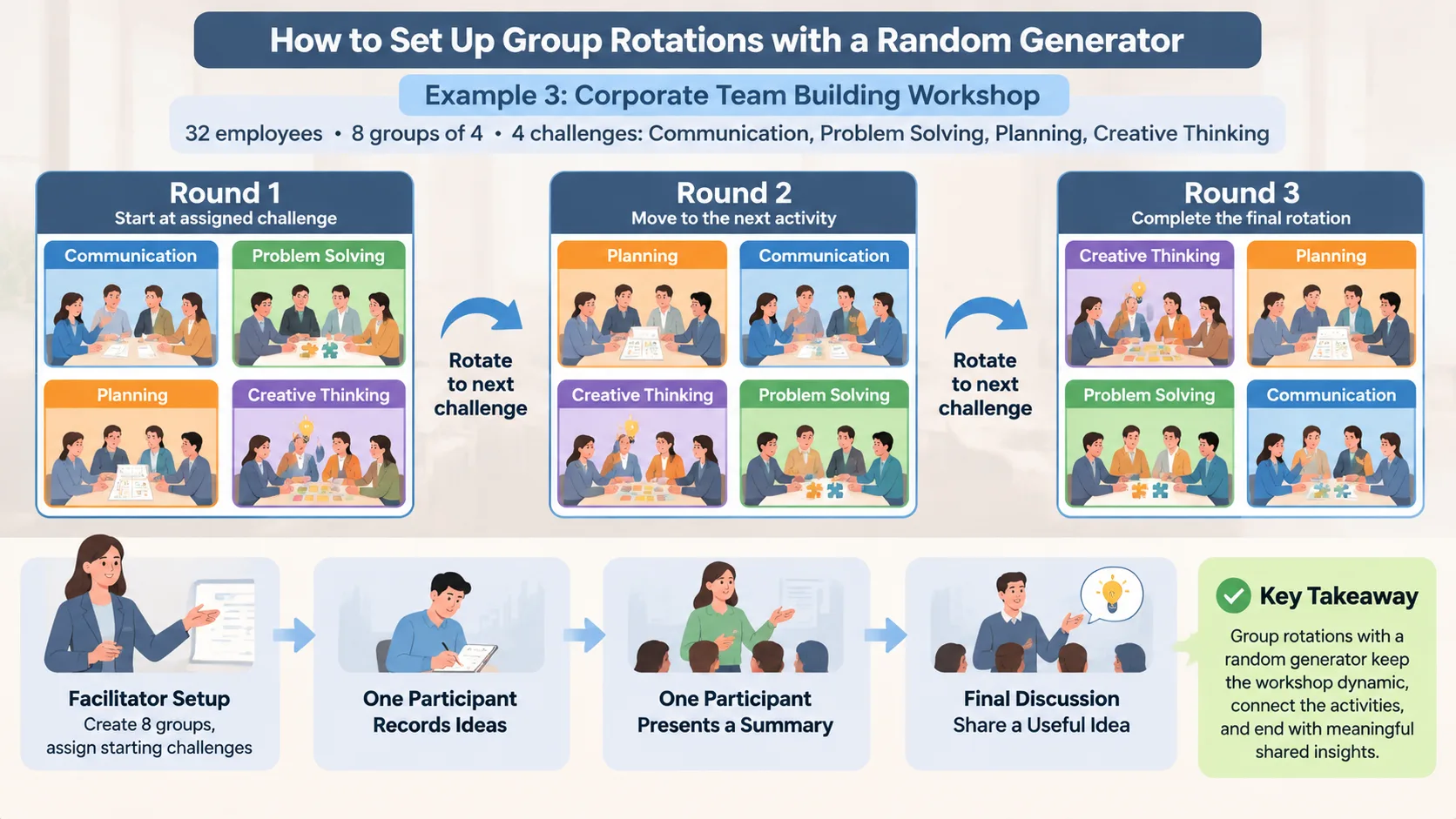
A training facilitator has 32 employees attending a collaboration workshop. The session includes four challenges, each focused on a different workplace skill: communication, problem-solving, planning, and creative thinking.
The facilitator creates eight groups of four and assigns each group a starting challenge. After each round, teams rotate to the next activity. One participant records the team's ideas, while another presents a short summary at the end.
For the final discussion, the facilitator asks participants to identify one useful idea they heard from another group. This connects the separate activities and gives the workshop a clear conclusion.
If the exercises require specific professional knowledge, the facilitator may choose to adjust the randomly generated groups before the session. This combines the speed of random assignment with the need for appropriate skill distribution.
Random Grouping vs. Other Rotation Methods
A random group rotation random generator is one option among several ways to organize collaborative activities. Understanding the differences helps you choose a method that matches your objectives.
Manual grouping gives teachers complete control over team composition. It is useful when participants have different support needs, when specific skills must be distributed, or when an activity requires carefully selected combinations. However, creating several rounds manually can become time-consuming.
Self-selected grouping allows participants to choose their own partners. This can be convenient for informal activities, but it may repeatedly place friends together. It also gives facilitators less control over the range of interactions.
Random grouping provides a quick way to create teams without asking participants to negotiate membership. It works well for short discussions, warm-up exercises, and activities where varied interactions are useful. However, randomness does not guarantee balanced abilities, equal participation, or unique combinations across multiple rounds.
Fixed rotation schedules provide a predetermined movement pattern. They are particularly useful when every group needs to visit every station in a specific sequence. They require some preparation but make transitions easier to communicate.
A practical approach is to combine these methods. Use random assignments to establish initial teams, then follow a fixed rotation schedule for stations. For activities that require specialist knowledge, make appropriate adjustments before the session begins.
Common Mistakes to Avoid When Organizing Group Rotations
Even simple rotation activities can become confusing without preparation. One common mistake is creating too many stations for the available time. If participants spend more time moving than completing activities, the lesson may lose its focus. Start with a manageable number of rounds and expand the system only when participants understand the routine.
Another mistake is assuming that random assignments always produce balanced groups. A random generator distributes participants according to its grouping settings, but it does not necessarily account for academic strengths, accessibility requirements, language needs, or previous collaboration experiences. Teachers should review assignments when these factors matter.
It is also easy to overlook group size. A team of six may work for a brainstorming activity but can make it harder for everyone to contribute during a short discussion. Cornell and other university teaching resources recommend considering the task and the opportunity for individual participation when choosing group sizes.
Finally, avoid changing groups without explaining why. Participants need to understand the purpose of the activity and the expected outcome. A short introduction, visible instructions, and clear transition signals can make a significant difference.
How to Make Group Rotations Fair and Inclusive
Fair grouping involves more than giving every participant a random assignment. It also means providing reasonable opportunities to contribute, understanding individual needs, and avoiding arrangements that repeatedly disadvantage the same people.
Start by making sure the participant list is accurate. Remove duplicate entries, include everyone who should take part, and check that participants can access the activities. If someone requires additional time, a particular seating arrangement, or communication support, plan for that before generating teams.
Consider rotating group responsibilities as well as group membership. When one participant always becomes the leader or spokesperson, others may have fewer opportunities to practice those skills. Assigning different responsibilities in successive rounds encourages a wider range of participation.
For example, a teacher might use random groups for a weekly discussion but create carefully balanced teams for a major science project. Both methods have a place. The appropriate choice depends on the learning objective, the participants, and the amount of time available.
The Institute on Community Integration at the University of Minnesota also describes several cooperative learning arrangements, including reciprocal teaching and long-term base groups. These approaches illustrate why one grouping method cannot meet every instructional need.
Remember that some activities are better suited to stable teams. Long-term projects, sensitive discussions, and tasks that require trust may benefit from consistent group membership. Use rotation when interaction with different people is part of the goal, not simply because changing groups is possible.
Frequently Asked Questions
What Is a Group Rotation Random Generator?
A group rotation random generator is a method or tool for creating random teams that participate in successive activities. It helps teachers and facilitators organize group assignments without manually selecting every participant. A separate rotation schedule determines how teams move between stations or discussion rounds.
How Many Students Should Be in Each Group?
The ideal group size depends on the activity. Groups of two to five often work well for classroom discussions, while more complex projects may benefit from larger teams. Consider the time available, the number of participants, and whether everyone needs an opportunity to speak.
Can I Use Random Groups for Multiple Rotation Rounds?
Yes. You can create new random assignments between rounds or generate an initial set of groups and follow a planned station schedule. If your goal is to give everyone different partners, check the combinations between rounds because independent random assignments can produce repeated pairings.
How Do I Prevent Students from Working with the Same People Every Time?
Keep a record of previous group combinations and review new assignments before using them. You can also use a structured rotation schedule that moves participants according to a predetermined pattern. For important activities, make small manual adjustments when random assignments create too many repeated pairings.
Is Random Grouping Suitable for Every Classroom Activity?
No. Random grouping is useful for short discussions, collaborative exercises, and activities that benefit from varied interactions. However, tasks involving specific skill requirements, individual accommodations, sensitive information, or long-term teamwork may need carefully planned groups.
What Should I Do If the Number of Participants Does Not Divide Evenly?
You can allow one group to have an additional member, create a mixture of pairs and trios, or adjust the total number of groups. Choose the arrangement that best supports the activity. For equipment-based stations, consider whether every participant will have enough access to participate fully.
How Long Should Each Group Rotation Last?
There is no universal time limit. Short discussions may need only a few minutes, while experiments and more complex projects require longer periods. Plan enough time for participants to understand the task, complete the work, and transition without rushing.
Start Organizing Your Group Rotations
Well-planned group rotations make classroom activities and team workshops easier to manage. The key is to combine suitable group sizes, clear instructions, sensible time limits, and a rotation schedule that supports your objectives.
You do not need to spend valuable preparation time assigning every participant manually. Start with a random assignment, review the results, and build a rotation plan around the activities you want people to complete.
Ready to organize your next classroom activity or team session? Try the Random Group Generator to create your groups and make your next rotation easier to prepare.
Related Tools
Pick the right generator for the job — every tool runs free in your browser.