
fair team competition
How to Run Fair Team Competitions with a Random Generator
Learn how to run fair team competitions with a random generator. Discover balanced team sizes, transparent rules, scoring systems, and practical examples.
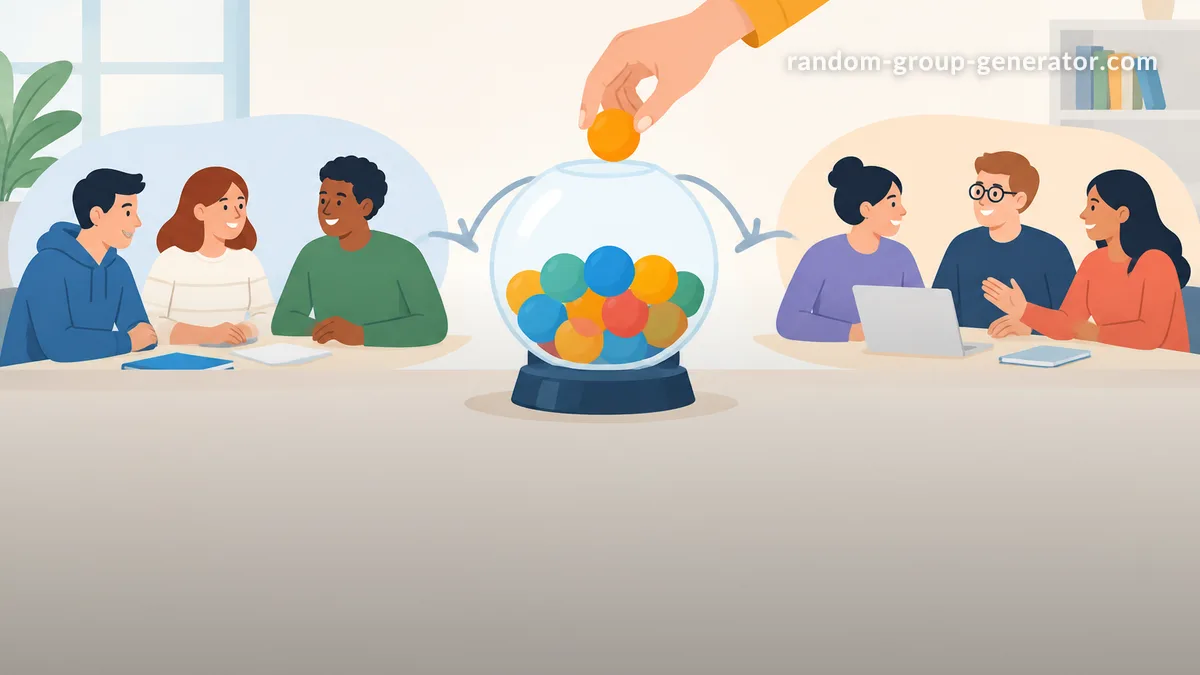
A team competition can quickly become frustrating when participants believe some teams have an unfair advantage. Perhaps students always choose their friends, experienced employees end up together, or one group has more members than another. A fair team competition random generator helps teachers, trainers, and event organizers assign participants without favoritism. When combined with sensible team sizes, clear rules, and consistent scoring, random selection creates a more transparent starting point for everyone.
Whether you are organizing a classroom quiz, a workplace challenge, a training exercise, or a friendly event, the goal is the same: give participants a reasonable opportunity to contribute and compete. Here is how to organize a competition that feels fair from the first team assignment to the final score.
Why Fair Team Selection Matters in Competitions
Team selection influences how participants experience a competition. When people always choose their own teammates, existing friendship groups or workplace relationships can determine who works together. Some participants may feel excluded, while others may repeatedly benefit from familiar partnerships. This can affect the atmosphere before the competition even begins.
Random team assignment offers a straightforward alternative. Instead of allowing participants to negotiate membership, an organizer distributes everyone through the same selection process. This reduces personal preference during team formation and makes it easier to explain how the teams were created. Participants can focus on the activity rather than questioning why certain people were placed together.
However, random selection does not automatically guarantee equal abilities or experience. A team containing several experienced participants may still have an advantage over a team of beginners. The Center for Innovative Teaching and Research at UC Santa Barbara identifies random assignment as an accessible approach while also recognizing that it does not account for specific team characteristics. The important distinction is between fair selection and balanced team composition.
For example, imagine a classroom with 24 students competing in a science challenge. If the teacher lets students choose their teammates, six students who regularly work together might form a strong team. Randomly distributing all 24 students into four teams of six creates a more transparent starting point and introduces students to different classmates.
A fair team competition random generator is particularly useful when you need to organize short activities quickly, repeat competitions regularly, or demonstrate that no participant received special treatment.
How to Use a Fair Team Competition Random Generator
The easiest way to organize a random competition is to prepare your participant list before generating the teams. A consistent process reduces administrative work and makes the results easier to communicate.
Follow these steps:
- Prepare your participant list. Collect the names of everyone who will take part. Check spelling, remove duplicates, and confirm attendance before starting.
- Choose the number of teams. Decide how many competing groups you need based on the activity, available time, and number of participants.
- Enter the names. Open the Random Group Generator and provide your participant list.
- Generate the groups. Use the generator to distribute participants into random teams. Review the resulting group sizes before announcing the competition.
- Share the results. Display or communicate the team assignments so everyone knows which group they belong to.
- Explain the rules. Before the competition begins, describe the tasks, scoring criteria, time limits, and any restrictions that apply equally to all teams.
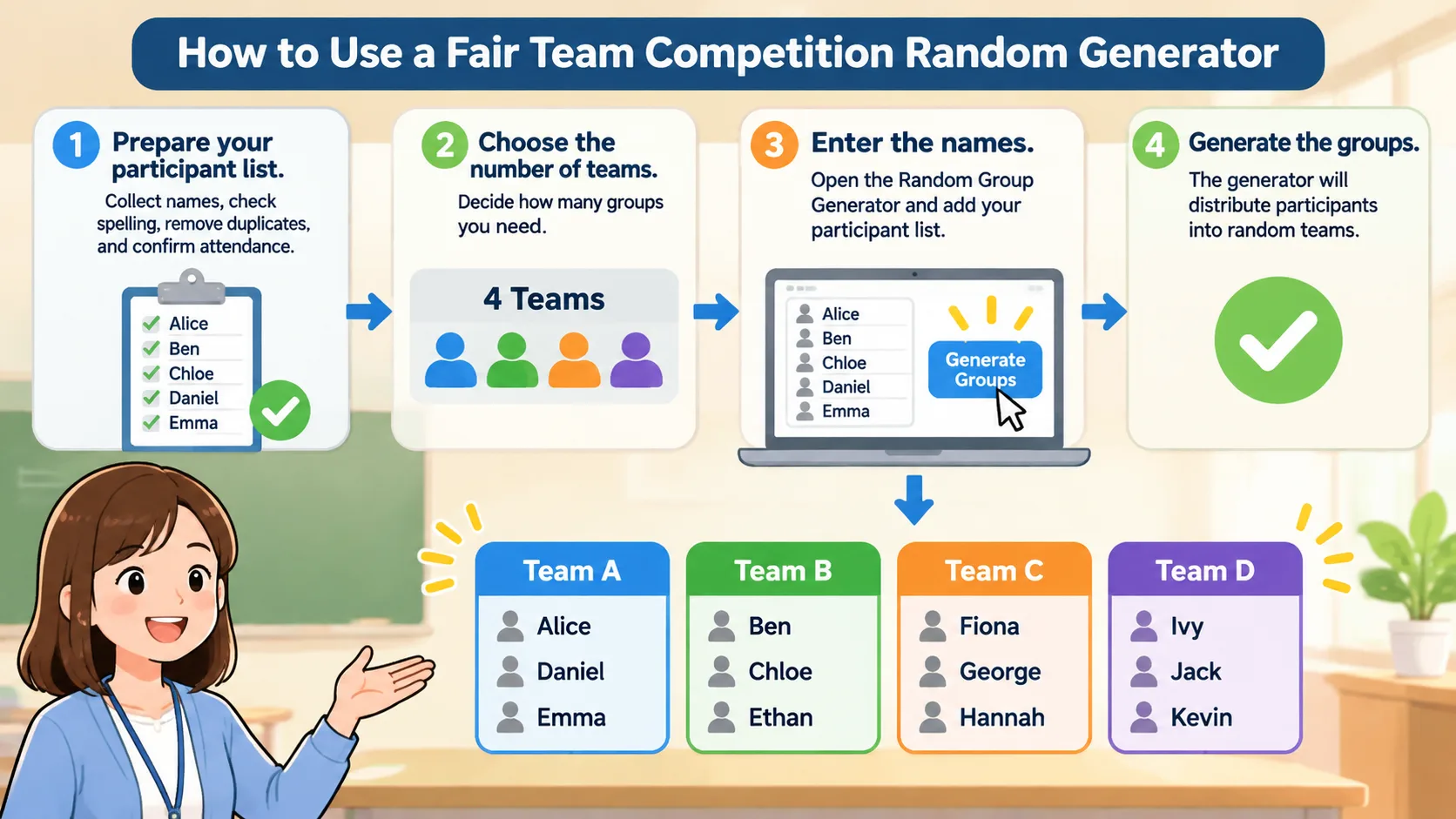
Consider a workplace training session with 20 employees. The facilitator wants five teams for a communication challenge. By entering all 20 names and generating five groups, the facilitator can prepare the activity without spending valuable training time negotiating team membership.
The process also works for online sessions. A facilitator can prepare the participant list before a Zoom or Microsoft Teams meeting, generate the groups, and announce assignments through the meeting chat. For a classroom, the teacher can display the results on a projector or share them through Google Classroom.
The key is to use the same selection method for everyone. If you need to make an adjustment because someone is absent or a participant requires an accommodation, explain the practical reason without turning the change into a personal advantage.
Choose the Right Team Size for Your Competition
Team size affects participation, communication, and how easily people can contribute. Very small teams may not have enough combined knowledge for a challenging activity. Very large teams can make it harder for quieter participants to take part or for everyone to agree on decisions.
For many classroom and workshop activities, teams of three to five people provide a practical starting point. This is not a universal rule. A quick quiz may work well with pairs, while a complex design challenge may need larger teams. The right number depends on the task and how much individual participation you expect.
Before using a fair team competition random generator, consider these common formats:
- Pairs: Suitable for short discussions, vocabulary games, problem-solving exercises, and quick knowledge checks.
- Teams of three: Useful for short challenges where each person can take responsibility for a different part of the task.
- Teams of four or five: A practical option for classroom competitions, brainstorming, and collaborative projects.
- Larger teams: Appropriate for event activities or challenges requiring several roles, provided that responsibilities are clearly distributed.
For example, a teacher organizing a spelling competition for 30 students might create ten pairs for a series of quick rounds. A corporate trainer working with 30 employees might instead create six teams of five for a collaborative problem-solving exercise.
Always check whether the participant count divides evenly into your preferred team size. If it does not, some groups may have one additional member. That is not necessarily unfair, but it is worth considering how the competition is scored. A team with six members should not automatically receive the same individual workload as a team with four members.
Set Clear Rules Before the Competition Starts
Fair team selection is only one part of a fair competition. Participants also need to understand what they are competing to achieve. Unclear rules can create disagreements even when every team was selected randomly.
Write down the essential competition details before introducing the activity. Explain the objective, time available, scoring method, permitted resources, and what happens if two teams finish with the same score. Keep the rules simple enough for everyone to understand without repeated clarification.
A useful competition structure includes the following elements:
- Objective: Explain exactly what each team must complete.
- Time limit: Give every team the same amount of time to work.
- Scoring: Use a consistent points system based on observable results.
- Participation: Establish expectations for individual involvement and teamwork.
- Tie-breaking: Decide how ties will be resolved before the first round.
- Conduct: Set expectations for respectful communication and appropriate competition.
For instance, a classroom geography challenge could award one point for each correct answer and two bonus points for completing a map task. Every team receives the same questions and time limit. If two teams finish with identical scores, a prepared tie-breaker question determines the result.
For a workplace activity, you might evaluate a team presentation using three equally weighted criteria: accuracy, clarity, and collaboration. Explain these criteria before teams begin preparing. This helps participants understand what matters rather than relying on the facilitator's personal preferences.
Research on team-based learning also emphasizes the importance of transparent team formation and clearly understood expectations. The Team-Based Learning Collaborative recommends making team formation sufficiently public that participants can see that no group has been deliberately given an advantage.
Make Random Teams More Balanced Without Losing Fairness
Random assignment is useful when you want a quick and impartial starting point. However, some competitions require more thoughtful team composition. This is particularly true when the activity depends heavily on prior knowledge, technical skills, or professional experience.
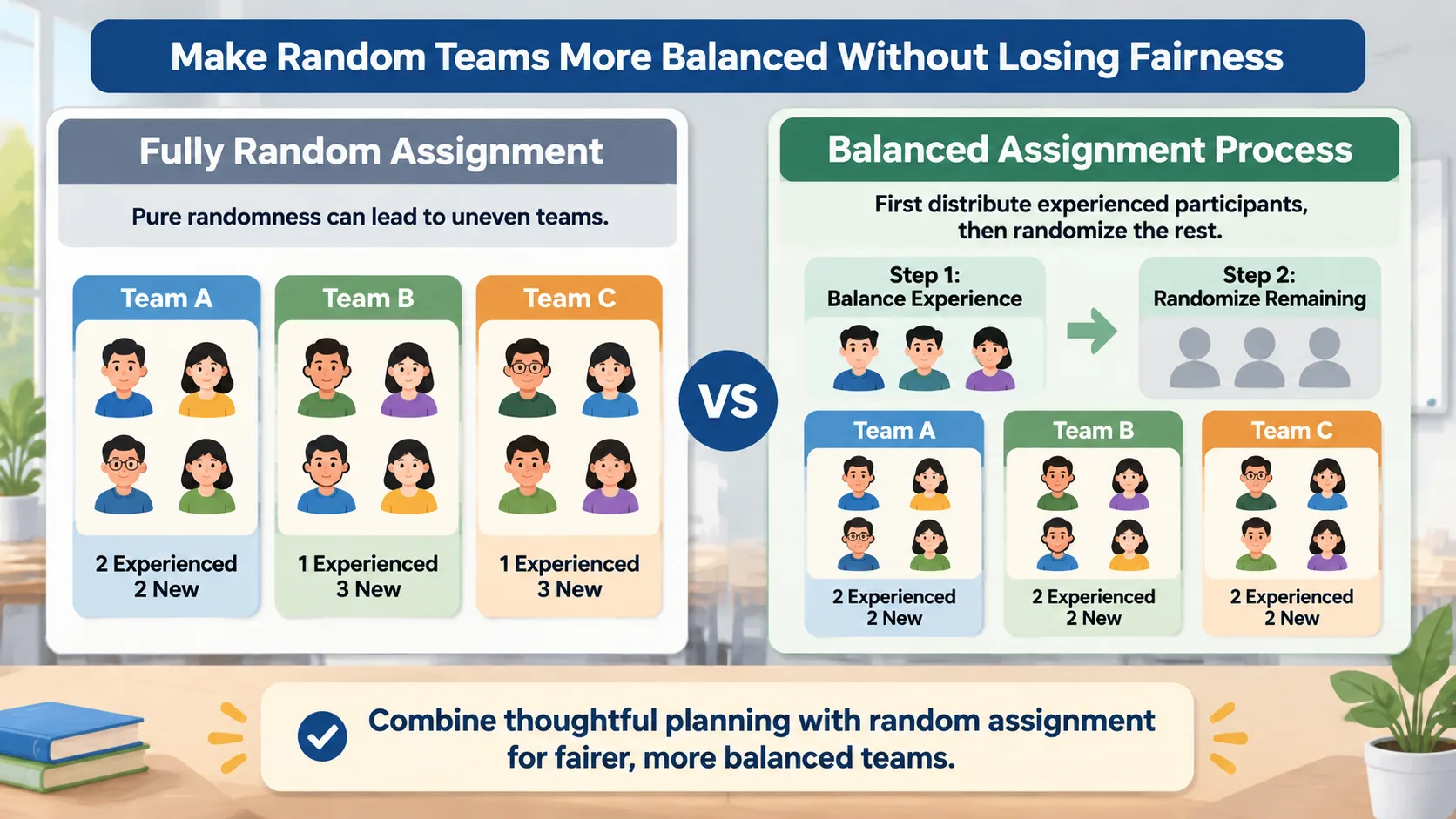
A fair team competition random generator does not know whether one participant has five years of experience while another is completely new. If those differences strongly influence performance, consider using a combination of intentional planning and random selection.
Here is a practical approach:
- Identify the characteristics that matter for the competition, such as experience, subject knowledge, or familiarity with a particular task.
- Decide whether any participants need to be distributed across teams to prevent a significant imbalance.
- Establish the relevant constraints before generating groups.
- Randomize participants within the remaining selection possibilities.
- Review the results for obvious practical problems, such as an unavailable participant or an inaccessible working arrangement.
- Explain any adjustments so that participants understand the process.
Imagine a company organizing a sales knowledge competition. Six employees have extensive product experience, while 18 employees are relatively new. The organizer could distribute the experienced employees across six teams, then randomly assign the remaining participants. This produces a more intentional mix than completely unrestricted random assignment.
The Cornell Center for Teaching Innovation similarly notes that random assignment can be efficient, particularly for groups that change frequently, but adjustments may be necessary to account for availability, experience, and other relevant circumstances.
There is an important limitation: avoid collecting unnecessary personal information simply to create teams. Use only criteria that genuinely affect participation or the competition's objectives. For a casual classroom game, a straightforward random draw is usually sufficient. For a long-term project, a more deliberate approach may be appropriate.
Keep Competition Scoring Consistent and Transparent
Once teams have been created, scoring becomes the next major source of potential disagreement. Participants should be able to understand why points were awarded and how the final result was determined.
Use scoring criteria that are relevant to the activity. A mathematics competition might focus on correct answers and completion time. A creative challenge might evaluate originality, usefulness, and presentation. A teamwork exercise might include collaboration and communication alongside the quality of the final result.
Avoid changing the scoring system halfway through the competition unless there is a clear reason that applies to everyone. If a rule needs clarification, communicate the change to all teams before the next round begins.
For example, consider a three-round classroom competition:
- Round one: General knowledge, with one point per correct answer.
- Round two: A practical problem-solving task, worth up to five points.
- Round three: A short team presentation, worth up to five points using a shared rubric.
The maximum possible score is identical for every team. The teacher records results after each round and displays the running totals. Participants can follow the competition without guessing how the winner will be selected.
It is also useful to separate team performance from individual participation. A group might achieve a high score because one person completed most of the work. If collaboration is part of the learning objective, assign rotating roles such as presenter, recorder, researcher, and timekeeper. This gives participants different opportunities to contribute.
For longer activities, consider collecting brief feedback from team members about participation. The UC Santa Barbara group-work guidance discusses peer evaluation and periodic check-ins as ways to monitor contributions and identify problems. This is especially useful when the competition involves several sessions rather than one short game.
Practical Team Competition Examples
The same selection principles can be applied to many settings. The important thing is to match the randomization method and competition rules to the activity.
Classroom knowledge competitions
Teachers can use random teams for spelling bees, mathematics challenges, science quizzes, history games, and vocabulary activities. Start by entering the class list, selecting the number of groups, and announcing the results. Give every team the same questions, preparation time, and scoring criteria.
For a class of 28 students, a teacher might create four teams of seven for a collaborative science challenge. Each group receives the same materials and investigation instructions. Students can rotate responsibilities so that everyone has an opportunity to participate.
If you frequently organize two-person activities instead of larger competitions, the Random Pair Generator can help you create new working partnerships without relying on friendship groups.
Corporate training competitions
Workplace facilitators can use random groups for communication exercises, product knowledge challenges, customer service scenarios, and leadership workshops. Random assignment can introduce employees to colleagues they do not usually work with.
For example, 24 employees could be divided into four teams of six for a customer service simulation. Each team receives the same scenario and preparation time. A shared evaluation rubric measures response quality, problem-solving, and communication.
After the exercise, ask each team to explain one strategy that worked and one challenge it encountered. This turns the competition into a learning activity rather than focusing exclusively on the winning score.
Events and team-building activities
Event organizers can use random groups for scavenger hunts, icebreakers, collaborative puzzles, and friendly social competitions. These activities often benefit from quick team creation because participants may not know each other beforehand.
For example, an event with 40 attendees could use eight teams of five. Each group completes a series of challenges, earning points for accuracy and successful completion. The organizer publishes the rules and distributes the assignments before the first activity begins.
For more engaging team identities, the Group Name Generator can help participants choose names after their groups have been formed. Giving teams an identity can make it easier to announce scores and organize activities.
Random Selection Versus Other Team Formation Methods
Random assignment is not the only way to organize a competition. The best approach depends on the activity's purpose, how well you know the participants, and how much time you have available.
| Team formation method | Advantages | Limitations | Best use |
|---|---|---|---|
| Random assignment | Quick, transparent, reduces personal selection | Does not automatically balance skills | Short activities and recurring games |
| Self-selection | Gives participants freedom to choose | Can reinforce existing friendship groups | Informal activities where comfort is the priority |
| Instructor assignment | Allows deliberate balancing | Requires time and knowledge of participants | Long-term projects and complex competitions |
| Hybrid assignment | Combines planned balance with random selection | Requires additional preparation | Skill-sensitive competitions |
For a quick classroom quiz, random selection is often sufficient. For a semester-long project, deliberate assignment may better support the learning objectives. For a corporate challenge where experience matters, a hybrid method can help distribute relevant expertise.
The key is not to assume that one method is always fairest. Fairness means choosing a process that fits the activity, applying it consistently, and explaining it clearly. Research and teaching guidance from Cornell and UC Santa Barbara both emphasize that team formation decisions should reflect the purpose and practical requirements of the group task.
Common Mistakes to Avoid When Running Team Competitions
Even a well-planned competition can encounter problems. A few simple precautions can prevent unnecessary disputes and make the activity easier to manage.
Ignoring attendance changes: Generate teams only after checking who is actually participating. If someone arrives late or leaves early, adjust the groups transparently rather than quietly giving one team an advantage.
Confusing random with balanced: Random selection does not guarantee equal experience, knowledge, or skill. If these characteristics are central to the activity, use an appropriate balancing process before finalizing teams.
Changing rules during play: Participants should not discover new scoring requirements after the competition has started. Explain the rules and tie-breaking method beforehand.
Allowing one person to dominate: Introduce rotating roles and opportunities for individual contributions. A team competition should not prevent quieter participants from taking part.
Focusing only on the winner: Recognize good collaboration, creative thinking, improvement, and problem-solving. These achievements can be just as valuable as the final score, particularly in educational settings.
For example, if one student repeatedly answers every question, introduce a rule that each team member must answer at least one question during the next round. This small change encourages broader participation without changing the competition's overall objective.
Frequently Asked Questions
What is a fair team competition random generator?
A fair team competition random generator is a tool that distributes participants into groups using random selection rather than personal preferences. It helps organizers create teams more transparently and reduces the influence of friendship groups or favoritism. However, random assignment does not automatically produce equal skill levels or experience.
How do I divide participants into equal teams?
Start by counting the total number of participants and deciding how many teams you need. Divide the participant count by the number of teams to estimate the group size. If the numbers do not divide evenly, some teams will have one additional participant. Consider this difference when assigning tasks and calculating scores.
Are random teams fairer than letting people choose their own groups?
Random teams can reduce favoritism and prevent participants from always working with the same friends. However, self-selection may be appropriate for informal activities where personal choice is important. For competitions involving different experience levels, instructor-assigned or hybrid teams may provide a more suitable balance.
How many people should be on each competition team?
Teams of three to five people are a practical starting point for many classroom and workshop activities. Pairs work well for quick challenges, while larger teams may be appropriate for complex activities requiring different responsibilities. Choose a size that allows everyone to contribute meaningfully.
Can I use a random team generator for online competitions?
Yes. You can prepare a participant list, generate the teams, and share the assignments through your online meeting or learning platform. For example, a facilitator can announce group assignments in Zoom or Microsoft Teams chat and then provide each team with the same competition instructions.
Does random team selection guarantee a fair competition?
No. Random selection makes the team formation process more transparent, but it cannot guarantee equal abilities, experience, availability, or resources. Combine random selection with clear rules, consistent scoring, appropriate adjustments, and opportunities for everyone to participate.
Start Your Next Team Competition with Fair Random Selection
A well-run competition begins before the first question is asked or the first challenge starts. Participants need teams that are created through a clear process, rules that apply equally, and scoring criteria they can understand.
Using a fair team competition random generator makes team formation easier and reduces the time spent organizing groups. For short classroom activities, workplace training sessions, and event challenges, it provides a practical way to bring participants together without relying on personal preferences.
Ready to organize your next competition? Try the Random Group Generator to create random teams, share the assignments, and spend more time on the activity itself.
Related Tools
Pick the right generator for the job — every tool runs free in your browser.