
random group assignment
Random Group Assignment Research Study: A Practical Guide
Learn how to randomly assign participants to research study groups. Explore randomization methods, balanced assignment, practical examples, and ways to document your process.

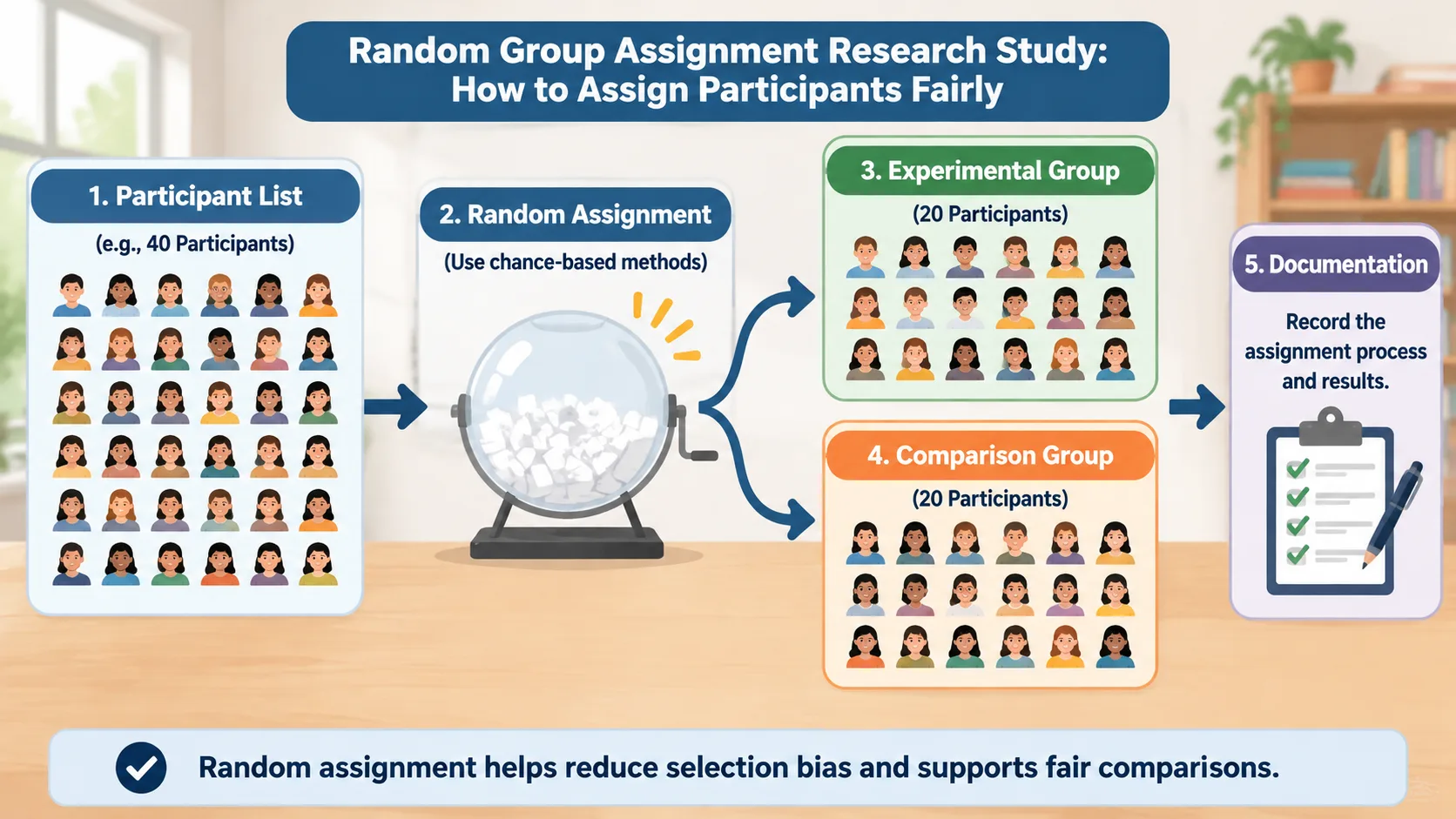
Imagine you are conducting a research study with 40 participants. You want to compare two teaching methods, test a workplace training program, or evaluate a new learning activity. Half of the participants will receive one intervention, while the other half will form a comparison group. The challenge is deciding who belongs where without allowing personal preferences to influence the results.
A random group assignment research study uses chance-based procedures to place participants into research groups. When designed and implemented correctly, random assignment helps reduce selection bias and supports fair comparisons between experimental conditions. This guide explains how to choose an assignment method, create balanced groups, document the process, and decide when a simple group generator is appropriate.
What Is Random Group Assignment in a Research Study?
Random group assignment is the process of allocating eligible research participants to different study conditions using a chance-based method. For example, participants might be assigned to an experimental group receiving a new teaching strategy or a control group following the existing curriculum.
The defining feature is that assignment is not determined by personal preference, participant characteristics chosen by the researcher, or a predictable administrative rule. Instead, participants have a known opportunity to enter each eligible group, and a random process determines the final allocation. The What Works Clearinghouse describes random assignment in terms of assigning study units entirely by chance and ensuring that each unit has a nonzero probability of entering each relevant condition.
It is important to distinguish random assignment from random sampling. Random sampling determines who is selected from a larger population to participate in a study. Random assignment determines what happens to participants after they have entered the study. A project can use random assignment without random sampling, and the two procedures address different research questions.
For example, a university researcher might recruit 30 volunteers through an online announcement. Those volunteers are not necessarily a random sample of all university students. However, the researcher can still randomly assign the 30 volunteers to two different learning conditions. This supports a fairer comparison between the conditions, although it does not automatically make the findings representative of every student.
Why Random Assignment Matters for Research Quality
Researchers need to avoid creating groups that differ systematically before an intervention begins. If participants with stronger academic backgrounds are deliberately placed in one group, that group might achieve better results even if the intervention itself has no effect. Similar problems can occur when employees with more experience are assigned to a new training program while beginners remain in the comparison group.
Random assignment helps address this problem by using chance rather than researcher judgment to determine group membership. Proper randomization can reduce selection bias and balance known and unknown participant characteristics across groups on average. It does not guarantee identical groups, particularly when the sample is small, but it provides a defensible basis for comparing outcomes.
Another advantage is that random assignment supports statistical reasoning. Researchers can use probability-based methods to evaluate whether observed differences between groups might reasonably have occurred by chance. This is one reason randomization is central to randomized controlled trials and many experimental research designs.
Consider a study evaluating a new professional development workshop. If experienced employees are allowed to choose the advanced workshop while newer employees attend the standard session, differences in later performance may reflect prior experience rather than workshop quality. Random assignment reduces this particular source of bias.
However, randomization is not a complete solution to every research problem. It cannot correct poor measurement, insufficient sample size, participant dropout, inconsistent intervention delivery, or misleading analysis. Researchers still need a sound study design, suitable outcome measures, and an appropriate analysis plan.
Choose the Right Random Assignment Method
The best randomization method depends on your research question, sample size, study conditions, and the characteristics that matter most to your analysis. A simple method may be sufficient for a small classroom experiment, while a clinical trial or multi-site study may require a more carefully controlled allocation procedure.
1. Simple random assignment
Simple random assignment gives each participant an opportunity to enter each study condition through an independent chance-based process. A computer-generated random sequence is a practical option. For a two-group study, a researcher might generate assignments labeled A and B, with an intended allocation ratio of 1:1.
This method is straightforward and relatively easy to explain. It works well when the study has enough participants and the researcher does not need to enforce exact group sizes at every stage. However, chance can produce unequal group sizes or differences in important baseline characteristics, especially in small samples.
2. Block randomization
Block randomization helps researchers maintain a planned allocation ratio throughout recruitment. Instead of generating every assignment independently, the researcher creates small blocks containing a predetermined balance of group assignments in a randomized order.
For example, a study comparing two interventions might use blocks containing two A assignments and two B assignments. The order within each block is randomized. This helps maintain similar group sizes as participants enter the study.
The method is useful when participants are recruited over an extended period or when balanced numbers are important at different recruitment stages. However, researchers must consider predictability. If recruiters know fixed block sizes and can see previous assignments, they may be able to anticipate later allocations. More rigorous studies should use appropriate safeguards and consider varying block sizes.
3. Stratified random assignment
Stratified random assignment is useful when certain baseline characteristics are especially important to the research question. Participants are first divided into relevant subgroups, or strata, and then randomized within those categories.
For example, a study comparing two teaching approaches might stratify participants by academic level. Students at each level are divided between the experimental and comparison conditions rather than allowing chance to place most advanced students in one group.
This approach can improve balance on selected characteristics, but it requires planning. Researchers should identify important factors before assignment and avoid creating so many strata that the process becomes difficult to manage. Stratification is not a substitute for an adequate sample size or a carefully designed analysis.
How to Randomly Assign Participants to Research Groups
Once the research design is established, the practical assignment process should be consistent, documented, and easy to reproduce. The following steps provide a useful starting point for educational studies, workplace experiments, and other projects involving human participants.
Step 1: Define the research conditions
Start by identifying exactly what each group will do. Common arrangements include:
- Experimental group: receives the intervention being evaluated.
- Control group: receives no intervention or follows the existing approach, depending on the study design.
- Comparison group: receives an alternative intervention or another specified condition.
Write down the number of groups, their intended sizes, and the allocation ratio. For example, a 1:1 ratio means that two conditions receive approximately equal numbers of participants. A 2:1 ratio means that one condition receives twice as many participants as the other.
Avoid changing the group definitions after seeing the allocation results unless a documented research amendment justifies the change.
Step 2: Prepare the participant list
Create a complete list of participants who have met the study's eligibility requirements and completed the necessary enrollment procedures. Give each participant a unique study identifier rather than relying on names in working allocation files.
Check the list for duplicate entries, missing records, and participants who have withdrawn. Confirm that eligibility decisions have been made before assignment and that the allocation process follows the approved study protocol.
For example, a workplace training study might include 24 eligible employees. The researcher could assign identifiers P001 through P024 and keep the identity key in a separate, appropriately protected file.
Step 3: Select an appropriate randomization method
Choose between simple, blocked, or stratified random assignment based on the study requirements. For a small exploratory activity with no special balancing requirements, simple randomization may be adequate. For a controlled study with a fixed allocation ratio, blocked randomization may be more appropriate.
If the study involves clinical interventions, sensitive participant information, or formal institutional requirements, do not rely on an ordinary group generator as a substitute for a validated research randomization system. Consult the study statistician, research ethics team, or institutional procedures before proceeding.
Step 4: Generate the assignments
Use an appropriate computer-generated randomization process or another method approved in your protocol. For an ordinary classroom or training exercise, a Random Group Generator can help divide a participant list into groups without manually choosing who works together.
A practical workflow is:
- Prepare the participant identifiers in a consistent format.
- Open the grouping tool and enter the eligible participant list.
- Specify the intended number of groups or group sizes.
- Generate the groups using the available random grouping function.
- Review the resulting allocation against the study requirements.
- Save the allocation record and the relevant process details.
For formal research, independently verify that the tool's randomization behavior, allocation probabilities, sequence controls, and data handling meet the approved protocol. A general-purpose grouping tool may be convenient for organizing participants, but convenience alone does not establish methodological suitability for a randomized trial.
Step 5: Check group sizes and implementation
Review the allocation to confirm that each participant appears exactly once and that the number of participants in each group matches the intended design or permitted allocation range.
If a participant is missing or duplicated, investigate the issue rather than silently changing the allocation. If the protocol permits a particular correction, document it. Do not repeatedly regenerate assignments simply because the first result appears inconvenient or produces an unexpected distribution.
Step 6: Record and protect the allocation
Document the randomization method, date, allocation ratio, number of participants, group identifiers, software or process used, and the person responsible for generating the sequence. Preserve the original allocation record and any authorized changes.
In formal randomized studies, sequence generation and implementation should be appropriately separated. People responsible for recruiting participants should not be able to predict upcoming assignments. Allocation concealment helps prevent foreknowledge of group membership from influencing enrollment decisions. This is different from blinding, which concerns knowledge of group assignments after allocation.
Real-World Examples of Random Group Assignment
Understanding the method becomes easier when you apply it to a realistic research question. The following examples show how different study settings can use random assignment while respecting their research requirements.
Example 1: Classroom teaching experiment
A teacher wants to investigate whether collaborative learning activities improve students' understanding of a science topic. The teacher has 32 eligible students and plans to compare two instructional approaches.
The students are assigned unique identifiers, and the researcher uses an approved random assignment procedure to create two groups of 16. One group receives the collaborative learning activities, while the other follows the comparison teaching approach. Both groups complete the same assessment under consistent conditions.
The researcher records the assignment process, checks whether the groups are reasonably balanced on relevant baseline information, and analyzes the results according to the study plan. If students are taught together in ways that allow them to share materials or instructions, the researcher must also consider contamination between conditions.
Example 2: Workplace training evaluation
An HR research team wants to compare an interactive training program with the organization's existing training format. Forty employees volunteer and meet the eligibility criteria.
The team uses a 1:1 allocation ratio, assigning 20 employees to each condition. If job role is an important baseline factor, the researchers may consider stratified randomization so that employees in different roles are represented across both groups.
After the training, both groups complete the same relevant performance assessment. The researchers document participation, training completion, and any departures from the original allocation. This makes it easier to distinguish the intended study design from what actually happened.
Example 3: Online learning experiment
A university researcher wants to compare two versions of an online learning resource. Participants register through a research portal and are assigned to one of two versions.
A computer-generated allocation sequence can support the assignment process, while a suitable research platform can control which resource each participant receives. The researcher records the assignment mechanism and ensures that the same eligibility and outcome-measurement procedures apply to both groups.
If participants can share access links or discuss the learning material, the study should account for possible cross-group exposure. Random assignment creates the initial comparison; it does not automatically prevent participants from influencing one another afterward.
Random Group Generator vs. Manual Assignment: Which Should You Use?
Researchers and facilitators can assign people manually, use spreadsheets, or use a dedicated grouping tool. Each option has a different level of convenience and control.
Manual assignment is useful when a study requires carefully controlled allocation rules, such as a specialized sequence managed by an independent research coordinator. However, assigning participants by hand can introduce personal judgment, especially when researchers know participant characteristics or preferences.
Spreadsheets offer flexibility. Researchers can maintain participant identifiers, organize baseline information, and create allocation records. However, spreadsheet-based randomization requires careful formula management, version control, and protection against accidental changes. A spreadsheet is only as reliable as the process used to create and preserve its assignments.
A general-purpose Random Group Generator is useful when the main task is dividing a participant list into groups efficiently. It can reduce repetitive manual work for classroom activities, pilot exercises, and routine facilitator tasks. It should not be assumed to provide allocation concealment, specialist randomization schemes, or a validated audit trail unless those capabilities have been independently verified.
For studies involving pairs rather than larger groups, a Random Pair Generator can help organize participants into two-person teams. For educational activities where an individual needs to be selected rather than assigned to a research condition, the Random Student Picker serves a different purpose.
The important decision is not simply which tool is fastest. It is whether the chosen method meets the methodological and ethical requirements of the study.
Common Mistakes to Avoid When Assigning Research Groups
Even a well-planned study can encounter problems during allocation. One common mistake is assuming that alternating participants between groups is random. For example, assigning the first participant to Group A, the second to Group B, and continuing in that pattern is predictable. Assignment by date of birth, registration order, or identification number is also deterministic rather than genuinely random.
Another mistake is repeatedly generating new groups until the researcher gets a preferred result. This undermines the purpose of random assignment because the researcher is effectively selecting the allocation that looks most convenient. Establish the method in advance and retain the original allocation record.
Researchers should also avoid confusing equal group sizes with equivalent groups. Two groups can contain the same number of participants while differing substantially in age, experience, baseline knowledge, or other relevant characteristics. Randomization balances characteristics on average, not perfectly in every individual study.
Finally, do not ignore the difference between random assignment and allocation concealment. Generating an unpredictable sequence is one part of the process. Preventing recruiters from knowing the next assignment before enrollment is another. Formal studies should address both issues explicitly and report the procedures transparently.
How to Document Random Assignment in a Research Paper
A research paper should explain enough about the assignment procedure for readers to understand how participants entered each condition. Simply writing that participants were randomly divided into groups is usually not sufficiently informative.
Describe the method used to generate the sequence, the intended allocation ratio, and any restrictions such as blocking or stratification. Explain who generated the sequence, who enrolled participants, and who implemented the assignments. Where relevant, describe how the sequence was concealed before allocation and whether outcome assessors were blinded afterward.
A concise methods statement for a basic educational experiment might read:
"Eligible participants were assigned to two study conditions using a computer-generated random allocation procedure. The intended allocation ratio was 1:1. Each participant was assigned a unique study identifier before allocation, and the original group assignments were retained for the study records."
This example is a reporting template, not a claim that a particular study used a verified procedure. Researchers should replace the wording with an accurate description of what they actually did. If allocation concealment, blocking, or stratification was not used, do not imply otherwise.
For randomized clinical trials, the CONSORT reporting guidance provides additional detail about sequence generation, allocation concealment, implementation, and blinding. The relevant reporting requirements depend on the study design and applicable guidelines.
Frequently Asked Questions
What is the difference between random assignment and random sampling?
Random sampling determines which individuals are selected from a population to participate in a study. Random assignment determines which study condition those participants enter. Researchers can use random assignment even when participants were recruited through convenience sampling, although the recruitment method affects how broadly the findings can be generalized.
How many participants should be in each research group?
The appropriate number depends on the research question, expected effect, outcome variability, statistical power, and study design. Equal group sizes are common in two-condition experiments, but unequal allocation can be justified in some circumstances. Researchers should conduct a sample-size or power calculation rather than choosing group sizes solely for convenience.
Does random assignment guarantee that research groups are equal?
No. Random assignment creates groups through chance and helps balance participant characteristics on average, but individual samples can still contain differences. This is especially important in small studies. Researchers should examine relevant baseline characteristics and use an analysis plan appropriate to the design.
Can I use a random group generator for a research study?
Yes, a general-purpose group generator can be useful for routine participant grouping, classroom experiments, pilot activities, and training exercises. However, formal randomized trials may require validated sequence generation, allocation concealment, controlled access, and an auditable allocation record. Verify that any tool meets the specific requirements of your approved protocol before using it for formal research randomization.
Should researchers change group assignments after randomization?
Generally, researchers should preserve the original allocation and follow the study protocol. If a participant withdraws, becomes ineligible, or cannot complete the intervention, document what happened rather than silently replacing or reassigning that person. Any permitted changes should be handled transparently and reflected in the analysis.
What is the best randomization method for a small research study?
Simple random assignment may be suitable for a small study when there are no special balancing requirements. Blocked or stratified methods may be preferable when group sizes or specific baseline characteristics need greater control. The decision should be made before enrollment and, where appropriate, with statistical guidance.
Make Your Research Group Assignment Process More Organized
A transparent random assignment process starts with a clear research design, a complete participant list, and a method selected before group allocation begins. Researchers should document how assignments were generated, protect participant information, and avoid changing results to fit expectations.
For ordinary classroom experiments, collaborative research activities, and facilitator-led exercises, a digital grouping tool can make participant organization easier. For formal randomized trials, use a research-grade allocation process that meets your protocol's requirements for unpredictability, concealment, and documentation.
Ready to organize participants into groups? Try the Random Group Generator to divide a participant list quickly and make your next group-based activity easier to manage.
Related Tools
Pick the right generator for the job — every tool runs free in your browser.