
classroom cliques
How Teachers Use Random Pickers to Reduce Cliques in the Classroom
Discover how teachers use random pickers to break up classroom cliques, foster inclusivity, and ensure every student gets a fair chance. Learn step-by-step strategies and practical tips.
How Teachers Use Random Pickers to Reduce Cliques in the Classroom
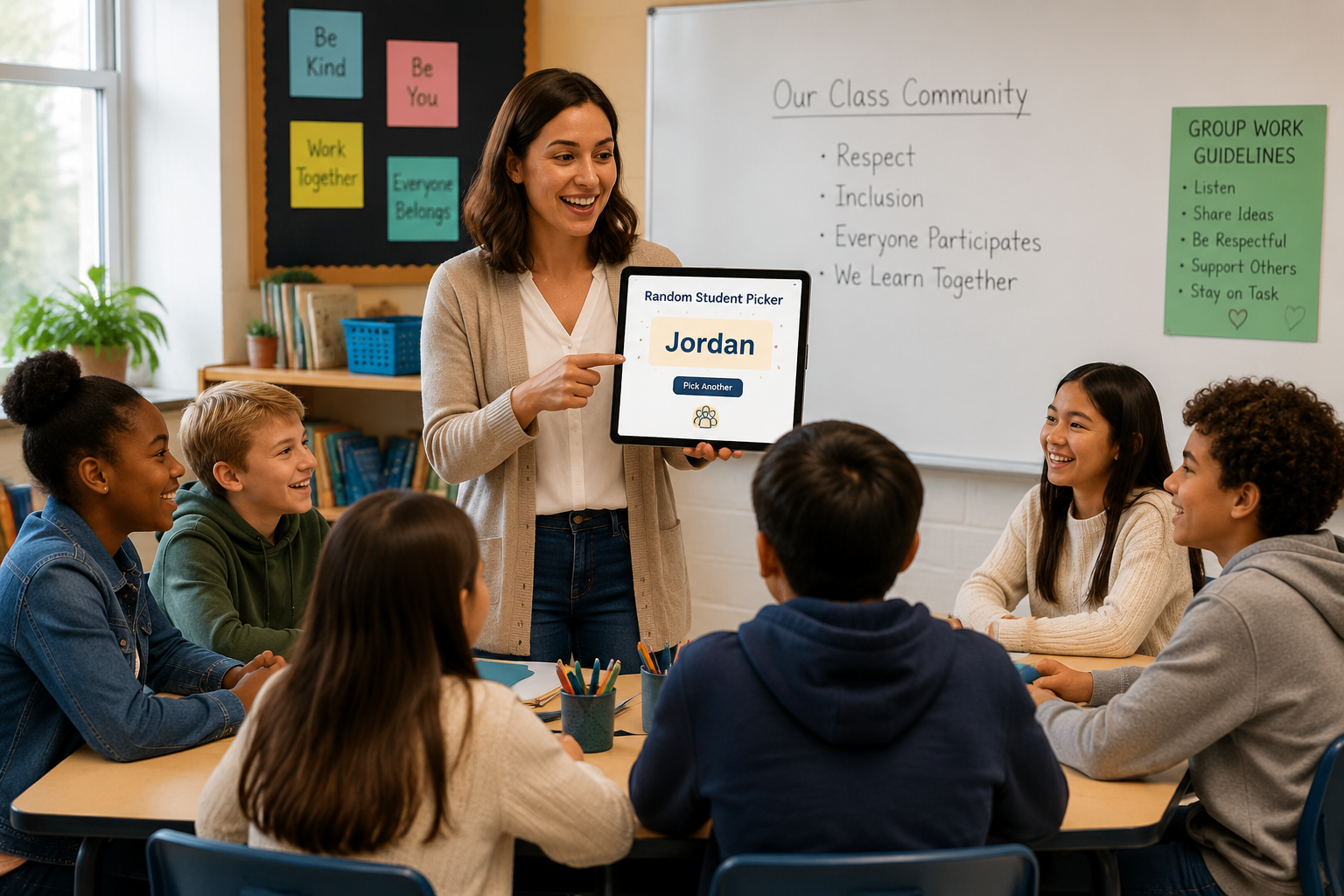
Classroom cliques can quietly undermine everything you work to build as an educator. When the same students always partner up, the same voices dominate discussions, and the same kids are left standing alone during group formation, everyone misses out. A random picker offers a simple, impartial way to break these patterns. By using the random student picker from Random Group Generator, you introduce fairness into everyday classroom routines—giving every student an equal chance to participate, collaborate, and feel included.
The Problem of Classroom Cliques
Cliques form naturally in almost every classroom. Students gravitate toward peers they already know, share interests with, or feel socially safe alongside. While these small groups can offer comfort, they also create invisible walls. Students outside those circles often experience exclusion during group work, lunch seating, or offhand classroom interactions. Over time, this can damage self-esteem, limit collaboration skills, and narrow the range of perspectives a student encounters during learning.
For teachers, self-selected groups are the most common entry point for cliques to harden. A well-intentioned “choose your own partner” can quickly become a familiar ritual where popular students pair up instantly, while quieter or new students wait to be chosen—or worse, remain unchosen. This public ordering reinforces social hierarchies and can make the classroom feel emotionally unsafe for those left on the sidelines.
Manual interventions, like strategically assigning students to mix them up, help but come with their own costs. Creating balanced groups by hand takes time that teachers rarely have, especially when trying to account for social dynamics, ability levels, and behavioral considerations. Moreover, students may resist teacher-made groupings as unfair or manipulative, which can trigger pushback and spoil the activity. A random picker solves both the time problem and the perception problem by acting as a neutral third party that nobody can argue with.
How a Random Picker Helps Break Down Social Barriers
The core power of a random student picker is its absolute impartiality. It does not favor friendship bonds, academic reputation, or social status. When you let the tool decide who answers a question, who presents first, or who works together, you communicate that every student is equally valuable. This impartiality reduces the anxiety of being “picked last” and removes the burden on teachers to manually engineer inclusivity—something that can backfire if students sense adult bias.
Used consistently, random selection interrupts entrenched grouping habits. A student who always partners with one friend now has a reason to interact with someone new. Repeated exposure across different activities—quick think-pair-share, project teams, presentation order—helps students discover common ground with classmates they might never have approached on their own. The tool doesn’t force friendships, but it opens doors. Over a semester, the classroom norm shifts from “everyone stay in your comfort zone” to “anyone can work with anyone, and that’s just how we do things here.”
This approach also reduces teacher stress around managing group dynamics. Instead of playing social engineer, you become the facilitator of a fair system. The random student picker on Random Group Generator makes this effortless: you simply enter a list of names, click to pick, and let the animated selection build anticipation. Students quickly accept the tool as the decider, which minimizes negotiations and complaints. If you need to form full groups rather than pick individuals, the random group generator can split the whole class into mixed teams in one click, ensuring no clique dominates a single table.
Step-by-Step: Using a Random Picker for Classroom Activities
Integrating a random picker into your daily flow takes no special training—just a device and an internet connection. The following steps work whether you are teaching in person or remotely through a screen share.
1. Prepare your student list. Open the random student picker and type or paste the names of all students. You can save this list for future sessions by bookmarking the page or keeping the text file handy, so you never need to retype it.
2. Choose your activity. Decide whether you need to select one person (to answer a question, demonstrate a concept, or choose the day’s helper) or form groups. For single picks, the random student picker is perfect. For larger group tasks, head to the random group generator and specify the number of groups or members per group.
3. Run the random selection. Involve the whole class—share your screen if teaching remotely, or turn your tablet so everyone can see. Click the pick button and let the name wheel spin. The visual suspense makes the process feel like a game, not a cold mechanical selection.
4. Act on the result immediately. Use the chosen student’s name right away for the intended purpose. For example: “The picker says Jasmine will present first today.” Because the selection is visibly random, there’s no room for favoritism debates.
5. Repeat across different activities. The more you use the picker, the more natural it becomes. Use it for taking attendance, forming quick pairs for a three-minute chat, selecting which team presents their findings first, or even picking the order of cleanup duties. The goal is to weave random, fair selection into the fabric of your classroom culture.
As an example, imagine a high school English class where students always cluster in the same discussion circles. The teacher uses the random pair generator to quickly create rotating “elbow partner” pairs each week for short writing check-ins. Over the course of a month, every student has had a real conversation with at least four classmates they rarely spoke to before, without any adult forcing them to sit together.
Real-World Example: Group Work Without Exclusion
Ms. Carter teaches eighth-grade science. Her lab tables seat four, and she had fallen into the habit of letting students pick their own seats most days. Predictably, the same friendship groups claimed the same tables, while a few students consistently drifted to the remaining spots without a genuine welcome. One new student, Emma, spent her first two months quietly working beside a different friend group each week, never really settling in.
Ms. Carter decided to reboot her approach using the random group generator for every lab activity. At the start of each class, she opened the tool on her Chromebook, projected the screen, and clicked “generate groups.” The room buzzed as names shuffled into new foursomes. There was mild grumbling at first from students who missed their usual partners, but within two weeks a shift occurred. Emma found herself naturally talking about the experiment with peers who previously ignored her. Other quiet students began speaking up more, knowing their voices were needed in a group where nobody held sway as the dominant friend.
Over the semester, the classroom climate improved. Students became more adaptable, and the awkwardness of being “left out” disappeared because the process was transparently random. Ms. Carter didn’t have to become a social referee; she just became the person who clicked the button. She still used the random student picker for quick individual tasks like explaining a lab safety step, reinforcing the idea that randomness was her default classroom management tool, not a punishment.
Tips for Integrating Random Selection into Your Routine
Start small and low stakes. In the first week, use the picker only for activities where no grade or ego is on the line—who gets to lead the morning greeting, who picks the brain-break music, who reads the daily announcement. This builds trust in the system and eliminates the pressure students often feel when being “called on” without warning.
Pair randomness with a positive frame. Explain to your class that the picker is there to help everyone get to know each other better and to make sure no one is invisible. When students understand the “why,” they are far less likely to resist. You can even give the picker a fun nickname to humanize it.
Add an element of fun with group names. To sweeten the deal, after the random group generator sorts your class into teams, let each team quickly come up with a creative name using the group name generator. Names like “The Thunder Lizards” or “Rocket Scientists” inject humor and identity into a random grouping, making students forget they didn’t choose their teammates.
Know when to intervene. Randomness does not mean you abdicate professional judgment. If you have two students with a documented conflict, it is perfectly acceptable to manually adjust the groups before announcing them. The key is to keep such adjustments rare and transparent, so randomness remains the classroom default.
Build it into your weekly rhythm. Consistency is everything. When students know that every Tuesday’s lab pairs are randomly assigned, or that Friday fun activity leaders are always chosen by the picker, the tool ceases to be a disruption and becomes a welcome ritual that consistently chips away at cliques.
When a Random Picker Might Not Be the Right Tool
A random student picker is not a universal solution. If your activity requires students to work at their instructional reading level, random grouping could place a struggling reader in a team that cannot offer appropriate support, leading to frustration. In skill-homogeneous tasks, intentional grouping based on data remains the better choice.
Similarly, if your classroom is dealing with active bullying or a recent traumatic social incident, random grouping without support can backfire. Victims placed with aggressors, even by chance, may feel unsafe. In these cases, a random picker should be paused or used only for low-risk solo tasks until the social health of the room is restored under your guidance.
The tool is also less effective if used in isolation. Reducing cliques long-term requires a broader classroom community strategy that includes class meetings, collaborative norms, and explicit teaching of social skills. The random picker acts as a powerful lever, but it cannot single-handedly fix deeply rooted social fractures.
Finally, overuse can cause fatigue. If every single interaction is randomized, students may feel a loss of agency. Balancing occasional free-choice moments with random pairings gives students the autonomy they need while still systematically broadening their social worlds.
Frequently Asked Questions
Does a random picker actually reduce cliques long-term?
Regular use breaks habitual grouping patterns, giving students repeated exposure to different peers, which can reduce in-group preference over time. It is not a magic wand, but when combined with a supportive classroom culture, it consistently helps more students feel included and valued.
Can I use a random picker for any subject or grade level?
Yes. The random student picker works from early elementary to university. You can adjust tone and framing for each age group. For younger students, the visual animation adds excitement; for older students, the fairness and efficiency are the main draws. The tool handles any class size effortlessly.
What if a student feels embarrassed when randomly chosen?
Establish a classroom norm where being picked is never a punishment. Use the picker for fun, low-stakes tasks first, and avoid using it for high-stakes solo performances without preparation. Always allow a student to say “pass” if they are truly uncomfortable, and follow up privately to understand their concerns.
How do I prevent students from gaming the random system?
Since the algorithm runs on a genuine random seed and isn’t influenced by anything a student does, there is nothing to game. The only risk is that students may try to negotiate after results are shown. Stick calmly to the result, and over time they will accept it as non-negotiable.
Is the random student picker on random-group-generator.com free?
Yes, the random student picker is completely free, requires no registration, and works on any device with a web browser. You can also use the random group generator and random pair generator instantly without any payment.
Ready to reduce cliques in your classroom? Try the free random student picker today and bring impartial, fair selection into every lesson.