
randomization
How Randomization Reduces Bias in Team Formation: A Practical Guide
Learn how randomization reduces bias in team formation, improves fairness, and helps teachers and facilitators create balanced groups with practical strategies.

Imagine asking a class of 30 students to form groups for a project. Within seconds, familiar friends gather together, confident students take charge, and quieter students wait to see where they belong. A corporate trainer faces a similar challenge when asking employees to join workshop teams. People often choose colleagues they already know, managers may favor experienced employees, and some participants repeatedly end up in less visible roles. Randomization reduces bias in team formation by replacing some of these subjective decisions with a consistent, transparent process. It gives teachers and facilitators a practical way to distribute people into groups without relying entirely on personal preferences, assumptions, or existing social relationships.
Random assignment is not a guarantee that every group will be perfectly balanced. However, it can make the formation process more consistent, reduce favoritism, and give participants opportunities to work with people they might not normally approach. The goal is not to remove every human decision from teamwork. It is to make the decisions that shape participation fairer and easier to explain.
Why Bias Happens During Team Formation
Forming teams may seem like a simple administrative task, but people bring assumptions into the process. Teachers might place students together because they appear to have similar abilities. Managers might select employees they consider reliable. Event organizers may repeatedly put familiar participants together because previous events went smoothly. These decisions are often well-intentioned, but they can create patterns that limit participation.
One common influence is familiarity bias. People naturally gravitate toward individuals they already know. In a classroom, this can create friendship-based groups that leave isolated students waiting for an invitation. In a workplace, employees from the same department may repeatedly collaborate, while colleagues from other teams receive fewer opportunities to contribute.
Another influence is confirmation bias. Once someone believes that a particular student is a strong leader or that an employee is not comfortable speaking publicly, they may continue assigning that person similar roles. Over time, these assumptions can become self-reinforcing. A participant who rarely receives leadership opportunities may appear less experienced simply because they have had fewer chances to practice.
There is also the problem of perceived fairness. Participants may question why certain people are always placed together or why particular individuals receive preferred assignments. Even when a facilitator has good reasons, an opaque selection process can create unnecessary disagreement.
For example, consider a teacher who manually creates five project groups. The teacher may unintentionally place the most confident students together because they are easier to identify as leaders. Random assignment changes the starting point: everyone enters the selection process under the same basic rule rather than depending on the teacher's personal impressions.
How Randomization Reduces Bias in Team Formation
Randomization introduces an impartial selection mechanism into the team formation process. Instead of asking who should work together, the facilitator allows a random process to determine initial group membership. This reduces the influence of individual preferences and makes it less likely that the same familiar combinations will be chosen repeatedly through habit.
The main benefit is procedural fairness. Participants know that group assignments were not simply based on friendship, popularity, personal relationships, or an informal judgment of their abilities. When the process is visible and consistently applied, facilitators can explain how the groups were formed without having to defend every individual placement.
Randomization can also broaden social and professional interactions. A student who usually works with the same three classmates may collaborate with someone from another friendship circle. An employee who spends most of their time with one department may meet colleagues from different parts of the organization. These interactions create opportunities for people to exchange perspectives and become familiar with different working styles.
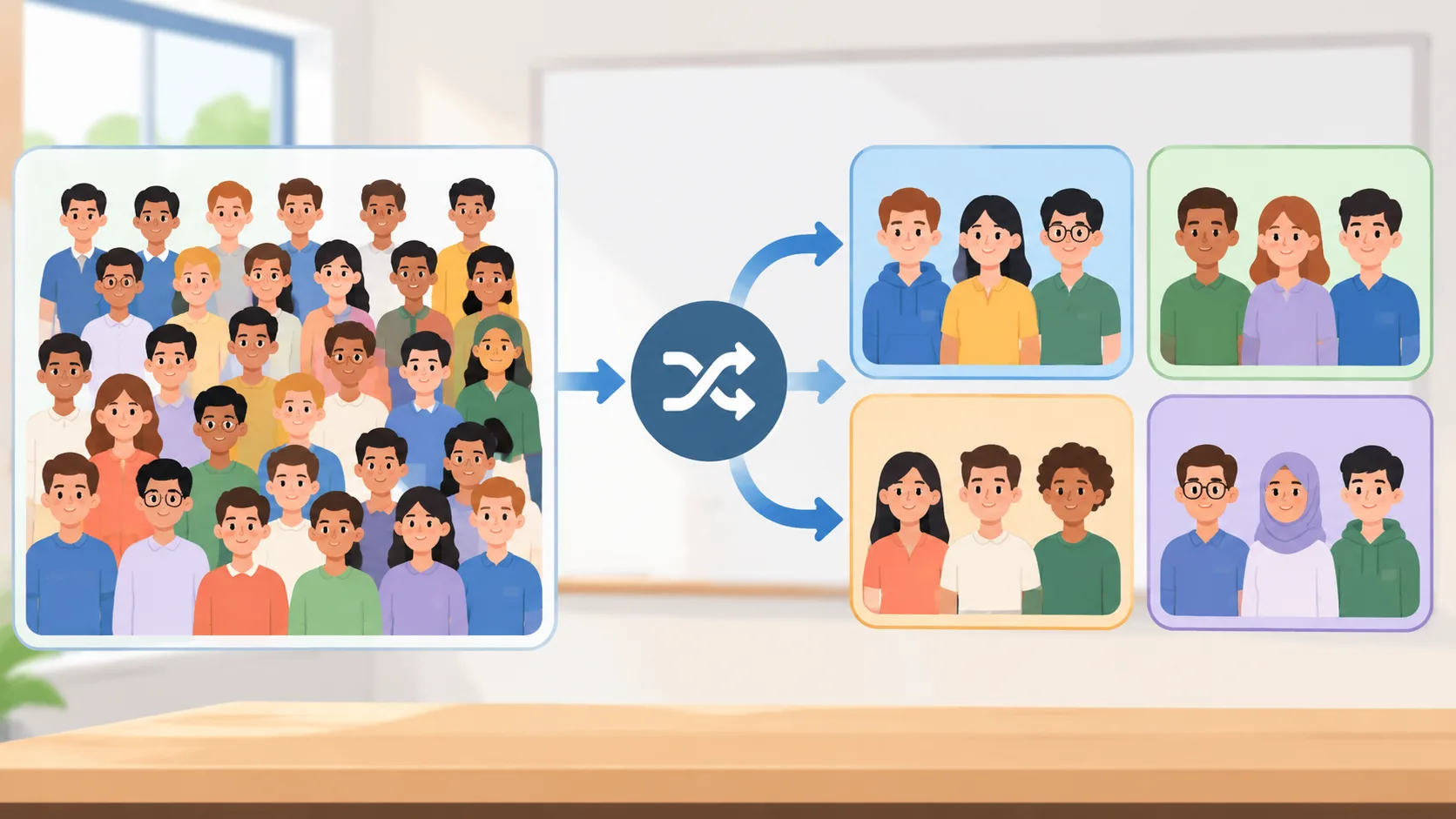
However, it is important to understand what randomization actually solves. It reduces discretion in the selection process, but it does not automatically remove existing differences between participants. A random group may still contain several experienced members and several beginners. It may also produce an uneven distribution of communication styles or accessibility needs.
A useful distinction is between equal treatment and balanced outcomes. Pure random selection gives participants an equal opportunity to be assigned to different groups, but it does not guarantee identical group characteristics. For facilitators who need particular skill or experience combinations, a structured approach that combines randomization with carefully defined constraints may be more appropriate.
Practical Benefits for Teachers and Team Facilitators
Randomization is particularly useful when a facilitator wants to create new working relationships without making personal judgments about every participant. It offers a repeatable starting point that works across different group sizes and activities.
1. Fewer friendship-based groupings. Students often prefer working with familiar classmates. Random assignment introduces different combinations and gives students a reason to communicate beyond their usual social circles. For example, a science teacher can generate four-person teams before a laboratory activity instead of allowing students to choose their own partners.
2. More transparent decisions. When participants understand that assignments were generated randomly, they have a clearer explanation for why they were placed together. This is useful during training sessions, classroom activities, and company workshops where participants may question team selection.
3. More opportunities to collaborate. Repeatedly working with the same people can limit exposure to different ideas and working styles. Changing group membership creates opportunities for new conversations. A corporate facilitator might rotate employees into different teams across a series of problem-solving workshops.
4. Less administrative work. Manually assigning participants takes time, especially when attendance changes or a session needs several rounds of group activities. A random group generator can handle the initial distribution quickly, allowing facilitators to spend more time preparing the actual activity.
5. More consistent procedures. A repeatable random assignment process can help facilitators avoid making different selection decisions based on mood, time pressure, or familiarity with participants. Consistency is particularly important when the same activity is repeated across several classes or departments.
These benefits depend on how the process is implemented. Randomization should support good facilitation, not replace it. Teachers still need to consider accessibility, safeguarding, learning requirements, and relevant interpersonal concerns. Managers should also avoid treating a randomly assigned team as a substitute for appropriate supervision or professional judgment.
How to Use Randomization for Fairer Team Formation
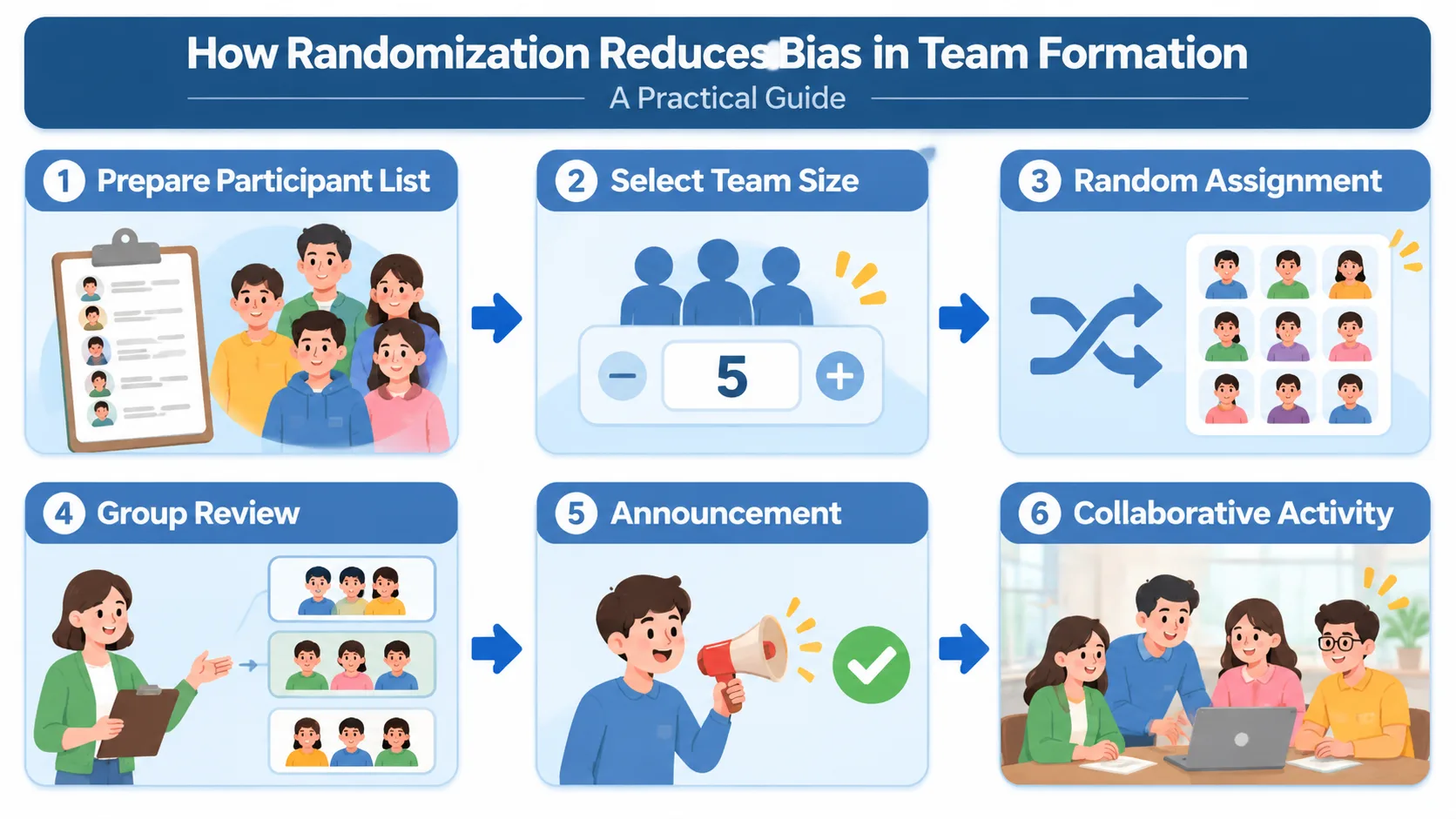
A random process works best when the facilitator establishes clear rules before generating groups. The following steps provide a practical approach for classrooms, training sessions, and workplace activities.
Step 1: Define the Purpose of the Teams
Start by identifying what participants need to accomplish. Are they completing a short discussion, solving a complex problem, conducting a laboratory activity, or developing a project over several weeks? The purpose affects the ideal group size and whether any additional constraints are necessary.
For a quick classroom discussion, groups of three or four may be convenient. For a detailed corporate workshop, smaller teams may allow everyone to contribute. These are practical starting points rather than universal rules. The facilitator should choose a size that fits the task, available time, and participant count.
Step 2: Prepare an Accurate Participant List
Collect the names of everyone who will take part. Check spelling, remove duplicates, and account for participants who are absent or joining remotely. An accurate list prevents avoidable confusion after the assignments are generated.
If a class has 24 students, for example, the teacher might prepare a list of all 24 names before dividing them into six groups. If one student is absent, the teacher should update the list before generating the final assignments.
Step 3: Choose a Randomization Method
Select a method that fits the situation. A facilitator can draw names from a container, shuffle numbered cards, use a spreadsheet, or use an online random group generator. The important point is that the method follows a consistent selection rule rather than relying on personal preference.
An online tool is especially useful when the participant list changes frequently or several grouping rounds are required. The Random Group Generator allows facilitators to create groups from a participant list without manually arranging every name.
Step 4: Set Group Sizes or the Number of Groups
Decide whether the activity requires a fixed number of participants per team or a fixed number of teams. For example, a facilitator with 25 participants might choose five groups of five. With 26 participants, the tool or facilitator needs to distribute the extra participant without creating an unnecessary oversized team.
If the activity requires partners instead of larger teams, use a Random Pair Generator. Pairing is useful for interviews, peer feedback, language practice, and short discussion exercises.
Step 5: Generate and Review the Assignments
Run the random selection process and review the resulting teams. Check for accidental duplicates, missing participants, or practical issues that would prevent someone from participating.
A review does not mean changing assignments simply because a facilitator prefers certain combinations. It means checking whether the result meets the activity's essential requirements. If a participant needs an accommodation or a documented safeguarding arrangement, address it using a consistent rule and explain the process appropriately.
Step 6: Explain the Process to Participants
Tell participants how their teams were created and why randomization is being used. A simple explanation is often sufficient: everyone was included in the same selection process, and the purpose is to give people opportunities to collaborate with different colleagues or classmates.
For recurring activities, consider generating new groups each time. This helps prevent the same participants from always working together. If the activity is part of a longer project, however, stable teams may be more useful than frequent changes.
Real-World Examples of Reducing Team Selection Bias
Example 1: A Middle School Science Classroom
A teacher has 28 students and wants to create seven teams of four for a science investigation. Allowing students to choose their own teams has repeatedly resulted in familiar friendship groups, while a few students struggle to find partners.
The teacher enters all 28 names into a random group generator and creates seven teams. Before announcing the results, the teacher checks that all names appear once and that any required accessibility arrangements are respected. Students then receive their assignments and begin the investigation.
The important change is the selection process. Rather than relying on friendship networks or assumptions about ability, the teacher gives every student access to the same assignment procedure. Over several activities, the teacher can generate new combinations so that students have opportunities to work with different classmates.
Example 2: A Corporate Training Workshop
A human resources facilitator is running a communication workshop for 20 employees from different departments. Without a selection process, participants tend to sit with familiar colleagues, making cross-department discussions less likely.
The facilitator prepares the participant list and generates four groups of five. Each group receives the same discussion question and a fixed amount of time to develop its response. The facilitator then rotates the groups for a second activity.
This approach makes team formation less dependent on departmental relationships. It also gives employees a structured opportunity to hear perspectives from colleagues they might not normally work with. Randomization does not guarantee equal participation, so the facilitator still monitors discussions and invites quieter participants to contribute.
Example 3: A University Seminar
A university lecturer wants students to review research papers in small groups. Some students are experienced researchers, while others are encountering academic research methods for the first time.
Pure random assignment could produce a group with several experienced students and another with mostly beginners. The lecturer therefore uses a structured approach: first identifying essential experience requirements, then randomly assigning students within appropriate categories.
This is an example of constrained randomization. The facilitator defines the relevant conditions before selection rather than changing groups based on personal preferences afterward. The process retains an element of fairness while addressing the specific learning requirements of the activity.
Randomization vs. Manual and Self-Selected Teams
Random assignment is not the only way to create teams. Manual selection and participant choice can also be useful, depending on the activity. Understanding the differences helps facilitators select a method that matches their goals.
| Team formation method | Main advantage | Potential limitation | Suitable situation |
|---|---|---|---|
| Random assignment | Reduces personal discretion in selection | Does not guarantee balanced skills | Classroom activities and workshops |
| Manual assignment | Allows targeted skill and experience distribution | Can introduce subjective bias | Specialized projects with clear requirements |
| Self-selected teams | Gives participants control over partners | Can reinforce existing social groups | Optional collaborative activities |
| Constrained randomization | Combines random selection with defined requirements | Requires more preparation | Mixed-experience training or specialized learning tasks |
Self-selected teams are useful when trust, comfort, or existing relationships are important to the activity. For example, participants may prefer to choose their partners for an informal creative exercise. However, this method is less appropriate when the objective is to introduce new working relationships or reduce repeated social grouping.
Manual selection is useful when a facilitator knows that particular expertise or accommodations are necessary. A project requiring a qualified specialist may need a specific person in each group. The challenge is to distinguish genuine requirements from assumptions about who is capable of contributing.
Constrained randomization offers a middle ground. It can preserve random selection within predefined categories, such as experience levels or workshop roles. The constraints should be relevant, transparent, and limited to what the activity genuinely requires.
The right choice depends on the purpose of the activity. Randomization is most valuable when equal access to the selection process matters more than controlling every group characteristic.
How to Make Random Team Assignments More Balanced
Randomness and balance are related, but they are not identical. A random process may produce uneven results, particularly when the participant pool is small. If a facilitator needs a particular distribution, the selection process should account for that requirement.
One approach is to identify the characteristics that genuinely matter before creating teams. For example, a training session may need at least one participant familiar with a particular software system in each group. A classroom activity may require access to specialized equipment. These practical conditions can justify limited adjustments.
Another approach is to separate selection from role assignment. First, generate the teams randomly. Then assign rotating responsibilities, such as discussion leader, note-taker, presenter, and timekeeper. This avoids automatically giving leadership roles to the same confident participants.
Consider a class with 24 students divided into six groups. The teacher could randomly assign the teams and then rotate the discussion leader role during each new activity. Students who have not previously led a discussion receive an opportunity to practice. The teacher can observe participation without assuming that the first random assignment will solve every group dynamic.
It is also helpful to record group combinations across repeated sessions. If a class completes five separate activities, a facilitator can check whether certain students repeatedly end up together. Randomization does not promise that every combination will be different, but reviewing previous assignments can help determine whether a rotation or additional constraint is needed.
The guiding principle is simple: use random selection to reduce unnecessary discretion, then make only the adjustments that serve a clearly defined educational or operational purpose.
Common Mistakes to Avoid When Using Randomization
The first mistake is assuming that random groups are automatically equal in every respect. A random selection process does not measure confidence, knowledge, communication ability, or experience. Facilitators should not present random teams as perfectly balanced unless they have actually checked the relevant characteristics.
The second mistake is repeatedly changing groups without considering the activity. Short exercises often benefit from new combinations, but longer projects may require time for trust, coordination, and shared responsibility to develop. Changing teams every session can disrupt progress when participants need continuity.
The third mistake is making unexplained exceptions. If a facilitator changes assignments whenever someone complains, participants may begin to question whether the original process was genuinely random. Essential accommodations and safety requirements should be addressed through clear rules established before selection.
The fourth mistake is ignoring participant experience after the teams are announced. Random assignment can create new opportunities, but it cannot ensure that everyone feels included. Teachers and managers should monitor whether participants have meaningful roles, whether conversations are dominated by a few individuals, and whether anyone is consistently excluded.
Finally, do not confuse randomization with anonymity or confidentiality. A random group generator helps determine team membership, but facilitators still need to handle participant information responsibly. Avoid sharing sensitive personal details or using group assignments to reveal private information.
Frequently Asked Questions
Does randomization completely eliminate bias in team formation?
No. Randomization reduces the influence of personal preferences and subjective selection decisions, but it cannot remove every source of bias. Existing differences between participants may still affect group dynamics. Facilitators should review assignments for genuine accessibility, safeguarding, and activity requirements.
Are randomly assigned teams always balanced?
No. Random selection provides an impartial starting point, but it does not guarantee equal experience, knowledge, confidence, or skill distribution. If balance is essential, use predefined constraints and explain how they affect the assignment process.
Is random team formation suitable for classroom activities?
Yes. It can be useful for discussions, peer reviews, science activities, collaborative problem-solving, and short projects. Teachers should still consider age, accessibility, safeguarding, and the learning objectives before finalizing groups.
How often should teachers and facilitators change teams?
The frequency depends on the activity. Short classroom exercises and workshops may benefit from new combinations each time, while longer projects often require stable teams. A practical approach is to rotate groups between activities when introducing new working relationships is more important than maintaining continuity.
What is the difference between randomization and constrained randomization?
Pure randomization assigns participants without considering individual characteristics. Constrained randomization introduces predefined conditions, such as ensuring that each team includes someone with a required skill. The second method is useful when a completely unrestricted assignment would not meet the activity's practical requirements.
Can an online random group generator help reduce favoritism?
Yes. An online tool can apply the same selection process to everyone on a participant list, reducing the need for manual decisions. However, the facilitator remains responsible for preparing accurate lists, selecting appropriate group sizes, reviewing results, and addressing legitimate participation requirements.
Create Fairer Teams with a Random Group Generator
Fair team formation starts with a process that participants can understand and trust. Randomization helps teachers, trainers, and event organizers reduce the influence of familiarity, personal preferences, and repeated selection habits. It also makes creating new team combinations faster and easier when activities require frequent regrouping.
The most effective approach is to combine impartial selection with thoughtful facilitation. Define the purpose of the activity, prepare an accurate participant list, choose suitable group sizes, generate the teams, and review only the adjustments that are genuinely necessary.
Ready to create your next set of teams? Try the Random Group Generator to assign participants quickly and give everyone an opportunity to collaborate with someone new.
Related Tools
Pick the right generator for the job — every tool runs free in your browser.