
random group generator
How Random Group Generators Work: The Algorithms Behind Fair Team Draws
Learn how random group generators work, from name lists and shuffles to fair team assignment. Explore Fisher-Yates shuffle, bias prevention, seeded draws, and balanced grouping.
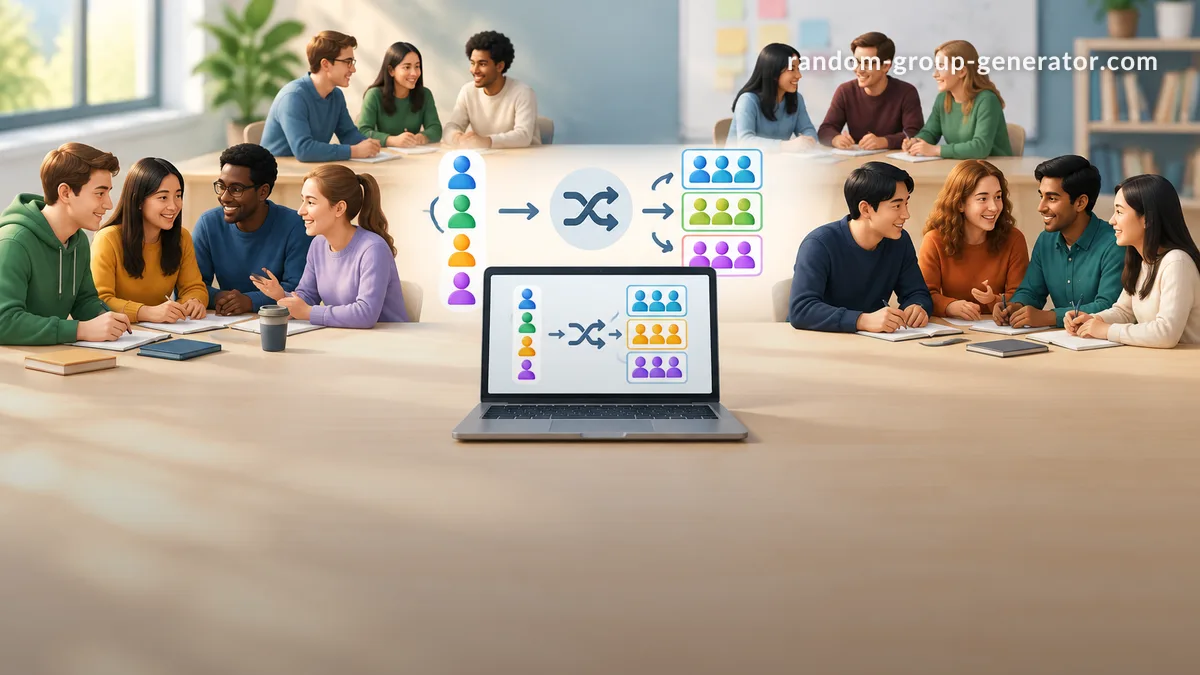
Teachers, trainers, and event facilitators often face the same challenge: creating groups quickly while making sure the process feels fair. A manual draw can take time, repeat the same patterns, or accidentally favor certain participants. This is why understanding how random group generators work helps educators and facilitators choose better tools and explain the process with confidence.
A random group generator takes a list of participants, applies a randomization method, and assigns people into teams based on selected rules. The basic process is simple, but the algorithms behind it determine whether the results are truly balanced. Modern tools use techniques such as the Fisher-Yates shuffle, careful random number handling, and optional balancing methods to improve fairness.
Why understanding random group generators matters
When a teacher asks students to form groups, the goal is usually more than speed. The teacher wants students to work with different classmates, avoid repeated partnerships, and create a sense that everyone has an equal chance. Corporate facilitators have similar needs when forming workshop teams or discussion groups.
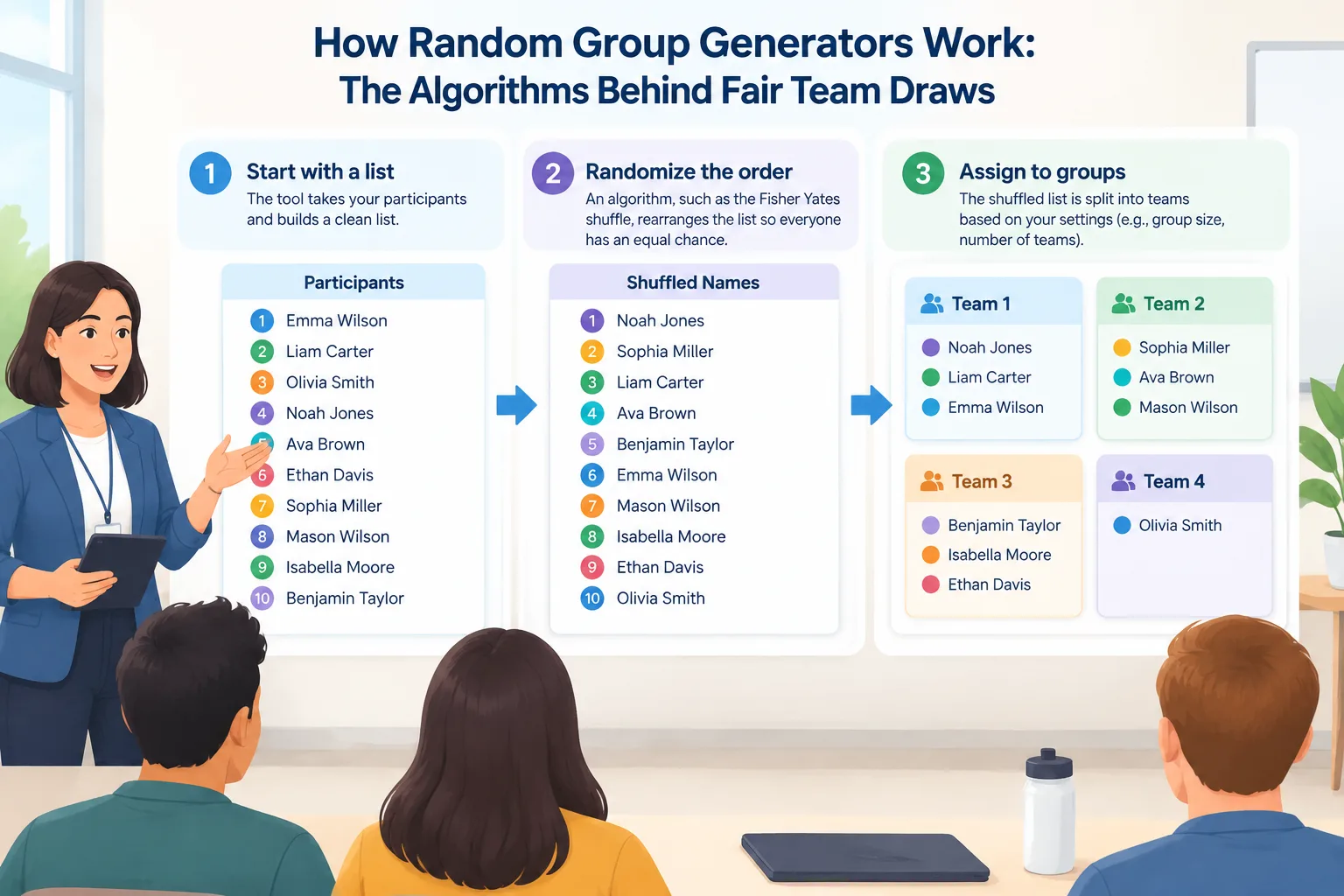
Understanding how random group generators work helps users know what happens after they click a button. The tool is not simply picking names from a virtual hat. It follows a sequence: reading the participant list, creating a randomized order, and distributing participants according to the chosen grouping method.
For example, a teacher with 24 students may need four groups for a science project. Instead of manually moving names between teams, a generator can create a new arrangement in seconds. The teacher can focus on the lesson rather than the mechanics of organizing groups.
Randomization also has limits. Pure randomness does not guarantee that every group has the same mix of skills, experience, or personality types. A good generator should offer different modes when the goal is equal participation rather than only random distribution.
The basic process behind a random group generator
The first stage of any random group generator is collecting and preparing the input. The tool needs a list of names and information about the desired number of groups or team size. Once the information is ready, the algorithm can begin creating an assignment.
The general process looks like this:
- The user enters participant names into the tool.
- The generator checks the list and prepares the names for processing.
- A shuffle algorithm changes the order of the names.
- The shuffled list is divided into groups using the selected rules.
- The final teams are displayed for the user.
Consider a workshop with eight participants: Ana, Ben, Cara, David, Emma, Frank, Grace, and Henry. The generator first stores the names as a list. It then changes the order randomly. If the user selects two groups, the first four names after shuffling may become Team A and the next four names may become Team B.
The important part is that the quality of the shuffle affects fairness. If the random order is predictable or biased, the final groups may not be as fair as they appear.
How the Fisher-Yates shuffle creates fair random order
The Fisher-Yates shuffle is one of the most common methods used for creating a random order. It works by moving through a list and swapping each item with another randomly selected item from the remaining positions.
The algorithm is designed so that every possible ordering of the list has an equal chance of appearing. This matters because a group generator depends on the shuffled order before it assigns people to teams.
A simplified example uses eight names. The algorithm starts at the final position and chooses a random position from the available range. It swaps those two names, then moves to the next position. It continues until the list has been processed.
The steps look like this:
- Start with the full list of eight names.
- Choose a random position for the last name and swap it.
- Move to the previous position and repeat the random swap.
- Continue until all positions have been processed.
- Use the finished order for group assignment.
For example, the original list could begin as:
Ana, Ben, Cara, David, Emma, Frank, Grace, Henry
After several swaps, it might become:
Grace, Ana, Henry, Cara, Frank, David, Ben, Emma
The generator then assigns names from this new order. This approach avoids common mistakes where some positions are more likely than others.
How random number choices affect fairness
A shuffle algorithm needs a source of random values. The quality of those values matters because the random choices decide the final order.
A common programming mistake is called modulo bias. This happens when a random number is reduced into a smaller range in a way that does not give each possible result the same chance. For example, simply using a remainder operation to select positions can make some outcomes slightly more likely than others.
A better approach is to generate a random value within the correct range and use it directly for the selection process. Many modern implementations use methods designed to avoid uneven probability during random choices.
For classroom and workshop activities, the difference may not be visible in a single draw. However, a reliable algorithm matters when a tool is used repeatedly by many people. Fair systems should avoid hidden patterns that could influence results over time.
How this tool assigns groups after shuffling
After the shuffle is complete, a generator still needs a rule for creating teams. The simplest method is sequential slice assignment. The shuffled list is divided into sections, and each section becomes a group.
For example, with 20 participants and four teams, the first five names after the shuffle become Group 1, the next five become Group 2, and so on. This approach is fast, easy to understand, and works well when the goal is equal random distribution.
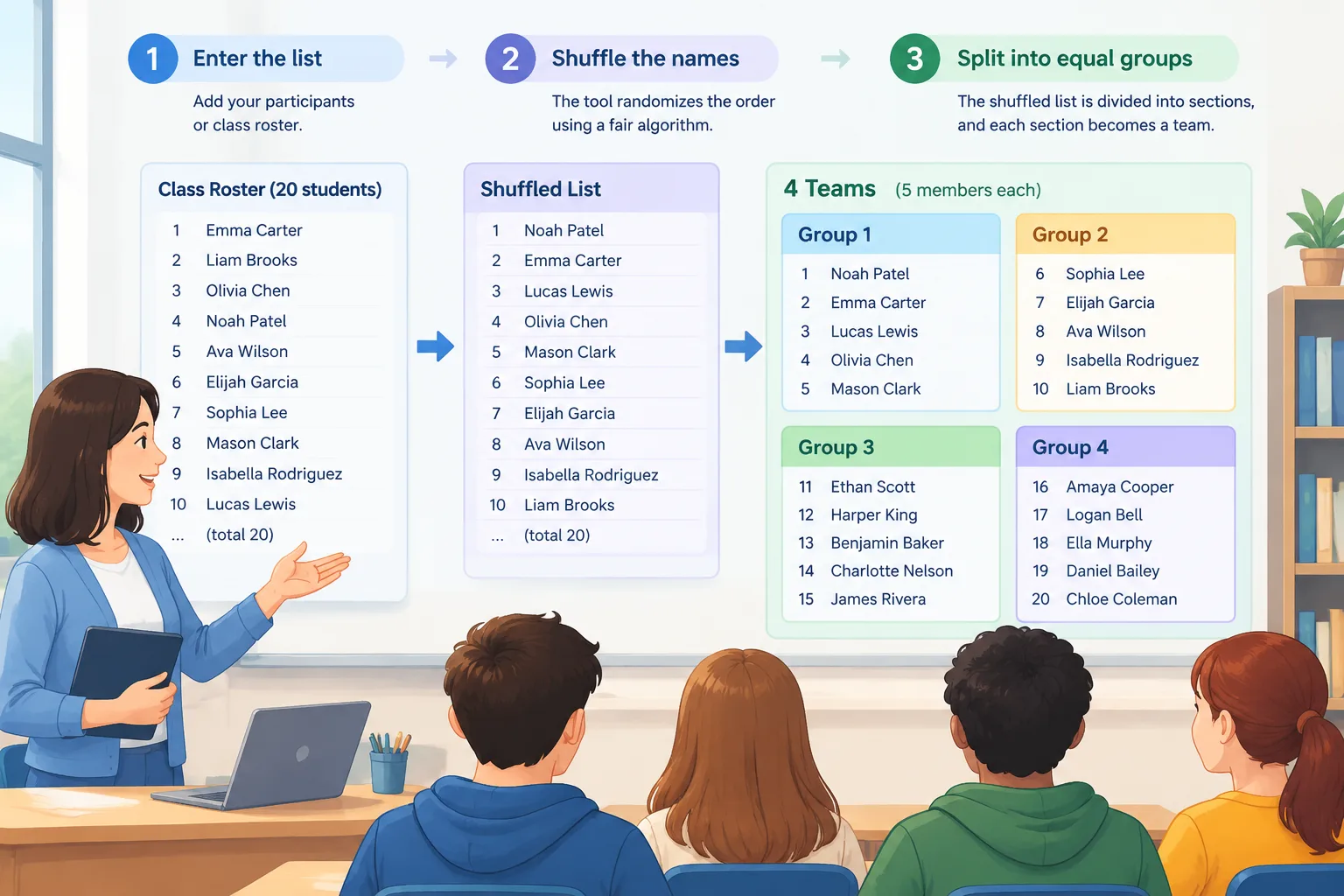
A practical example is a teacher preparing literature discussion teams. The teacher enters the class roster, selects four groups, and receives four randomly created teams. Students see that the process is consistent because the same rules are applied to everyone.
The standard mode of the Random Group Generator uses a client-side Fisher-Yates shuffle followed by sequential assignment. This means the grouping happens directly through the tool process without requiring a manual draw.
Why balanced grouping is different from pure randomness
Pure random grouping treats every participant equally, but it does not control the mix of characteristics inside each group. This is an important distinction when facilitators care about skill balance or representation.
A random group generator can create fair individual chances while still producing uneven teams. For example, if students have different skill tags, a completely random draw may accidentally place several advanced students in one team and fewer in another.
Balanced modes solve this problem by adding extra rules. Instead of only asking who should be next, the system considers the current group sizes or attributes. One approach is emptiest-group-first assignment, where the next participant is placed into the group with the fewest members.
Another approach is tag round-robin assignment. If participants have categories such as skills or roles, the system can distribute those categories across groups. This creates more balanced teams but is no longer pure randomness.
This is why facilitators should choose the right method for the situation. A quick icebreaker may only need random teams. A long project with mixed responsibilities may benefit from balanced assignment.
Seeded shuffle and repeatable group draws
A seeded shuffle uses a starting value, called a seed, to create a repeatable random sequence. The same seed and the same participant list can produce the same result again.
This can be useful for organizations that need records of how groups were created. A trainer running multiple sessions may want to reproduce a previous arrangement for testing or planning purposes.
For everyday classroom use, a normal random draw is often enough. However, seeded methods can help when transparency and repeatability are important.
For example, a teacher might create teams during preparation and share the same grouping process with another teacher. A repeatable seed allows both teachers to confirm that they are using the same arrangement.
Comparing manual draws and algorithm-based grouping
Manual grouping has advantages. A teacher knows the students and may understand relationships that a computer cannot see. For sensitive situations, human judgment is often necessary.
However, manual methods can also introduce unconscious preferences. People may choose familiar students together or repeatedly separate the same individuals. An algorithm provides a consistent process that treats each name according to the same rules.
A good approach is to combine both methods. Use a generator for the first draft of teams, then adjust when there are real educational or operational reasons. The tool creates a fair starting point while the facilitator provides context.
Related tools can support other activities as well. For example, pairing exercises may work better with a Random Pair Generator, while classroom participation activities can use a Random Student Picker.
FAQ about how random group generators work
How does a random group generator decide who goes together?
A random group generator usually starts by creating a randomized order of participant names. It then applies a grouping rule, such as dividing the shuffled list into equal sections. The final teams depend on both the shuffle method and the assignment method selected.
Why is the Fisher-Yates shuffle used in random group generators?
The Fisher-Yates shuffle is used because it gives each possible ordering an equal chance when implemented correctly. This makes it a reliable method for creating random lists before assigning participants to groups.
Can a random group generator create perfectly balanced teams?
Pure randomness can create fair chances for individuals, but it cannot guarantee a specific mix of skills or traits. Balanced modes add rules that distribute selected characteristics more evenly across groups.
What is modulo bias and why does it matter?
Modulo bias occurs when a random selection method makes some outcomes more likely than others. Avoiding it helps ensure that each participant has a fair chance of appearing in different positions during the grouping process.
When should I use a seeded shuffle?
A seeded shuffle is useful when you need to reproduce the same result later. It can help with testing, documentation, or situations where a facilitator wants to show how a group arrangement was generated.
Create fair teams with a random group generator
Knowing how random group generators work makes it easier to choose the right method for your classroom, workshop, or event. The best results come from matching the tool settings with your goal: quick random teams, repeatable draws, or more balanced assignments.
When you need a fast and transparent way to organize participants, try the Random Group Generator and create your next set of teams in a few steps.
Related Tools
Pick the right generator for the job — every tool runs free in your browser.