
Fisher-Yates algorithm
Fisher-Yates Algorithm vs Other Shuffle Methods: A Practical Guide
Compare the Fisher-Yates algorithm vs other shuffle methods, understand randomization bias, and learn how fair shuffling helps create balanced classroom and team groups.

When you divide a classroom into teams, assign workshop partners, or organize participants for an activity, randomization can make the process feel fair and impartial. However, not every method of shuffling a list produces equally reliable results. Understanding the Fisher-Yates algorithm vs other shuffle methods helps educators, developers, and team facilitators recognize why some randomization techniques introduce bias while others can produce uniformly distributed permutations. This guide explains how the algorithms work, compares their strengths and weaknesses, and shows what to consider when choosing a random group generator.
1. Why Does the Choice of Shuffle Method Matter?
Imagine a teacher preparing a class of 24 students for a collaborative activity. The teacher wants six groups of four, with every student having an equal opportunity to join any group. A random shuffle seems like a straightforward solution: put the names into a list, mix them, and distribute them into groups.
The important detail is how the list gets mixed. A shuffle can look random without giving every possible ordering an equal probability. Some methods produce certain arrangements more often than others. This is called randomization bias, and it can affect activities where participants expect an impartial selection process.
For example, suppose a facilitator repeatedly assigns the first few participants to the same positions because of a flawed shuffling method. Even if the results look different each time, the process may not give all possible arrangements an equal chance. Over several sessions, participants might notice patterns or question whether the allocation is fair.
The Fisher-Yates algorithm addresses this problem by making a sequence of controlled random selections. Its design provides a mathematically sound way to generate permutations when each random index is selected uniformly from its permitted range.
For educators and facilitators, this distinction matters most when fairness and transparency are important. A suitable algorithm does not guarantee perfectly balanced skill levels or personalities, but it can help ensure that the ordering itself is not systematically favored by the shuffle procedure.
2. How the Fisher-Yates Algorithm Works
The Fisher-Yates algorithm is a method for randomly rearranging the elements of a list. Its original form appeared in the statistical work of Ronald Fisher and Frank Yates in 1938. Richard Durstenfeld later developed an efficient computer implementation in 1964, which is commonly called the modern Fisher-Yates or Knuth shuffle.
The basic idea is simple: start at one end of the list, choose a random position from the portion that has not yet been finalized, and exchange the selected elements. Repeat until the remaining portion is complete.
Consider a list of five students:
- Alex
- Jordan
- Taylor
- Morgan
- Casey
A simplified version of the algorithm follows these steps:
- Start with the final position in the list.
- Select a random position between the first position and the current position, including both endpoints.
- Swap the selected element with the element in the current position.
- Move one position toward the beginning of the list.
- Repeat until the remaining list contains only one element.
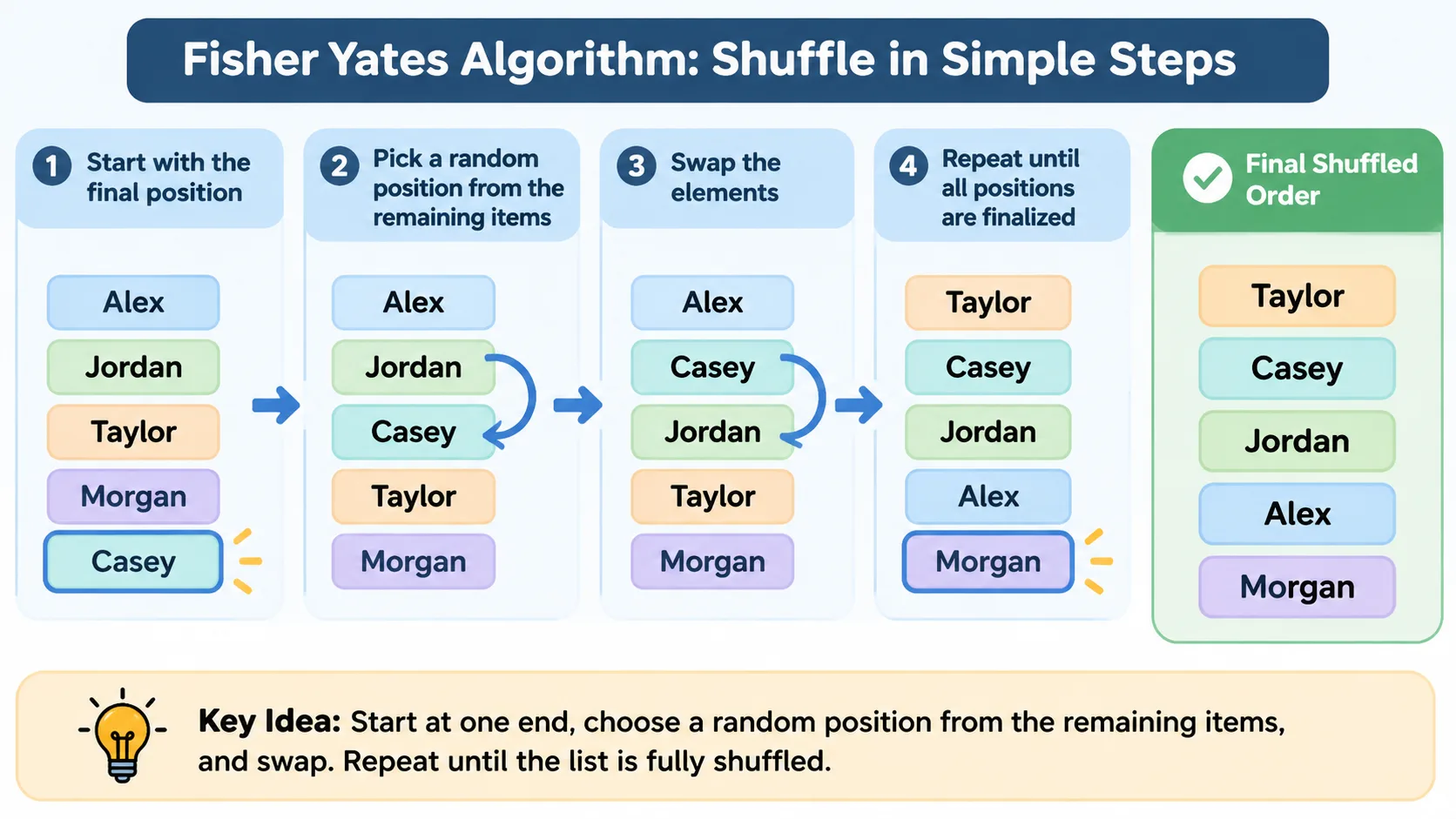
After the process finishes, the list contains the same five students in a different order. No participant has been added or removed, and each possible permutation has an equal theoretical probability under ideal uniform random selection.
Why the method can produce uniform permutations
The mathematical reasoning comes from the number of choices available at each step. For a list containing five elements, the algorithm makes random selections from ranges containing five, four, three, and two possible positions.
The total number of possible selection paths is therefore:
5 × 4 × 3 × 2 = 120.
There are also 120 possible permutations of five distinct elements. Because each selection path corresponds to exactly one permutation, and every selection is uniform, every permutation has the same probability.
This property is the foundation of the Fisher-Yates algorithm. The result is not merely a list that appears mixed; it is a shuffle designed to avoid favoring particular permutations.
3. Fisher-Yates Algorithm vs Other Shuffle Methods
Several techniques can rearrange a list. However, their behavior differs in terms of mathematical fairness, implementation complexity, and performance. Comparing these approaches helps explain why a familiar programming shortcut may not be appropriate for every randomization task.
Fisher-Yates vs random sorting
One common JavaScript shortcut is:
javascript
items.sort(() => Math.random() - 0.5);
This approach assigns a random comparison result whenever the sorting function compares two elements. It looks convenient because it uses a built-in array method, but it does not implement a proper uniform shuffle.
Sorting algorithms expect comparison functions to follow consistent rules. A random comparator can return conflicting results for the same pair of elements, violating the assumptions of the sorting process. The resulting distribution can depend on the sorting implementation and input arrangement.
The Fisher-Yates algorithm avoids this problem by selecting random positions directly instead of asking a sorting algorithm to organize elements using inconsistent comparisons.
Fisher-Yates vs the naive swap method
Another common approach is to visit every element and swap it with a randomly selected element from the entire list.
For example, a developer might loop through all five students and exchange each student with another randomly chosen student, including the possibility of selecting the same position.
Although this approach is easy to understand, it does not generally produce a uniform distribution of permutations. Different combinations of swaps can lead to the same final arrangement, and the number of paths leading to each permutation is not necessarily equal.
Fisher-Yates avoids this problem by shrinking the selection range after each finalized position. This ensures that each permutation has a corresponding sequence of valid choices.
Fisher-Yates vs random key sorting
Random key sorting works differently. Each participant receives a random number, and the list is sorted using those numbers. For example, a facilitator might assign each student a random decimal value and then arrange the students from smallest to largest.
With ideal independent, continuous random keys, ties have probability zero and every ordering is equally likely. However, practical implementations use finite random values, so collisions are possible. Sorting also introduces additional computational work compared with a direct linear-time shuffle.
Random key sorting can be useful for specific workflows, especially when random priorities need to be stored or inspected. However, it requires careful handling of duplicate keys and sorting behavior.
| Method | Uniform shuffle guarantee | Typical performance | Main concern |
|---|---|---|---|
| Fisher-Yates | Yes, with uniform index selection | O(n) | Requires correct index ranges |
| Random comparator sorting | No | Depends on sorting implementation | Inconsistent comparisons |
| Naive full-list swapping | No, in general | O(n) swaps | Unequal permutation probabilities |
| Random key sorting | Under ideal continuous keys | O(n log n) | Key collisions and sorting overhead |
The main lesson is that a method should be judged by how it produces its results, not by how random the output looks. Fisher-Yates has a direct mathematical basis for uniform shuffling, while the alternatives require additional assumptions or can introduce bias.
4. Understanding the Performance and Fairness Differences
Performance matters when a randomization tool handles large participant lists. A teacher might shuffle 20 students, while a corporate facilitator might organize hundreds of employees across multiple sessions. Both situations benefit from an algorithm that is efficient and predictable.
The modern Fisher-Yates algorithm runs in linear time, commonly written as O(n), because it visits each element once and performs a constant amount of work at each step. It also uses constant auxiliary space when implemented with in-place swaps, excluding the input list itself.
By comparison, random key sorting typically requires O(n log n) sorting time. Its performance depends on the sorting implementation and the number of elements. The random comparator shortcut also relies on sorting, but its larger issue is not speed: it fails to provide a dependable uniform shuffle.
Fairness and balance should also be treated as separate concepts. A uniformly shuffled list gives every permutation an equal probability, but it does not guarantee that every resulting team has the same experience, skill level, or background.
For instance, a teacher might randomly distribute 24 students into six teams of four. The shuffle can be unbiased while one team happens to contain several experienced students and another contains several beginners. That is a possible outcome of random allocation, not necessarily an algorithmic error.
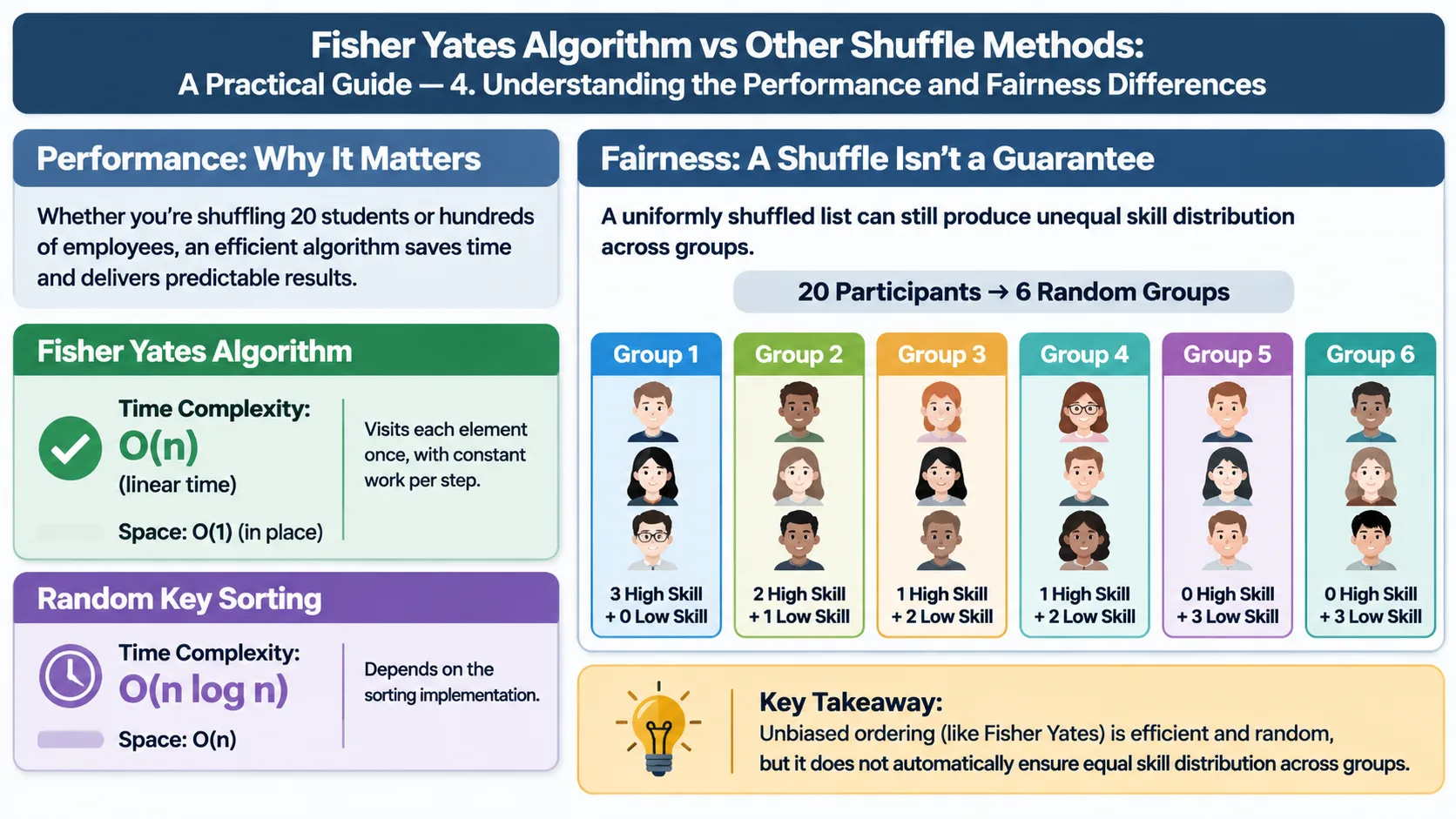
When both fairness and team composition matter, facilitators may need additional rules. These might include distributing participants according to experience levels, balancing departments, or preventing repeated partnerships. Such constraints change the allocation problem and should be considered separately from the underlying shuffle algorithm.
5. How to Use Fair Shuffling for Classroom and Team Grouping
Understanding the Fisher-Yates algorithm is useful, but educators and facilitators usually want a practical result rather than an algorithm they must implement themselves. A random group generator can handle the list preparation and allocation process while reducing the need for manual assignments.
For example, consider a teacher with 28 students who wants seven groups of four for a science project. The teacher can prepare the participant list, choose the desired group size, and generate the groups. The shuffled ordering determines how students are distributed across the teams.
A practical workflow looks like this:
- Prepare a complete list of participants. Check spelling and remove duplicate entries where appropriate.
- Decide how many groups are needed or how many people should be assigned to each group.
- Enter the names into a Random Group Generator.
- Generate the groups and review the allocation.
- Share the results with participants using the available classroom or collaboration workflow.
- If another activity requires new teams, run a new allocation rather than manually moving selected participants.
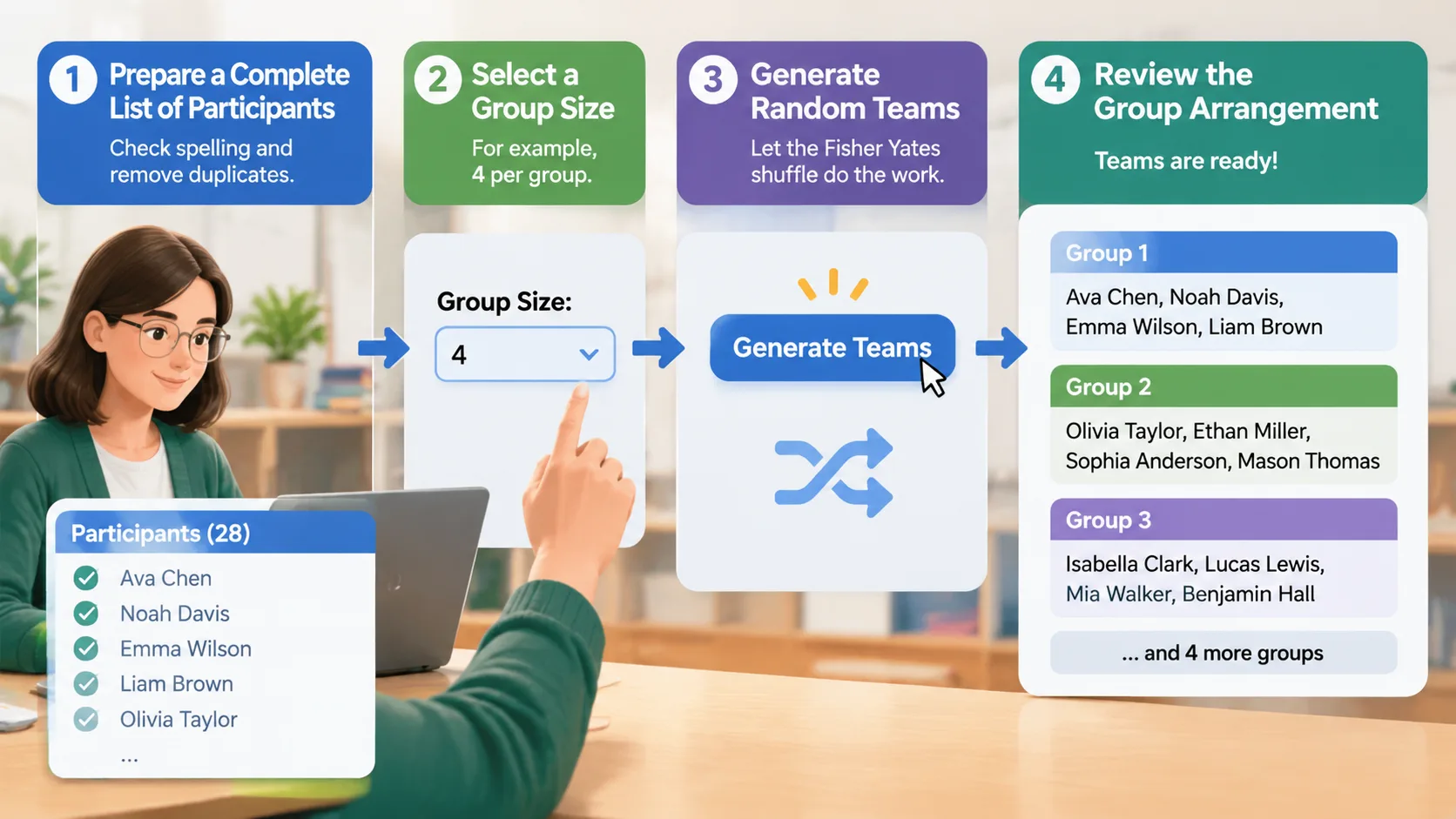
The same approach works for corporate training. A facilitator organizing 36 employees into nine groups of four can use random allocation to avoid repeatedly assigning people based on personal preference or convenience.
For partner activities, a Random Pair Generator provides a more focused workflow. Rather than creating several larger teams, the tool helps organize participants into pairs for interviews, discussions, peer reviews, or practice exercises.
If the activity involves selecting one participant to answer a question or demonstrate a technique, a Random Student Picker is a different tool for that specific purpose. Choosing the appropriate workflow makes the activity easier to manage without mixing up group formation and individual selection.
6. When Should You Choose Fisher-Yates Over Other Methods?
Fisher-Yates is particularly appropriate when you need to rearrange an entire list and want a uniform distribution of possible orderings. It is suitable for classroom group formation, randomized presentation orders, participant rotations, and other tasks where every possible permutation should have an equal chance.
Consider the following situations:
Classroom team assignments: A teacher wants to divide students into small groups without manually favoring particular names or positions. A proper shuffle provides an impartial starting point for distributing the list.
Workshop partner rotations: A trainer wants to create fresh pairings for a discussion activity. Shuffling the participant list before assigning pairs offers a straightforward way to produce a new arrangement.
Presentation schedules: An event organizer needs a randomized speaking order. A uniform shuffle helps avoid systematic preferences for early or late positions.
Employee collaboration: An HR facilitator wants to mix employees from a participant list before assigning workshop teams. Random ordering can support a transparent allocation process.
However, Fisher-Yates is not automatically the right answer for every allocation problem. If participants must be separated by department, distributed according to skill level, or assigned according to accessibility requirements, a simple unrestricted shuffle may not satisfy the task.
Similarly, if an activity requires weighted selection, such as giving some entries a deliberately different probability, a uniform shuffle is not the same as the required weighted allocation. A separate selection method should be chosen and its rules communicated clearly.
For ordinary educational and workplace grouping, the practical decision is straightforward: use a proper shuffle when you want unbiased random ordering, and introduce explicit allocation constraints when the activity requires more than randomness alone.
7. Common Implementation Mistakes to Avoid
Even a well-established algorithm can produce unreliable results when implemented incorrectly. Developers and people evaluating randomization tools should pay attention to several details.
Choosing the wrong random index range: At each Fisher-Yates step, the random position must come from the portion of the list that has not yet been finalized. Choosing from the entire list at every step changes the distribution.
Using an incorrect loop boundary: The current element must be included in its own selection range. A position should also be finalized only once. Incorrect loop boundaries can skip elements or introduce unnecessary operations.
Using modulo without considering bias: Mapping random integers into a smaller range with the modulo operator can produce unequal probabilities when the original range is not evenly divisible by the target range. Appropriate bounded-integer generation avoids this issue.
Ignoring the quality of the random number generator: Fisher-Yates assumes that the required random indices are selected uniformly. The algorithm cannot correct a biased or unsuitable random number source. For ordinary non-security classroom grouping, a standard pseudorandom generator may be sufficient. Sensitive applications require stronger random-number generation and additional security considerations.
Confusing balanced teams with uniform permutations: A fair shuffle does not automatically produce teams with equal academic performance, experience, or representation. If those qualities matter, they must be addressed through the allocation rules.
For a practical evaluation, ask whether the implementation uses a shrinking selection range, whether random indices are selected uniformly, and whether the output preserves every original participant exactly once. These checks provide a useful starting point for assessing a shuffle implementation.
8. Frequently Asked Questions
Is the Fisher-Yates algorithm completely random?
Fisher-Yates produces a uniformly distributed permutation when every random index is selected uniformly from the correct range. In practical software, the result also depends on the quality of the random number generator. Therefore, the algorithm provides a mathematical guarantee under its assumptions rather than making every real-world random-number source perfect.
Why is random sorting not as reliable as Fisher-Yates?
Random sorting typically uses a comparator that returns a different result for repeated comparisons. Sorting algorithms expect consistent comparison behavior, so this shortcut can produce biased or implementation-dependent results. Fisher-Yates directly selects positions and does not rely on random comparison results.
Does Fisher-Yates make classroom groups equally balanced?
It makes the ordering unbiased when implemented correctly, but it does not guarantee equal academic ability, experience, or personality across teams. If a teacher needs balanced skill levels, additional allocation rules are necessary. Randomization and group balancing are related but different tasks.
Is Fisher-Yates faster than sorting a list randomly?
The modern Fisher-Yates algorithm runs in O(n) time, while random key sorting generally requires O(n log n) sorting time. Fisher-Yates also avoids the inconsistent comparator problem associated with random sorting. Actual performance depends on implementation and list size, but its linear-time structure makes it efficient for ordinary shuffling tasks.
Can Fisher-Yates be used to generate random pairs?
Yes. First, shuffle the participant list using Fisher-Yates, then take consecutive entries two at a time. If the participant count is odd, one person will remain unless the activity allows a group of three or another arrangement. This approach is useful for classroom discussions, peer reviews, and workplace exercises.
Should I use Fisher-Yates for every random group activity?
Use it when you need a uniformly shuffled participant list and have no additional allocation restrictions. If participants must be separated by department, balanced by experience, or assigned using weighted probabilities, a more specialized allocation process may be needed. The right method depends on the activity's requirements.
Create Random Groups With a Simple Workflow
Choosing a reliable shuffle method is an important part of making random assignments fair and repeatable. Fisher-Yates provides a mathematically grounded approach to uniform shuffling, while random sorting and naive swapping can introduce distribution problems. Understanding the difference helps teachers, trainers, and event organizers make better decisions about how participants are assigned.
You do not need to implement a shuffling algorithm manually to organize your next activity. Prepare your participant list, choose the group size, and let a dedicated tool handle the allocation process. Try the Random Group Generator to organize classroom activities, training sessions, and collaborative team exercises with a straightforward random grouping workflow.
Related Tools
Pick the right generator for the job — every tool runs free in your browser.