
random grouping
Random Grouping and Learning Outcomes: What Does Research Show?
Does random grouping improve learning outcomes? Explore education research, the benefits and limitations of random groups, and practical ways to build effective classroom teams.

A teacher divides a class into four teams for a science investigation. Instead of letting students choose their friends, everyone is assigned to a group at random. Some students welcome the change, while others wonder why they cannot work with their usual partners. Does this approach actually help them learn? Research into random grouping and learning outcomes suggests that working with different classmates can create valuable opportunities for collaboration, but the results depend heavily on how teachers organize and support the activity. Random assignment alone does not guarantee better academic performance. The real opportunity comes from combining fair group formation with meaningful tasks, active participation, and individual accountability.
For teachers, university instructors, corporate trainers, and workshop facilitators, understanding this distinction is important. Random grouping can make team formation easier and introduce new working relationships. However, the educational value comes from what participants do after the groups are formed.
1. What Is Random Grouping in Education?
Random grouping is a method of assigning students or participants to teams without allowing personal preferences, friendships, or deliberate ability rankings to determine every placement. A teacher might shuffle a class list, draw names, use numbered cards, or use a digital random group generator. The goal is to distribute participants through an impartial selection process rather than repeatedly placing familiar people together.
This approach differs from several other common grouping methods. In self-selected grouping, students choose their own partners. In ability-based grouping, teachers organize students according to academic performance or specific learning needs. In teacher-selected grouping, the instructor considers individual strengths, personalities, behavior, and learning objectives. Random grouping uses chance as its starting point, although teachers can still apply necessary classroom accommodations and adjustments.
For example, imagine a class of 28 students preparing for a geography project. The teacher wants seven teams of four. Allowing students to choose their own teams might result in friendship groups that have worked together throughout the year. Random assignment introduces different combinations and gives students an opportunity to work with classmates they might not normally approach.
The important distinction is that random grouping describes how teams are formed, not how they learn. A randomly assigned group that receives unclear instructions and an unstructured task may achieve very little. A thoughtfully designed collaborative activity, on the other hand, can give every participant a reason to contribute.
2. What Does Research Say About Random Grouping and Learning Outcomes?
Educational research generally provides encouraging evidence for structured collaborative learning. However, it is important to distinguish research about group work from research specifically comparing random assignment with other grouping methods.
The Education Endowment Foundation's Teaching and Learning Toolkit identifies collaborative learning as an approach with positive average effects on academic progress. Its review reports an estimated five additional months of progress on average. The foundation also emphasizes that this finding applies to collaborative learning approaches rather than simply putting students together. Its evidence review identifies carefully designed activities, active participation, and shared learning goals as important features. The evidence strength is rated as limited, so the estimate should not be treated as a guaranteed result for every classroom.
A separate 2024 meta-analysis published in BioScience, titled "Group Work Enhances Student Performance in Biology," examined 91 estimates from 53 articles. The researchers reported a positive overall effect of group work on student performance in biology courses. Their analysis also explored factors such as group size, course level, and whether instructors assigned the groups. These findings support the educational value of group work in the studied context, but they do not establish that random assignment is universally superior to teacher-selected or student-selected groups.
More direct evidence comes from a study of collaborative testing in a neuroanatomy course. Researchers compared students assigned to randomized groups with students who selected their own groups. The randomized groups achieved higher overall quiz performance, but the researchers did not find a corresponding difference in overall examination performance. The findings suggest that group formation can influence some learning activities without necessarily producing lasting differences in every assessment.
Together, these studies support a balanced conclusion: collaborative learning can improve academic performance, and random assignment can be a useful way to organize collaboration. However, the evidence does not justify claiming that random groups always produce better learning outcomes than other grouping methods.
3. How Random Grouping Can Support Student Learning
One potential benefit is exposure to different perspectives. When students regularly work with the same classmates, they may become comfortable with familiar ways of thinking and communicating. Random assignment can introduce new explanations, problem-solving approaches, and questions. A student who understands a mathematics concept in one way might discover a different strategy through discussion with another classmate.
Another advantage is the opportunity to develop communication skills. Students need to explain their ideas, listen to alternative opinions, ask questions, and agree on a shared approach. These activities can make learning more active than simply listening to a presentation. Explaining an idea also gives students an opportunity to identify gaps in their own understanding.
Random grouping may also make classroom participation more inclusive. Students who are not part of established friendship groups have opportunities to interact with a wider range of classmates. Teachers can use changing teams to reduce the tendency for the same students to work together every time. This does not automatically eliminate social barriers, but it can create additional opportunities for meaningful interaction.
Consider a history lesson about the causes of a major historical event. A teacher randomly assigns students to teams of four. Each student receives a different responsibility: examining political factors, investigating economic conditions, reviewing social influences, or presenting evidence. The group must combine its findings into one explanation. Students encounter perspectives beyond their usual interests, while the shared task gives everyone a reason to contribute.
These benefits depend on the activity. Simply changing seats or assigning new partners is unlikely to produce substantial learning by itself. Students need a task that requires discussion, explanation, and shared thinking.
4. When Does Random Grouping Work Best?
Random grouping is particularly useful when the objective is to encourage interaction, introduce new working relationships, or give everyone an equal opportunity to join different teams. It can work well for brainstorming, classroom discussions, short problem-solving activities, peer review, revision exercises, and project planning.
The size of each team also matters. The Education Endowment Foundation identifies groups of three to five students with a shared outcome as a promising structure for collaborative learning. This gives students enough opportunities to exchange ideas without creating a team so large that some participants can disappear into the background. The best size still depends on the activity, available time, and age of the learners.
Random assignment is also useful when repeated group selection becomes a classroom management problem. Teachers sometimes spend valuable lesson time negotiating friendship groups, resolving disagreements about partners, or rearranging teams. A consistent assignment process can simplify this routine and help the class move into the learning activity more quickly.
For example, a middle school science teacher could use random teams of four for a weekly experiment. Each team receives the same investigation question and must submit a shared explanation supported by observations. Students rotate responsibilities between experiments so that one person does not always handle the equipment while another writes the report. This combination of random assignment and clear responsibilities supports broader participation.
However, random grouping is not necessarily the best choice for every situation. Students who need specialized support, accessibility accommodations, language assistance, or carefully planned peer arrangements may benefit from teacher-guided placement. Sensitive discussions and activities involving established interpersonal conflicts also require professional judgment. Fairness does not mean ignoring individual needs.
5. How to Create Effective Random Groups for Better Learning
The most useful approach is to treat group formation as one part of lesson planning rather than the entire collaborative learning strategy. Before assigning teams, teachers should identify the intended learning outcome and decide what students will need to accomplish together.
Follow these steps to make random grouping more purposeful:
- Define the learning objective. Decide what students should understand, explain, create, or demonstrate by the end of the activity. For example, a mathematics lesson might require each team to compare two methods for solving the same problem.
- Choose an appropriate team size. Consider groups of three to five for activities that require discussion and shared responsibility. Use pairs when the task involves quick explanations or peer feedback.
- Prepare the participant list. Check attendance and identify any necessary accessibility arrangements or other learning needs before assigning groups.
- Generate the groups. Use shuffled name cards, numbered slips, or a digital tool to distribute participants. Avoid manually changing the results simply because some combinations seem unfamiliar.
- Assign responsibilities. Give students clear roles such as discussion leader, evidence collector, recorder, or presenter. Rotate responsibilities in future activities.
- Explain the expected outcome. Tell students what they must produce and how each person should contribute. A shared worksheet, presentation, experiment result, or written explanation provides a concrete goal.
- Monitor participation. Move between teams, listen to discussions, and intervene when students are excluded or one person takes over the entire task.
- Check individual understanding. Finish with a short independent response, reflection, or quiz so that every student demonstrates personal understanding.
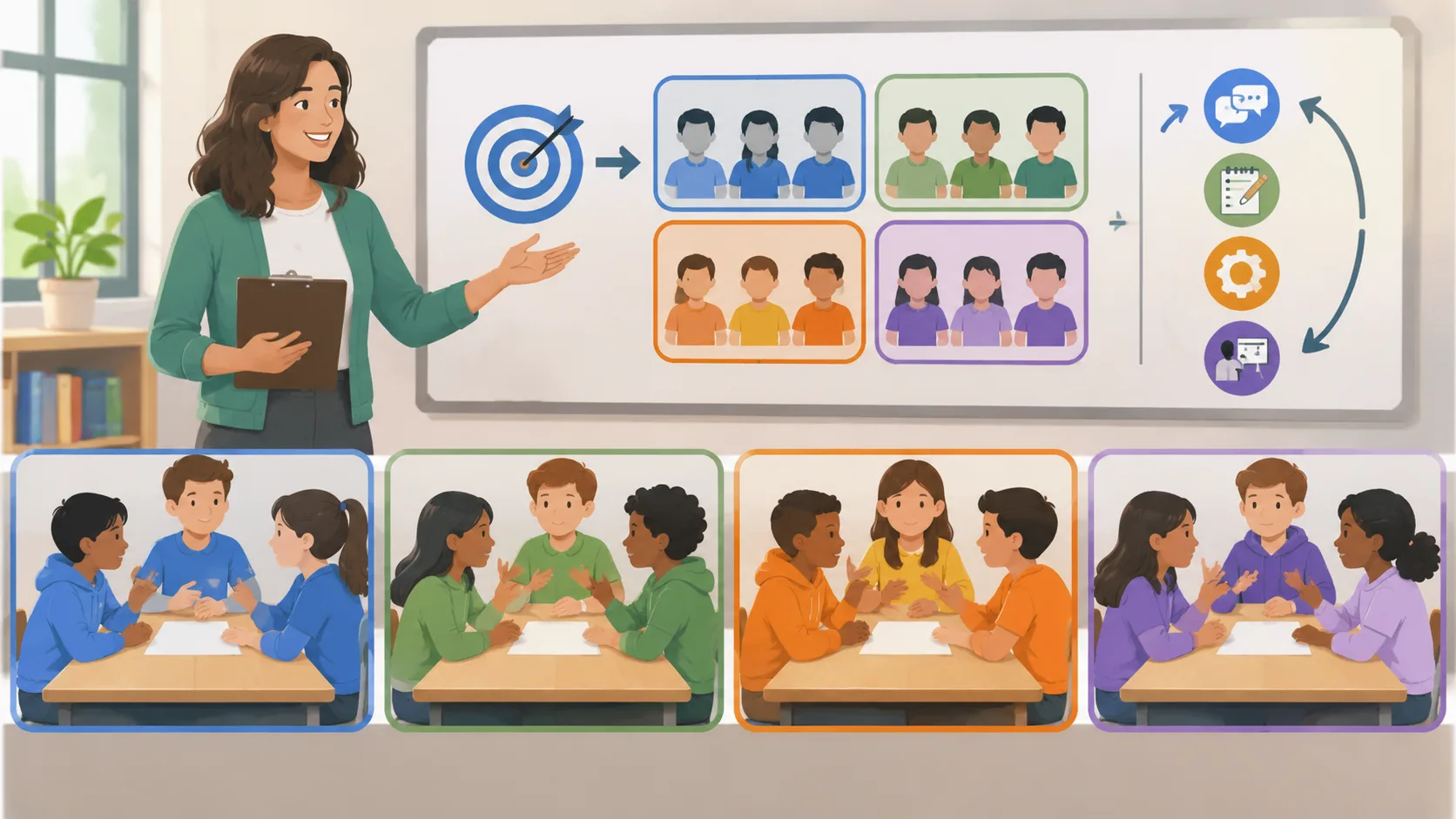
For a practical example, imagine a teacher preparing a 30-minute English lesson on persuasive writing. The class is divided into teams of four using a random assignment process. Each team analyzes a short argument, identifies its main claim, evaluates the supporting evidence, and prepares a short response. Every student takes responsibility for explaining one part of the analysis. At the end, each student independently writes a paragraph using the techniques discussed. The teacher can assess both the collaborative process and individual understanding.
Teachers who want to simplify team formation can use the Random Group Generator. It helps organize participants into randomly assigned teams without requiring teachers to draw names or manually reorganize a class list. For activities involving exactly two participants, the Random Pair Generator offers a more suitable format.
6. Random Grouping vs. Teacher-Selected and Student-Selected Groups
Random, teacher-selected, and student-selected groups each serve different instructional purposes. The best method depends on the learning objective, the characteristics of the participants, and the level of support required.
Student-selected groups can create a comfortable environment, particularly when participants already know one another and have established communication patterns. Familiar partners may coordinate quickly and feel confident sharing early ideas. However, students may repeatedly choose the same friends, limiting opportunities to interact with different classmates. Friendship-based selection can also leave some students feeling excluded when teams are formed publicly.
Teacher-selected groups offer more control. An instructor can deliberately combine different levels of prior knowledge, balance specific skills, or provide additional support to learners who need it. This approach is useful for complex projects, sensitive classroom situations, and activities where the teacher has a clear instructional reason for controlling group composition. The trade-off is that teachers need enough information and preparation time to make informed decisions.
Random groups offer a simpler and more neutral starting point. They can reduce repeated friendship-based selection and help participants experience different working relationships. However, chance does not guarantee balanced skills, compatible working styles, or appropriate support for every learner.
A practical strategy is to alternate methods. Use random groups for routine discussions and revision activities, teacher-selected groups for projects with specific learning requirements, and student-selected pairs for low-stakes peer feedback. This allows teachers to match group formation to the task rather than relying on one approach throughout the year.
The following comparison summarizes the main differences:
| Grouping method | Main advantage | Potential limitation | Suitable activities |
|---|---|---|---|
| Random grouping | Introduces different combinations and simplifies selection | Does not guarantee balanced abilities | Discussions, revision, brainstorming |
| Teacher-selected grouping | Allows deliberate instructional decisions | Requires planning and knowledge of students | Differentiated projects, targeted support |
| Student-selected grouping | Encourages comfort and familiar communication | Can reinforce existing friendship patterns | Informal practice, low-stakes activities |
The central lesson is that group composition should support the intended activity. There is no single grouping method that is best for every subject, age group, or classroom situation.
7. Common Mistakes That Can Reduce the Benefits of Random Grouping
One common mistake is assuming that randomly assigned teams will automatically collaborate effectively. Students may have little experience working together, and some may be unsure how to share responsibilities. Without guidance, confident participants can dominate discussions while quieter students contribute very little. Teachers should model useful discussion behaviors and establish expectations before starting collaborative activities.
Another mistake is making the group responsible for the entire grade without checking individual understanding. A shared result can hide unequal contributions. One student might complete most of the work while the others receive the same recognition. Combining a shared product with an individual reflection, explanation, or assessment provides a clearer picture of what each participant has learned.
A third problem is changing groups without changing the activity. If students repeatedly receive identical worksheets with no meaningful reason to discuss their answers, random assignment may simply rearrange the same passive classroom routine. Effective collaborative tasks require participants to exchange information, explain reasoning, solve problems, or create something together.
Finally, teachers should avoid treating randomization as a substitute for professional judgment. A student who requires a particular accommodation should not lose access to that support because a computer generated a different team. Teachers should also respond to bullying, exclusion, language barriers, and other issues that may make a particular combination unsuitable.
A useful way to evaluate an activity is to ask three questions afterward: Did everyone participate? Did students demonstrate stronger understanding of the topic? Did the group process help achieve the lesson objective? If the answer is no, the next step is to adjust the task, support, or grouping approach rather than simply generating another random arrangement.
8. How to Evaluate Whether Random Grouping Improves Learning Outcomes
Teachers do not need a formal research study to evaluate their classroom practice. A simple comparison of student participation, individual understanding, and the quality of completed work can provide useful information. The key is to assess learning rather than assuming that a busy classroom or enthusiastic discussion necessarily indicates academic progress.
Start by identifying a specific learning objective. For example, if students are learning how to evaluate scientific evidence, assess their ability to identify reliable evidence and explain how it supports a conclusion. Use an individual task before or after the group activity to check whether students can apply the concept independently.
Next, record observations during the activity. Note whether students share ideas, ask questions, explain their reasoning, and distribute responsibilities. Pay attention to students who remain silent or rely heavily on classmates. These observations can help identify whether group composition or task design is creating barriers to participation.
For a more structured classroom comparison, a teacher could use the following process:
- Select a learning objective and prepare a short individual assessment.
- Run a collaborative activity using randomly assigned groups.
- Record participation and collect the group's completed work.
- Give students an individual assessment covering the same learning objective.
- Compare the results with an appropriate earlier assessment or another comparable activity.
- Review whether students with different starting levels participated and demonstrated understanding.
- Adjust group size, responsibilities, instructions, or support for the next lesson.
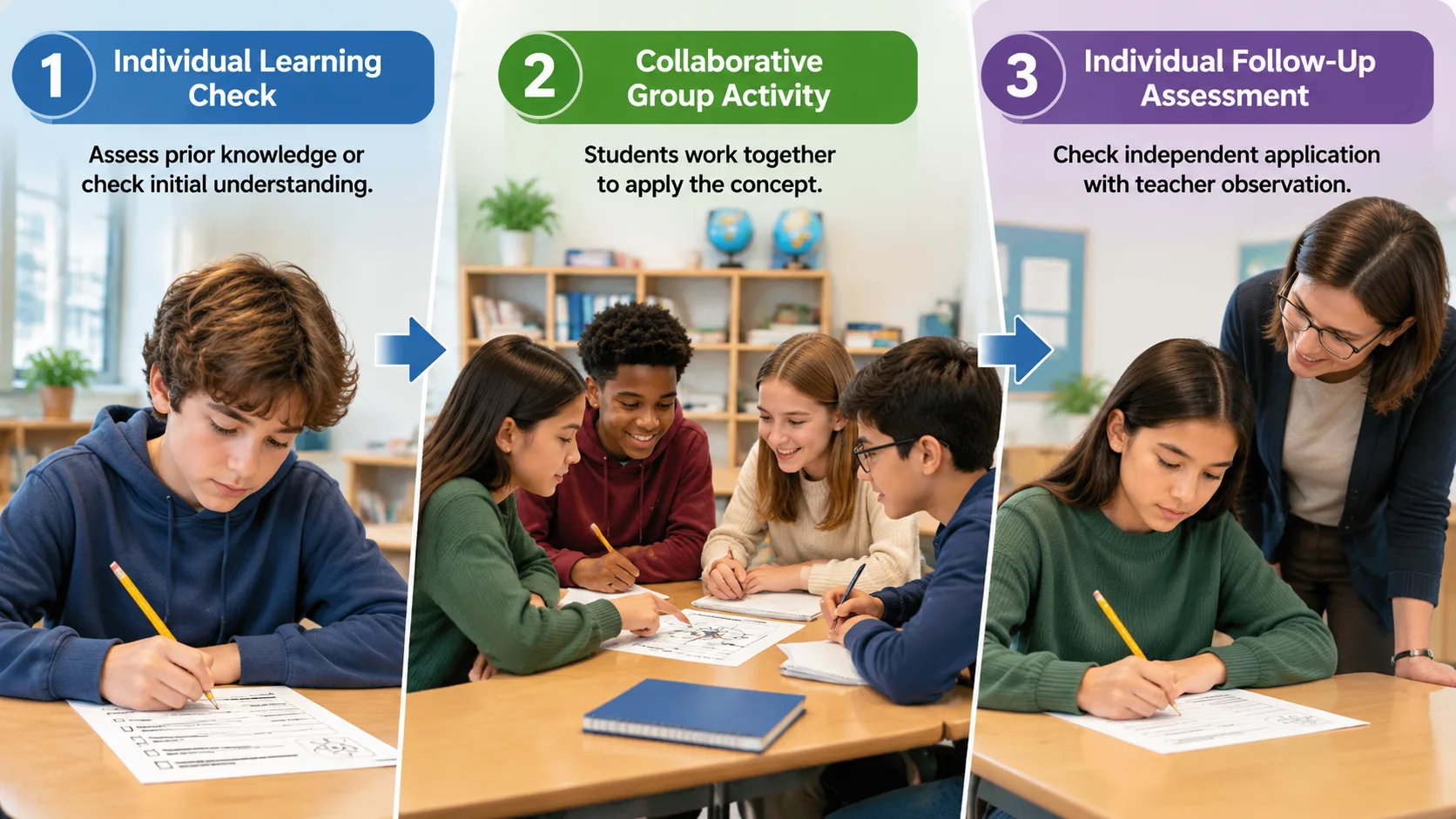
For a stronger comparison, teachers should consider using similar tasks, comparable assessment conditions, and more than one lesson. A single activity cannot establish that random grouping caused a change in achievement. Differences in lesson difficulty, prior knowledge, attendance, and student familiarity with the material can influence results. The purpose of classroom evaluation is to identify useful patterns and improve teaching decisions, not to make unsupported causal claims.
Frequently Asked Questions About Random Grouping and Learning Outcomes
Does random grouping improve student academic performance?
It can support academic performance when students complete well-designed collaborative activities. Research reviews generally find positive effects for structured group learning, but this does not mean random assignment alone improves grades. Task design, participation, teacher guidance, and individual accountability all matter.
Are random groups better than letting students choose their own partners?
Neither method is universally better. Random groups can introduce new perspectives and reduce repeated friendship-based selection, while self-selected groups may provide greater comfort and familiarity. Teachers should choose the approach that best supports the activity and the needs of the learners.
What is the best group size for collaborative learning?
Groups of three to five students are a promising starting point for many collaborative classroom activities. The Education Endowment Foundation highlights this range in its evidence review. Smaller pairs may be more appropriate for quick discussions, while more complex projects may require different arrangements.
How often should teachers change random groups?
There is no universal schedule. Teachers can change groups between activities, weekly, or when a new learning objective requires different interactions. The important consideration is whether changing teams supports the learning experience rather than disrupting productive working relationships.
Can random grouping work for students with different academic abilities?
Yes, but teachers should consider whether students have the knowledge, resources, and support needed to participate meaningfully. Random assignment can bring different perspectives together, but it does not guarantee a balanced distribution of skills. Clear responsibilities, accessible instructions, and teacher monitoring can help prevent some students from doing all the work.
Does random grouping help students develop social skills?
It can provide opportunities to practice communication, listening, cooperation, and respectful disagreement. Students get to interact with classmates beyond their usual social circles. However, these skills develop through supported interaction, not simply through changing team membership.
When should teachers avoid random grouping?
Random grouping may be unsuitable when an activity requires carefully differentiated support, specialized accommodations, or particular interpersonal arrangements. It may also be inappropriate when students are discussing sensitive personal experiences or when a known conflict could interfere with participation. Teachers should prioritize safety, inclusion, and the purpose of the lesson.
Conclusion: Use Random Grouping as a Learning Strategy, Not Just a Selection Method
Research suggests that collaborative learning can make a meaningful contribution to student achievement, communication, and problem-solving. Random grouping provides one practical way to organize these experiences, especially when teachers want students to work with different classmates and move beyond familiar friendship groups. However, evidence about collaborative learning should not be confused with proof that random assignment is always the best way to form teams.
The most effective approach combines thoughtful group formation with clear learning objectives, shared responsibilities, meaningful discussion, and individual assessment. Teachers should also remain flexible enough to make adjustments when students need additional support. By evaluating participation and understanding after each activity, educators can identify which arrangements work best in their own classrooms.
Ready to organize your next classroom activity? Use the Random Group Generator to create random student teams quickly and spend more time focusing on the learning that happens within them.
Related Tools
Pick the right generator for the job — every tool runs free in your browser.