
cryptographically secure randomization
Cryptographically Secure Randomization vs. Pseudo-Random Generators: What's the Difference?
Understand cryptographically secure randomization, how pseudo-random generators work, and which approach is appropriate for classroom activities, team assignments, simulations, and security-sensitive applications.
When you randomly assign students to classroom groups, select a participant for a workshop, or distribute employees across project teams, you want the result to feel fair and unpredictable. But what does random actually mean? Cryptographically secure randomization and ordinary pseudo-random generation both produce random-looking results, yet they serve different purposes. Understanding the distinction helps educators, trainers, and developers choose an appropriate method without adding unnecessary complexity to everyday activities.
The important difference is not simply whether a result looks random. It is whether someone could predict or reproduce the sequence. This matters enormously when generating passwords or security tokens, but it has different implications when creating classroom groups or choosing volunteers. Let's explore how both approaches work and how to decide which one fits your situation.
What Is Cryptographically Secure Randomization?
Cryptographically secure randomization uses random number generation designed to make future outputs computationally unpredictable, even when someone knows some of the previous outputs. It is intended for situations where guessing or reproducing a random value could create a security problem.
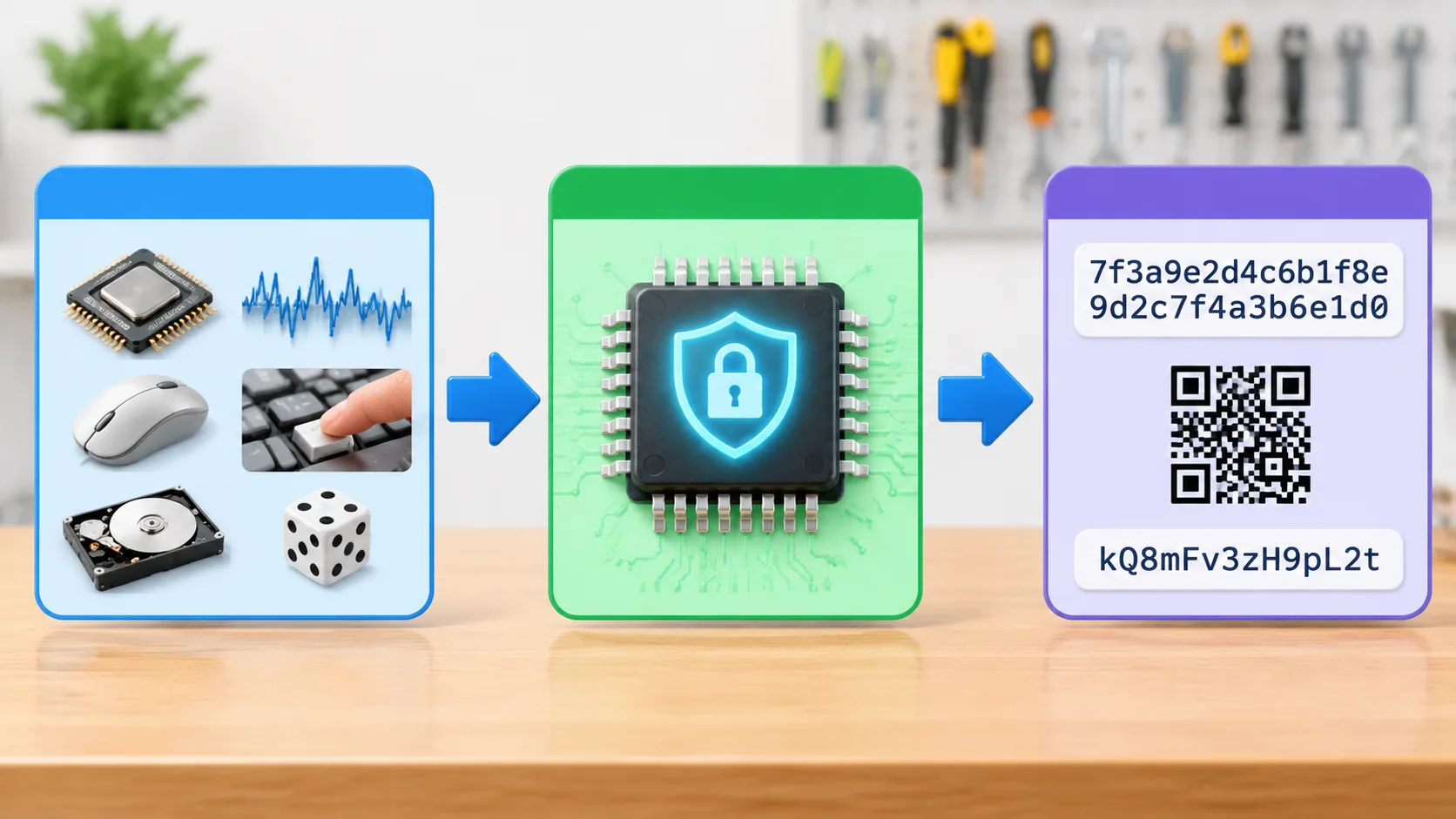
A cryptographically secure pseudorandom number generator, often abbreviated as CSPRNG, typically combines an initial source of entropy with a carefully designed cryptographic algorithm. Entropy describes the unpredictability available to initialize or update the generator. The algorithm then produces a sequence of values that should be computationally difficult to predict without access to the necessary secret state.
Importantly, cryptographically secure does not necessarily mean that every output comes directly from a physical random process. Modern secure generators often use deterministic algorithms after receiving suitable entropy. The National Institute of Standards and Technology (NIST) describes this approach in its SP 800-90 series, which covers deterministic random bit generators, entropy sources, and complete random bit generator constructions.
Consider an organization generating temporary authentication tokens for employees. If an attacker can predict the next token, they might gain unauthorized access. A security-focused generator helps reduce this risk by making the output unpredictable to an outside observer.
Cryptographic security is therefore about more than producing a sequence that passes visual inspection. It requires an appropriate algorithm, sufficient entropy, secure implementation, and proper handling of generator state.
What Is a Pseudo-Random Number Generator?
A pseudo-random number generator (PRNG) produces sequences using a mathematical algorithm. It starts with an initial value called a seed and applies a deterministic process to generate subsequent values.
The word pseudo is important. Given the same algorithm and the same initial seed, a conventional deterministic generator can reproduce the same sequence. This property is useful in simulations, statistical experiments, educational demonstrations, and software testing because it allows someone to repeat an earlier result.
For example, a teacher might use a seeded generator to create groups for a lesson. If the same student list and seed are supplied again, the generator can reproduce the same assignment. This makes it easier to investigate a result, prepare classroom materials, or compare different grouping approaches.
However, ordinary PRNGs are not automatically suitable for security-sensitive tasks. Some generators have internal states or predictable patterns that can potentially be inferred from their outputs. Their statistical quality may be perfectly adequate for simulations while still being insufficient for protecting passwords, authentication tokens, or encryption keys.
Python illustrates this distinction clearly. Its random module is designed for modelling and simulation, while its secrets module provides access to operating-system randomness suitable for security-sensitive values. The distinction is about intended use, not whether the ordinary generator produces obviously repetitive numbers.
Cryptographically Secure Randomization vs. Pseudo-Random Generation
Both approaches can produce sequences that appear random, but their design goals are different. Understanding these differences helps prevent the common mistake of assuming that every random-looking result offers the same level of protection.
| Comparison | Cryptographically secure randomization | Ordinary pseudo-random generation |
|---|---|---|
| Main purpose | Unpredictability and security | General-purpose random values |
| Generation method | Entropy combined with cryptographic algorithms | Mathematical algorithms and an initial seed |
| Reproducibility | Normally not intended to be publicly reproducible | Often reproducible with the same seed |
| Predictability | Designed to resist computational prediction | Depends on the algorithm and available state information |
| Typical applications | Security tokens, keys, and authentication values | Simulations, games, testing, and everyday random selection |
| Performance considerations | May involve additional system or cryptographic requirements | Often convenient and efficient for general computation |
| Implementation requirements | Requires careful entropy and security management | Requires an algorithm appropriate to the task |
The distinction becomes clearer when you consider two real situations.
A software developer generating a password-reset token needs a value that an unauthorized person cannot reasonably predict. An ordinary generator with a visible or predictable seed could create a security weakness. A cryptographically secure generator is the appropriate choice.
A teacher dividing 24 students into six groups of four has a different requirement. The teacher generally needs a fair assignment, not a sequence that can resist a determined attacker. A suitable general-purpose randomization method can be sufficient, provided the grouping process handles the student list correctly.
One important qualification is that cryptographic security and fairness are not interchangeable. A secure random number generator does not automatically guarantee balanced teams, equal participation, or unbiased selection if the surrounding application introduces unequal probabilities.
How Cryptographically Secure Randomization Works
A secure random generator is more than a mathematical formula. Its reliability depends on several components working together.
First, the system needs an appropriate entropy source. Operating systems collect unpredictable information from supported system events and hardware sources. The quality and availability of this information matter because a weak initial state can undermine an otherwise well-designed generator.
Second, the generator uses a cryptographic mechanism to expand its initial secret state into a sequence of output bits. NIST SP 800-90A describes deterministic random bit generator mechanisms based on approved cryptographic algorithms. SP 800-90B addresses entropy sources, while SP 800-90C describes constructions that combine these elements into random bit generators.
Third, the implementation must manage its internal state securely. It must follow appropriate initialization, reseeding, and protection requirements. A theoretically secure algorithm can still be undermined by poor software implementation or exposure of sensitive internal information.
For a practical example, imagine an online service generating a temporary login token:
- The operating system provides suitable randomness to the application.
- A cryptographically secure generator produces an unpredictable value.
- The application converts that value into a token suitable for its authentication system.
- The service stores or validates the token according to its security design.
- The token expires or becomes invalid when its intended use is complete.
Each stage contributes to the overall result. Simply calling a number random does not establish that the complete authentication process is secure.
How Ordinary Pseudo-Random Generation Works
An ordinary pseudo-random generator follows a deterministic process. It receives an initial seed, updates its internal state, and produces values based on that state.
A simplified example is a classroom activity in which a teacher uses a seeded generator to shuffle a list of students. The same seed and original list can produce the same shuffled order. This is useful when the teacher wants to document an assignment or repeat an experiment under the same conditions.
The general process looks like this:
- Prepare the list of values or participants.
- Initialize the generator with a seed.
- Apply the generator's algorithm to produce random-looking values.
- Use those values to shuffle the list or select an item.
- Save the seed when reproducibility is required and appropriate.
The algorithm determines the sequence, so the quality of the generator matters. A weak generator can produce undesirable patterns or distributions. A suitable modern PRNG, however, can be entirely appropriate for non-security applications.
For example, a corporate trainer organizing a workshop with 30 participants might shuffle the participant list and divide it into five groups of six. If the grouping method is appropriate and each participant has an equal opportunity to be assigned, ordinary pseudo-random generation can meet the practical requirement.
There is also an important distinction between reproducibility and fairness. A repeatable sequence can help explain how a result was produced, but it does not prove that the algorithm treats every possible outcome equally. The selection process should be evaluated separately.
Which Randomization Method Should Educators and Facilitators Use?
For most classroom and workshop activities, the decision should start with the consequence of an unpredictable result rather than the technical terminology behind the generator.
If you are assigning students to discussion groups, selecting a volunteer, creating pairs for a language exercise, or distributing employees across workshop teams, your primary concerns are usually fairness, balanced group sizes, ease of use, and transparency.
A general-purpose randomization tool can be sufficient for these activities. You do not need cryptographic security simply because you want participants to receive different assignments. However, you should still use a process that avoids accidental omissions, duplicate entries, and unintended preferences.
Consider these examples:
- Classroom discussion: A teacher divides 28 students into seven groups of four. A random grouping method helps distribute participants without manually choosing favorites.
- Language practice: An instructor creates pairs from 25 learners. A pair-generation tool can handle the participants while making the extra participant easy to account for.
- Employee workshops: A facilitator distributes 36 employees across six project groups. Random assignment can reduce the appearance of favoritism when everyone has equal eligibility.
- Volunteer selection: An event organizer chooses one participant from an eligible list. A random selection method can simplify the decision when the selection criteria are clearly defined.
For classroom grouping, the Random Group Generator provides a practical starting point for creating groups from a participant list. If the activity requires pairs instead of larger teams, the Random Pair Generator is a more focused option. For choosing one participant, the Random Student Picker supports a different selection workflow.
Remember that random assignment does not automatically account for learning needs, accessibility requirements, skill balance, or existing classroom accommodations. Teachers may need to establish eligibility rules or make appropriate adjustments before distributing participants.
When Should You Choose Cryptographically Secure Randomization?
Cryptographically secure randomization becomes important when the output itself has security consequences. If a person who can predict a random value could gain access to an account, compromise confidential information, or interfere with a protected process, an ordinary PRNG should not be assumed safe.
Common examples include:
- Generating password-reset tokens.
- Creating authentication credentials and session identifiers.
- Producing cryptographic keys.
- Generating unpredictable values used by security protocols.
- Creating sensitive verification challenges.
In these situations, use a well-established cryptographic random number generator supported by the operating system or a trusted security library. Avoid writing a custom generator unless you have the specialist expertise and validation process needed to do so.
Python provides a useful illustration. Its secrets module is intended for security-sensitive random values, while its random module is intended for general-purpose modelling and simulation. This is a practical example of selecting an API according to the consequences of predictability.
There are also cases where an ordinary generator is the better operational choice. A researcher may need to reproduce a simulation, a teacher may want to repeat a grouping exercise, and a developer may need predictable test data. Cryptographic unpredictability can make those workflows less convenient without providing a meaningful benefit.
The best decision is therefore contextual: use security-oriented randomness for security problems and appropriate general-purpose randomness for ordinary selection and simulation.
Common Mistakes When Comparing Random Number Generators
One frequent misconception is that a pseudo-random generator is automatically unreliable. That is not true. Pseudo-random generation is a broad category that includes cryptographically secure deterministic generators. The important distinction is whether the specific algorithm and implementation provide the properties required by the application.
Another mistake is assuming that unpredictable results guarantee fair outcomes. Imagine a teacher selecting one student from a list where the same student accidentally appears three times. Even a cryptographically secure generator would give that student more opportunities to be selected. The problem is the input list, not the randomness source.
A third mistake is treating a successful statistical test as proof of cryptographic security. Statistical tests can help identify certain patterns, but they cannot establish that an attacker cannot predict future outputs. Security requires an appropriate design and implementation, not just random-looking results.
Finally, educators sometimes confuse balanced grouping with perfectly equal skill distribution. A random assignment can create groups of equal size without ensuring that every group has the same experience, ability, or background. If those characteristics matter, define the constraints before randomization and choose a method that supports them.
For practical grouping activities, check the participant list, group-size settings, and eligibility rules before generating the final assignment. These simple checks often matter more to the classroom experience than the difference between two technically sophisticated random number generators.
How to Choose the Right Approach: A Practical Decision Process
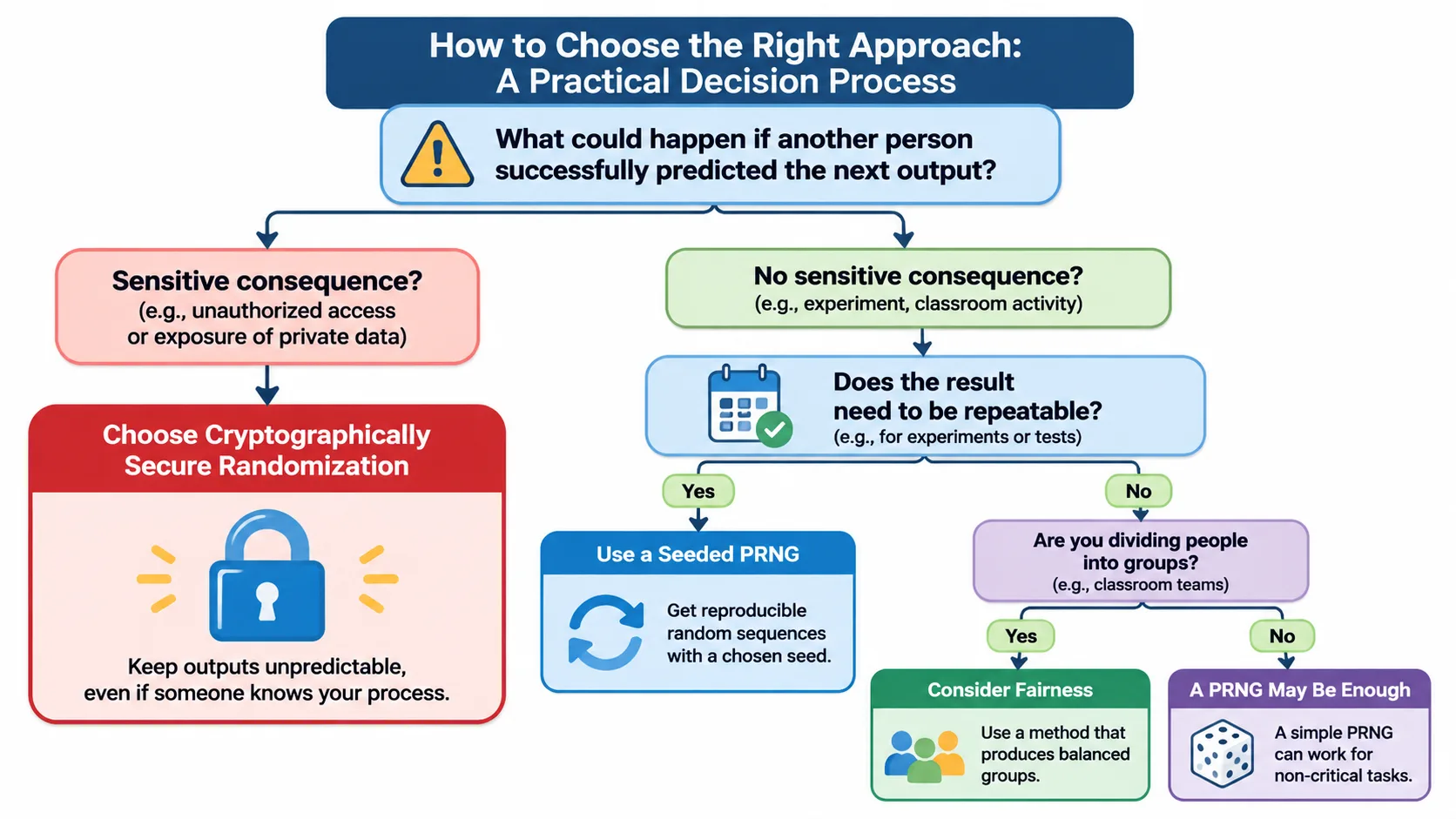
You can make the decision using a few straightforward questions. Start by identifying what could happen if another person successfully predicted the next output. If the consequence involves unauthorized access or exposure of sensitive information, choose cryptographically secure randomization.
Next, consider whether the result needs to be repeatable. Reproducible random sequences are useful for experiments, software tests, and documented classroom activities. A seeded PRNG is often convenient for these situations, although the chosen algorithm must still be appropriate for the application.
Finally, consider the fairness requirements. If you are dividing people into groups, check whether group sizes must be equal, whether some participants must be assigned together or separately, and whether all eligible participants have an equal chance of selection.
A simple decision process looks like this:
- Is the output security-sensitive? Choose a cryptographically secure generator if predictability could create a security vulnerability.
- Does the result need to be reproducible? Consider a seeded pseudo-random generator designed for general computation.
- Are you assigning people? Check participant eligibility, duplicates, and group-size requirements.
- Does the activity require balanced teams? Add suitable constraints rather than relying on randomness alone.
- Do you need to explain the result? Document the method and relevant settings so participants understand how the assignment was produced.
For example, a teacher creating six groups for a one-day science activity can focus on equal group sizes and a transparent assignment process. A software engineer generating authentication tokens must instead prioritize unpredictable values and secure implementation. Both tasks involve randomness, but they have different success criteria.
Frequently Asked Questions
Is cryptographically secure randomization always better than a pseudo-random generator?
Not necessarily. Cryptographically secure randomization is designed for applications where unpredictability protects against attacks. Ordinary pseudo-random generators can be more convenient for simulations, reproducible experiments, and everyday selection. The appropriate choice depends on the application's requirements rather than a universal ranking.
Can a pseudo-random number generator produce fair classroom groups?
Yes. A suitable pseudo-random generator can support fair classroom assignments when the participant list and grouping algorithm are handled correctly. Teachers should check for duplicate names, missing participants, unequal group sizes, and any constraints that affect eligibility. Cryptographic security is not a prerequisite for ordinary classroom grouping.
Are cryptographically secure random generators truly random?
Not necessarily in the physical sense. Many cryptographically secure generators use deterministic algorithms initialized with sufficient entropy. Their outputs are designed to be computationally unpredictable, even though the underlying generation process is deterministic after initialization.
Should teachers use a cryptographically secure random group generator?
Most teachers do not need cryptographic security for ordinary classroom assignments. They generally need a reliable process that distributes eligible students fairly and handles group sizes correctly. If an activity involves sensitive credentials or security-related decisions, use an appropriately designed security system instead of an ordinary grouping tool.
Does randomization guarantee equal group sizes and balanced teams?
No. Randomness alone does not guarantee equal group sizes, equal abilities, or balanced experience. The grouping method must account for the number of participants and any relevant constraints. A teacher may also need to adjust assignments to support accessibility, learning objectives, or classroom dynamics.
Can the same pseudo-random generator produce the same result twice?
Yes, if it uses the same deterministic algorithm, initial seed, and relevant inputs, it can reproduce the same sequence. This property is useful for testing and repeatable experiments. However, some applications deliberately avoid exposing or retaining seeds because doing so can undermine unpredictability requirements.
Final Thoughts: Match Randomization to the Task
Cryptographically secure randomization and ordinary pseudo-random generation solve related but different problems. One focuses on making outputs computationally unpredictable for security-sensitive applications. The other provides convenient random-looking sequences for everyday computing, simulations, and selection tasks.
For educators and team facilitators, the most important considerations are usually fair participation, suitable group sizes, transparent procedures, and simple workflows. You should not mistake cryptographic security for better classroom outcomes, nor assume that every random-looking sequence is suitable for protecting sensitive information.
Choose a method based on what the activity requires. When you need to divide students or workshop participants into teams, start with the Random Group Generator and create an assignment that fits your session. For security-sensitive applications, use a properly implemented cryptographic random number generator designed for that purpose.
Related Tools
Pick the right generator for the job — every tool runs free in your browser.