
2 person team generator
2 Person Team Generator: Create Random Duos Fairly
Learn how to use a 2 person team generator to create random duos for classrooms, sports, games, and workshops. Get practical steps and examples.

Choosing partners sounds simple until you have a full classroom, a sports practice, or a workshop waiting to begin. Some people choose their friends immediately, others are left out, and the organizer loses valuable time rearranging teams. A 2 person team generator offers a practical way to create random duos from a list of names, helping teachers, coaches, trainers, and event organizers start activities without lengthy negotiations over who works with whom.
Random pairing is useful when everyone should have a fair chance of working with different people. It can support classroom discussions, cooperative games, physical education activities, training exercises, and team-building challenges. The key is to prepare an accurate participant list, decide how to handle an odd number of people, and check that random assignment suits the activity before sharing the results.
What Is a 2 Person Team Generator?
A 2 person team generator is a tool or method for dividing a participant list into teams containing exactly two people whenever the total number of participants allows it. Instead of asking people to choose their own partners, the organizer supplies a list and uses a random selection process to form duos. The resulting assignments can be used for classroom work, workplace activities, games, or events that require partners.
The distinction between a two-person team and a larger group matters. A four-person project group can accommodate several roles, but a two-person team encourages direct collaboration between partners. Each person has a clear counterpart, making it easier to organize interviews, peer reviews, timed challenges, and partner-based practice. Random selection also gives organizers an alternative to repeatedly assigning the same confident students or familiar colleagues to one another.
For example, a teacher with 24 students can create 12 pairs for a reading discussion. A trainer with 18 attendees can create nine partner teams for a role-play exercise. In both cases, the goal is not to guarantee perfect compatibility. It is to establish a neutral starting point so the activity can begin efficiently.
A random result is not automatically an appropriate result for every situation. If participants have specific accessibility requirements, safety considerations, language needs, or established support arrangements, the organizer should review the assignments before using them. Randomness is a way to simplify allocation, not a substitute for professional judgment.
Why Use a Random Duo Generator?
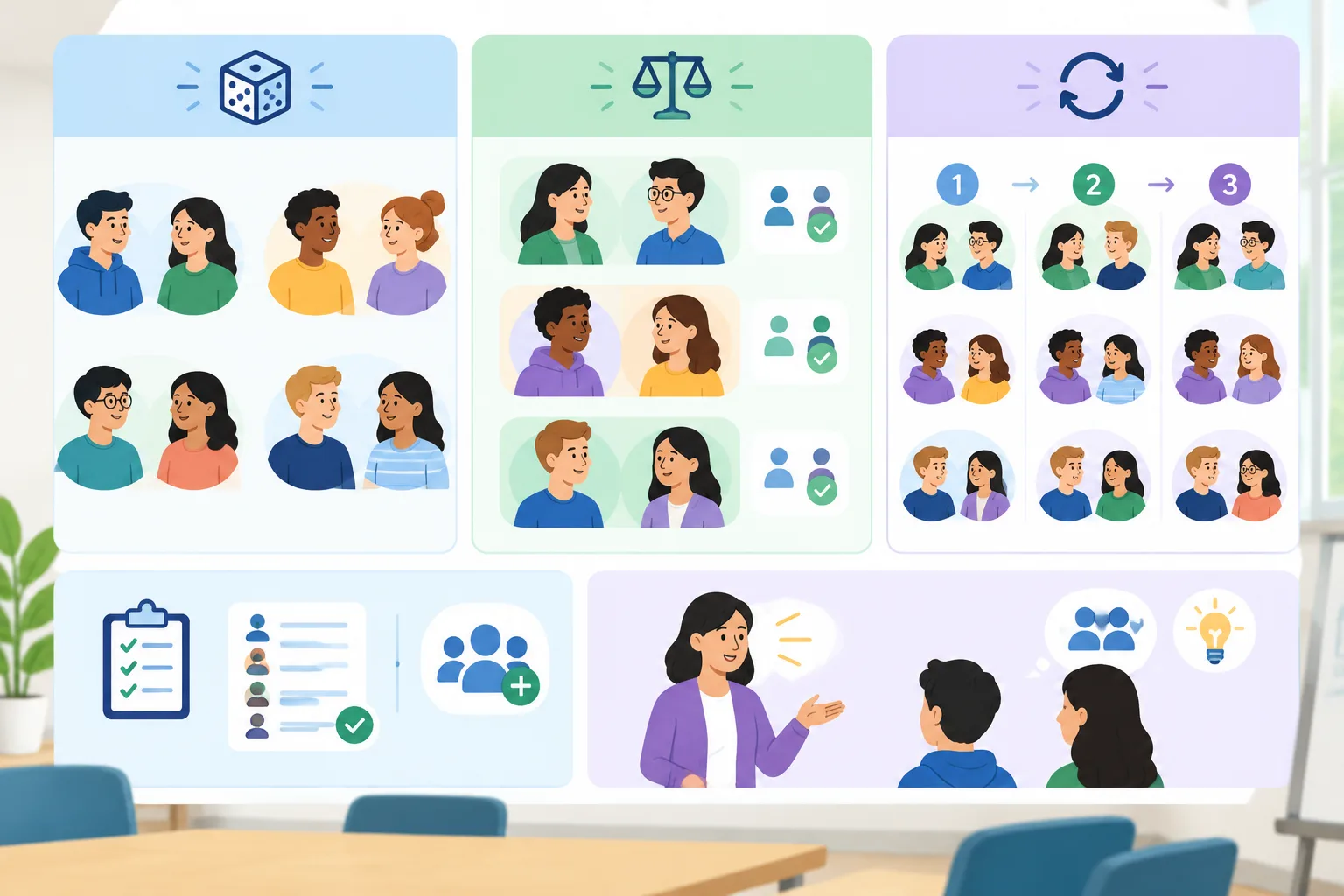
Manually selecting pairs can introduce unconscious preferences. An educator may repeatedly match familiar students, a facilitator may group colleagues who already work together, or a coach may rely on the same partner combinations during practice. These choices are not necessarily unfair, but they can limit opportunities for participants to work with someone new. A random duo generator provides a more neutral starting process.
It also reduces the time spent negotiating assignments. When an activity needs to start immediately, an organizer can prepare a list, generate pairs, and explain the task instead of asking everyone to find a partner. This is particularly useful for short activities that occur several times in one lesson or workshop.
Consider a professional development session with 20 teachers. The facilitator wants each participant to discuss a classroom scenario with a colleague they do not usually sit beside. Generating ten random duos removes the need to assign every pair manually. The facilitator can then distribute prompts and set a time limit for the discussion.
Random pairing also makes repeated activities easier to manage. A teacher can generate new duos for a second discussion rather than keeping the same partners throughout the lesson. However, each fresh random draw can produce a previous pairing again unless the process explicitly prevents repeats. If avoiding repeat partners is important, check the assignments against earlier rounds or use a method designed for rotation.
How to Use a 2 Person Team Generator
You can create useful duos in a few straightforward steps. The exact interface depends on the tool, but the underlying preparation is similar whether you use an online generator or a manual randomization method.
- Collect the participant names. Create one entry for each person who will take part. Check spelling and remove duplicate entries that represent the same participant.
- Choose the required team size. Set the grouping size to two if the generator supports team-size settings. A general grouping tool may offer several possible group sizes, so verify the setting before generating results.
- Enter the complete list. Add names consistently, using one name per line if the interface accepts a multiline list. For a large class or workshop, prepare the list before the activity begins.
- Generate the duos. Run the randomization process and review the resulting assignments. Confirm that all expected participants appear and that no name is unintentionally duplicated or missing.
- Handle any remaining participant. If the number of names is odd, decide whether to create a trio, assign a rotating observer, or have one person work with the facilitator.
- Share the assignments. Display or distribute the final list in a format participants can understand. Explain the activity, the time available, and what each pair needs to produce.
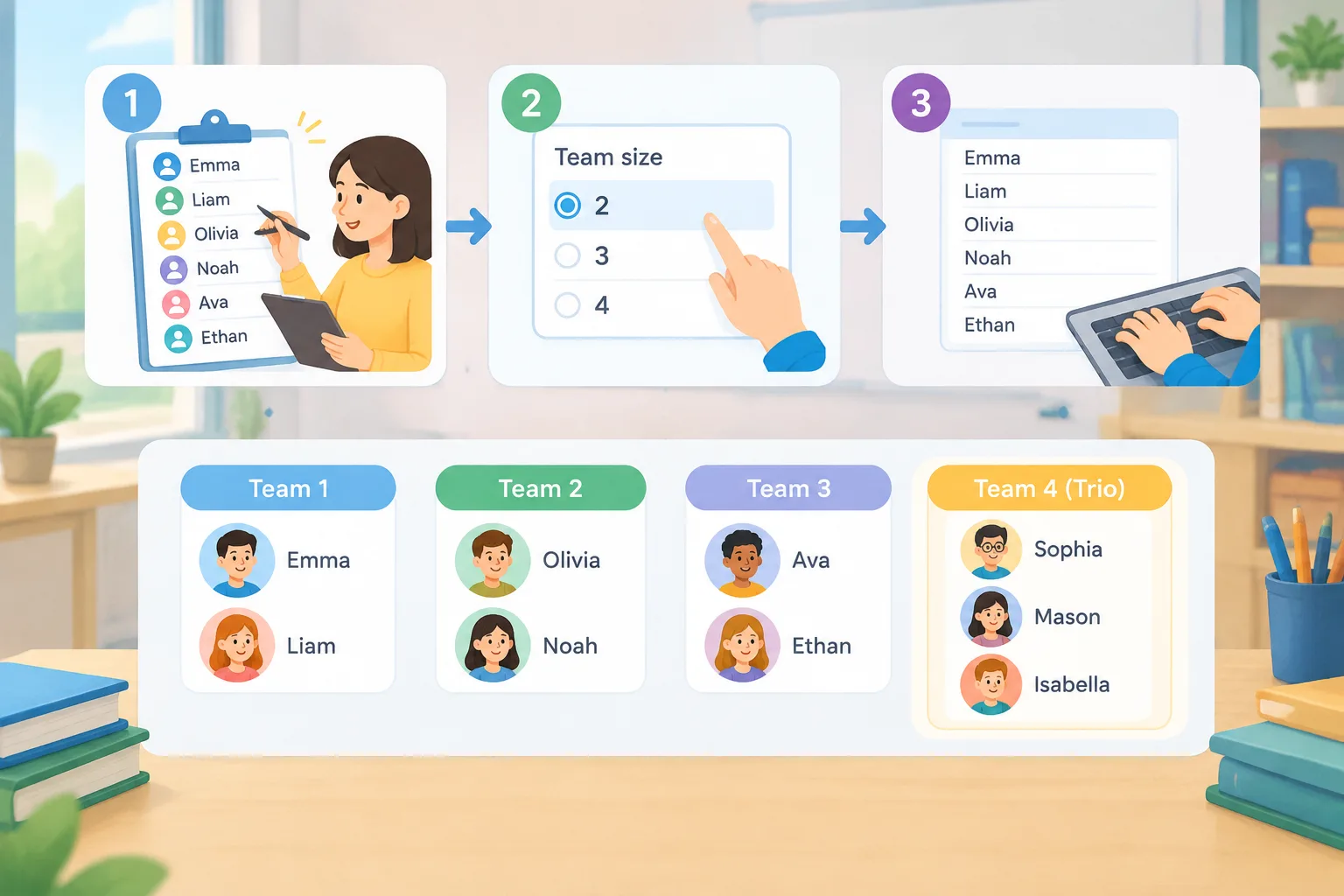
For a quick classroom example, imagine entering the names Ava, Ben, Chloe, Daniel, Emma, and Finn. The generator might return Ava and Finn, Ben and Emma, and Chloe and Daniel. These are illustrative assignments, not a prediction of what a particular tool will produce. The important point is that every name is assigned once and each team contains two people.
Before presenting the results, consider whether participants should see the entire list or only their own assignments. A whole-class activity may benefit from a projected list, while a workplace exercise involving confidential scenarios may be better managed through private instructions. The best sharing method depends on the activity rather than the randomization itself.
To begin with a flexible grouping tool, visit the Random Group Generator. If your activity requires partner assignments specifically, the Random Pair Generator is another relevant option. Review the available controls to ensure they match your intended group size and workflow.
How to Handle Odd Numbers and Uneven Lists
A two-person team requires two participants. When the total number is odd, it is mathematically impossible to divide everyone into pairs without leaving one person unpaired or changing at least one team's size. For example, 25 participants can form 12 complete pairs, with one person remaining. This is a property of the participant count, not a failure of the generator.
The most appropriate solution depends on the activity. In a discussion exercise, one trio may work well because participants can take turns speaking. In a sports drill, a rotating substitute can join each round so that everyone gets a turn. In a peer-review activity, the facilitator might review one person's work or arrange a temporary three-person review team.
Use this decision process when the list contains an odd number of names:
- Decide whether every team must contain exactly two people.
- If exact pairs are essential, assign the remaining participant a meaningful alternative role, such as timekeeper, observer, or facilitator assistant.
- If the activity allows flexible team sizes, create one trio and keep the other teams as pairs.
- If the activity has multiple rounds, rotate the alternative role so the same person is not always left out.
- Explain the arrangement before the activity starts to avoid confusion or embarrassment.
For example, a physical education teacher has 27 students and wants to run a partner-based coordination drill. The teacher can create 12 pairs and one trio. During each drill, the trio rotates roles so everyone practices, observes, and receives feedback. This approach keeps the class involved without pretending that 27 people can form only two-person teams with nobody left over.
The same principle applies when participants arrive late or leave early. Update the list before generating the final assignments whenever possible. If a change occurs after the activity begins, make a small, transparent adjustment rather than silently leaving someone without a partner.
Practical Examples for Classrooms, Sports, and Workshops
In a classroom, a 2 person team generator can support think-pair-share, vocabulary practice, peer feedback, reading discussions, and problem-solving tasks. A teacher might ask students to solve a math problem individually, compare approaches with a partner, and then explain their reasoning to the class. Random assignments can broaden interaction beyond established friendship groups, while a clear task keeps the conversation focused.
For example, a middle-school science teacher has 30 students and wants each duo to compare two possible explanations for an experiment. The teacher generates 15 pairs, provides the same prompt to every team, and gives each pair five minutes to agree on an explanation supported by evidence. The assignment method helps organize the class; the prompt, instructions, and follow-up discussion determine the learning task.
In sports and physical education, pairs can be useful for passing drills, technique practice, warm-up activities, and skill demonstrations. A coach with 16 players can create eight duos and assign each pair a station. However, randomization should not override safety or skill requirements. For activities involving physical contact, specialized equipment, or significant differences in ability, the coach should review the pairings and make adjustments when necessary.
In corporate training, random duos can help employees practice interviews, customer conversations, feedback techniques, or presentations. A facilitator with 22 attendees could form 11 pairs and assign one person the role of customer and the other the role of representative. After the first round, partners can switch roles. If the session requires everyone to meet multiple colleagues, the facilitator should track previous assignments and deliberately rotate partners rather than assuming that a new random draw will eliminate every repeat.
At community events or networking sessions, two-person teams can serve as conversation partners for a short introduction activity. Provide an accessible prompt, a clear time limit, and an easy way for people to request an adjustment. Random assignments can reduce the burden of choosing partners, but participation should remain respectful and voluntary when circumstances call for flexibility.
Choosing Between a Duo Randomizer and Other Grouping Methods
A duo randomizer is a good fit when the activity requires teams of exactly two and the main goal is quick, neutral allocation. It is less suitable when the organizer needs to balance several variables at once, such as experience, language proficiency, specialist roles, or individual support needs. In those cases, use random assignment as a starting point and apply deliberate adjustments based on the activity's requirements.
A general group generator is more appropriate when the target is larger teams rather than pairs. For instance, a teacher dividing 28 students into four groups of seven needs a different setup from a coach dividing 28 players into 14 duos. The Random Group Generator can be a useful starting point for flexible group allocation, while the Random Pair Generator is aligned with partner-based activities.
A group picker wheel offers a more visual way to make selections in a live session. A wheel can add suspense when choosing a participant or group, but it is not automatically the best method for producing a complete set of non-overlapping duos. Choose the format that matches the task rather than selecting a tool solely for its presentation.
Manual assignment remains valuable when specific constraints matter more than speed. A teacher may need to pair students with complementary skills, a trainer may need to separate colleagues who are evaluating each other, or a coach may need to balance practice partners by experience. In these cases, a structured manual process can be fairer than unreviewed random assignment. The practical goal is to make the decision process transparent and suitable for the people involved.
Tips for Fair and Effective Two-Person Teams
Start with a complete, accurate list. Missing names and duplicate entries can undermine an otherwise sensible randomization process. If participants use preferred names, use those names consistently. For recurring sessions, keep an approved roster so you can make updates without rebuilding the list from scratch each time.
Next, explain what random selection means in your activity. Participants may wonder why they have been assigned to someone unfamiliar, especially when they expected to choose a friend. A brief explanation can help: the purpose is to give everyone an opportunity to work with different partners, and the assignment is not a judgment about anyone's ability. Avoid describing random pairing as a guarantee that every team will be equally skilled or compatible.
Use clear roles to support collaboration. In a two-person team, roles such as speaker and note-taker, interviewer and respondent, or problem-solver and checker can make participation more balanced. If the activity lasts long enough, switch roles halfway through. This provides a concrete way to encourage both partners to contribute without requiring the organizer to supervise every conversation.
Finally, review the results when the context requires it. Check for missing names, accidental repeats, unsafe combinations, or accessibility concerns before sharing assignments. Keep the review focused on legitimate needs rather than changing pairings simply because the outcome is unexpected. When fairness matters across several rounds, maintain a simple record of previous partners and plan rotations deliberately.
Frequently Asked Questions
What is the best way to make random teams of two?
Prepare a complete list of participants and use a tool that supports pairs or a group size of two. Review the result before sharing it, particularly if the activity has safety, accessibility, or role requirements. If the list has an odd number of people, decide in advance how the remaining participant will take part.
Can a 2 person team generator work with any list of names?
Most name-based approaches can work with different types of lists, provided the selected tool accepts the list format and number of participants. Use one consistent entry per person and check for duplicates before randomizing. For confidential or sensitive lists, also consider where the names are processed and who can access the resulting assignments.
What happens when there is an odd number of participants?
One person will remain unpaired if every team must contain exactly two people. You can create one trio, rotate an observer or substitute role, or join the activity as the organizer. Choose an arrangement that allows everyone to participate meaningfully and explain it before the activity begins.
Are random duos always fairer than manually selected pairs?
Random assignment can reduce favoritism and make partner selection more transparent, but it does not guarantee equal skill levels, compatibility, or support. Manual adjustments may be necessary for safety, accessibility, or specific learning goals. The fairest approach is the one that uses clear criteria and treats participants consistently.
Can I reuse the same pairings for several activities?
Yes, if continuity is useful for the task. However, reusing the same duos throughout a course or workshop may limit opportunities to collaborate with others. If variety is the goal, keep a record of previous pairings and rotate partners deliberately because independent random draws can produce repeat duos.
Is a random duo generator suitable for online classes and remote teams?
It can help organize partner assignments for remote discussions, virtual training, and online team exercises. Generate the pairs first, then communicate the assignments and explain how participants should meet or collaborate using the available conferencing or collaboration tools. Confirm that the workflow fits your platform and privacy requirements instead of assuming every generator has a direct integration with every service.
Create Your Next Set of Duos
Whether you are organizing a classroom discussion, a sports drill, a team-building exercise, or a workshop, a 2 person team generator can make partner selection faster and easier to explain. Begin with a clean list, select the appropriate grouping method, and review the results before participants start. For odd-numbered groups or activities with special requirements, plan a practical adjustment so that every person has a meaningful role.
Ready to organize your next activity? Start with the Random Group Generator for flexible team sizes or use the Random Pair Generator when your activity calls for partner assignments. Choose the method that suits your group, share clear instructions, and give every duo a task worth working on together.
Related Tools
Pick the right generator for the job — every tool runs free in your browser.