
language practice
Language Practice Pairing Strategies: Boost Engagement with Random Pairing
A practical guide for language teachers on using random pairing strategies to increase student engagement during speaking activities. Learn step-by-step how to implement random pairs effectively.

Every language teacher knows the scene: you announce a speaking activity and students gravitate towards the same few friends, while quieter learners shrink into silence. The energy sags, the practice becomes predictable, and only a handful of voices fill the room. If this struggle sounds familiar, it’s time to rethink how you pair learners. In this article, we’ll explore language practice pairing strategies that use random pairing to break routines, mix proficiency levels, and get every student talking. Whether you teach ESL, French, or corporate Mandarin, you’ll find actionable steps and real-world examples that make random pairing a simple, reliable part of your teaching toolkit—all supported by free digital tools like the Random Pair Generator.
Why Random Pairing Works for Language Learners
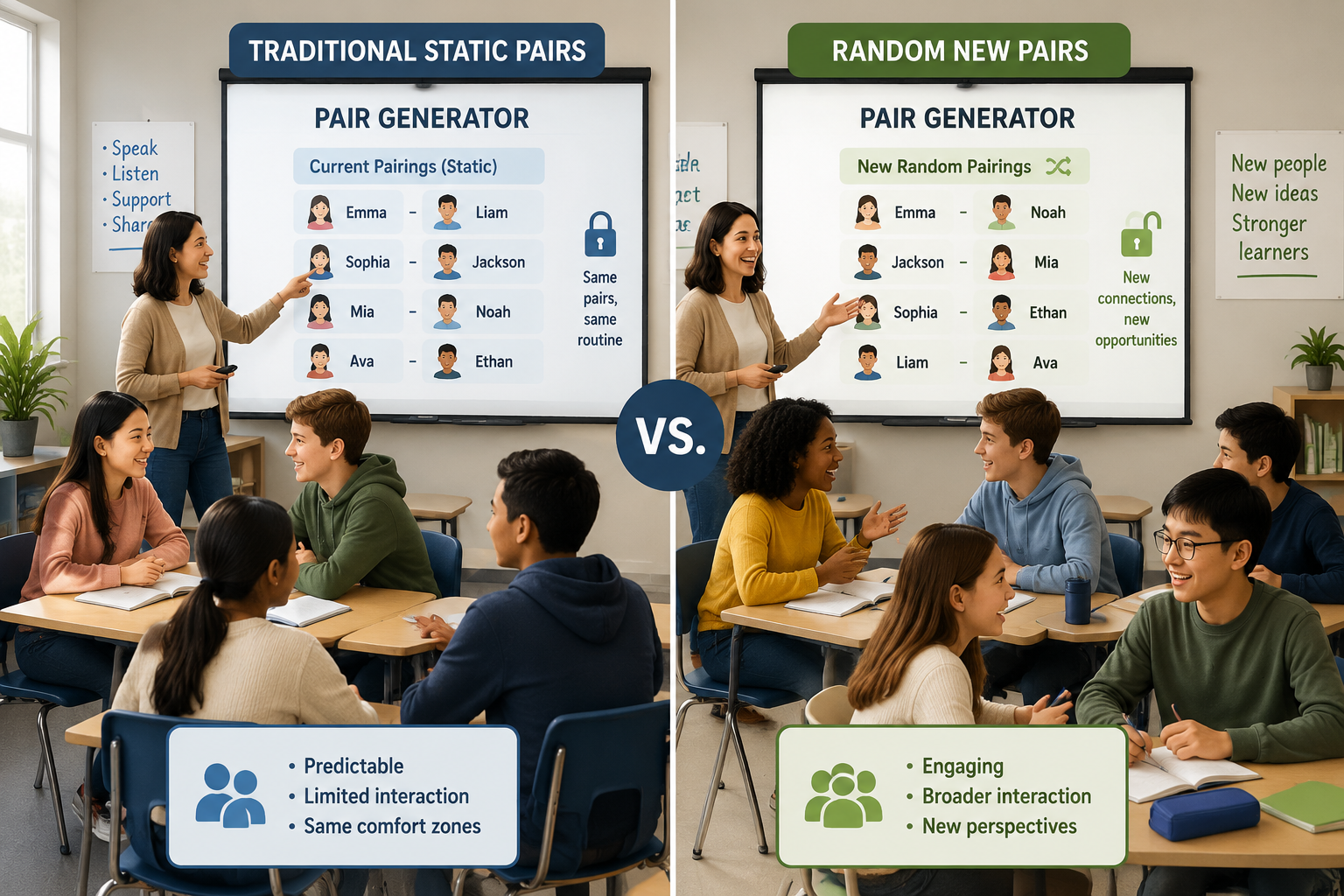
Random pairing does more than shuffle names. It tackles some of the deepest obstacles language learners face: the fear of making mistakes in front of familiar classmates, the boredom of the same conversation partner, and the lack of exposure to different accents and speaking styles. When you remove the social pressure of choosing a partner, learners focus on the task itself rather than on who they are sitting with.
Research in language acquisition shows that interacting with a variety of peers pushes learners out of their comfort zones and into real communicative practice (Swain, 2005). A learner who always pairs with a higher-level friend may lean too heavily on that partner, while random pairing forces both learners to negotiate meaning independently. It also distributes linguistic strengths more evenly across the room. A shy student with good pronunciation benefits from a confident but less accurate speaker, and vice versa.
From a classroom management standpoint, random pairing eliminates the “leftover” problem—the one student who is always last to be chosen. When the pairing is visibly random and impartial, it builds a sense of fairness. Students quickly accept that today’s partner is the luck of the draw, which reduces complaining and gets groups working faster.
Step‑by‑Step: Using a Random Pair Generator for Language Practice
Ready to try random pairing in your next lesson? Follow these steps to integrate the Random Pair Generator seamlessly into your language practice activities.
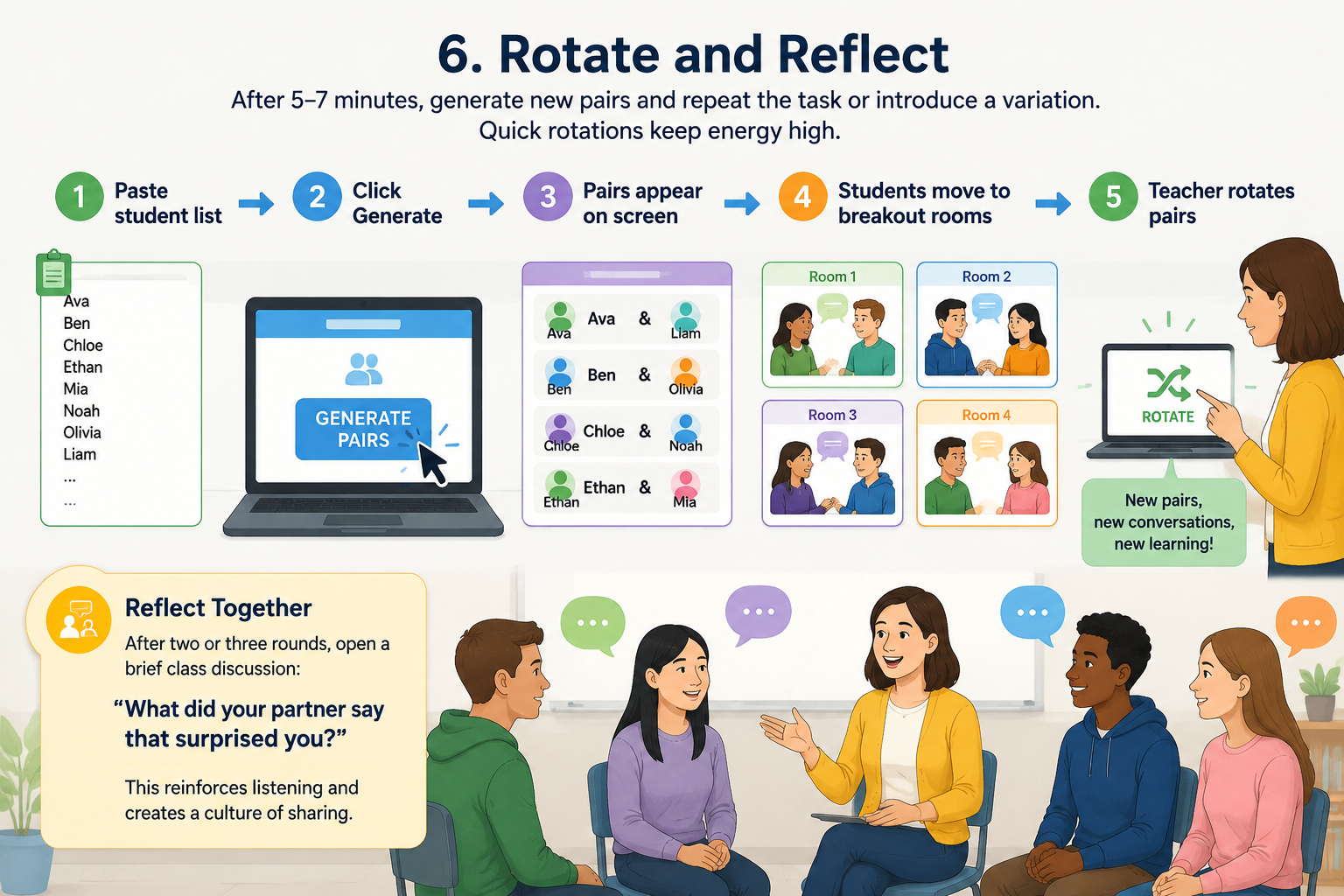
1. Prepare Your Class List
Before class, copy your student roster into a plain text file or spreadsheet. For privacy, use first names only or assigned nicknames. You can also include custom labels like “Beginner,” “Intermediate,” or “Advanced” if you want to experiment with mixed-ability pairing later.
2. Open the Random Pair Generator
Go to https://random-group-generator.com/tools/random-pair-generator. The interface is simple: a text box where you paste the list, a button to generate pairs, and options to set the number of members per group (keep it at 2 for pairs).
3. Paste Names and Generate
Paste the list into the input field and click “Generate.” Instantly, the tool shuffles all names into random pairs. If you have an odd number, the last “pair” will be a solo student—this is a cue for you to join as a partner or create one group of three.
4. Display the Result
Project the pairs onto the screen or share the link in your virtual classroom chat. Transparent display reinforces the random nature of the process and saves you from calling out pairs one by one. Students can see their partner and move into breakout rooms or sit together right away.
5. Set the Speaking Task
Now launch the activity. A prompt like “Discuss your weekend plans, but every sentence must contain the past tense” gives learners a clear goal. Because pairings change every session, you can reuse the same prompt and still get fresh conversations.
6. Rotate and Reflect
After 5–7 minutes, generate new pairs and repeat the task or introduce a variation. Quick rotations keep energy high. After two or three rounds, open a brief class discussion: “What did your partner say that surprised you?” This reinforces listening and creates a culture of sharing.
Real Classroom Examples: Random Pairing in Action
Example 1: High‑School ESL Conversation Class
Ms. Rivera teaches a mixed‑proficiency ESL class with 28 students. Before using random pairing, she noticed that advanced speakers dominated while beginners sat passively. She started using the Random Pair Generator at the beginning of each lesson for a five‑minute warm‑up chat. On Monday, Maria (a shy beginner) was paired with Jun (an advanced speaker). Because Jun didn’t know Maria well, he naturally simplified his speech and asked more questions. Over the following weeks, Maria’s speaking confidence grew noticeably. Ms. Rivera now uses the tool three times per lesson—warm‑up, main activity, and wrap‑up—and reports that participation rates are at their highest ever.
Example 2: Corporate Language Bootcamp
A multinational company runs an intensive French course for relocated employees. The facilitator, Pierre, used to assign partners based on department, but the conversations quickly turned into shop talk in English. After switching to random pairing, each session forced learners from different departments to interact in French. The random element also meant that the strongest speaker might be paired with the weakest, which created organic peer‑tutoring moments. Pierre integrates the Random Group Generator for larger role‑play scenarios, further diversifying the interactions.
Beyond Pairs: Managing Group Speaking Activities
While random pairing is ideal for dialogues and quick exchanges, many language activities work better in small groups of three or four. The same randomisation principles apply, and the Random Group Generator lets you form teams of any size with a single click.
For example, in a task‑based learning unit, groups of three can each receive a problem‑solving scenario (“Plan a weekend trip to Paris using only French”). Randomly formed groups ensure that learners aren’t clustering with their usual study partners. The variety in accents, vocabulary, and problem‑solving styles enriches the learning experience.
If you need to pick a volunteer for a whole‑class demonstration, the Random Student Picker offers a quick, fair selection method that keeps all students on their toes. Integrating these tools consistently creates a classroom culture where unpredictability is expected and exciting rather than stressful.
Tips for Facilitating Effective Random Pairing Sessions
- Set Clear Expectations Up Front
Explain why random pairing is used: “We’ll work with different partners so everyone gets to practise listening to many voices and styles.” When students understand the purpose, they buy in.
- Use a Timer and Visual Cues
Display a countdown clock. Knowing that the pairing will change in a few minutes reduces the anxiety of being “stuck” with a partner and keeps conversations focused.
- Provide Language Scaffolds
Post sentence starters on the board: “I think that… because…”, “Could you repeat that?”, “I agree/disagree because…”. These supports are especially helpful for lower‑level learners who may feel nervous speaking with a new partner.
- Balance Random with Intentional
While random pairing is the norm, occasionally you may need to override it for assessment tasks or when a student genuinely needs a consistent partner for emotional reasons. Keep randomisation as the default, with exceptions handled privately.
- Collect Feedback
Ask students every few weeks how they feel about random pairing. Many will say they’ve made new friends or learned words they wouldn’t have heard otherwise. Use that positive feedback to reinforce the practice.
- Combine with Physical Movement
If you’re in a physical classroom, ask students to stand up, walk around, and sit next to their new partner. Movement increases blood flow and engagement, turning the pairing into a mini energiser.
Frequently Asked Questions
1. Does random pairing work for beginner language learners, or will it intimidate them?
Random pairing can actually reduce intimidation because beginners aren’t singled out. When everyone is shuffled, the spotlight is on the activity, not the individual. Provide sentence stems and allow short, low‑stakes tasks (like asking and answering three simple questions) to build comfort.
2. What if I end up with an odd number of students?
You have two options: join the activity yourself as the partner for the unpaired student, or create one group of three. Many teachers find that joining a learner adds a valuable modelling element. The Random Pair Generator will display one solo slot when the total is odd, making this easy to spot.
3. How often should I change pairs during one lesson?
For typical 45‑minute classes, two to three rotations work well. A quick warm‑up pair, a main activity pair, and a wrap‑up pair with a reflection task. Frequent changes prevent stagnation without causing chaos.
4. Can I use random pairing for online language classes?
Yes—the same digital tool works seamlessly. Share your screen with the generated pairs, and then assign breakout rooms in Zoom or Teams according to the displayed matches. This is especially effective because online learners often miss the social cues of in‑person partner selection.
5. What’s the difference between the random pair generator and the group generator for language practice?
The pair generator creates partners of two, ideal for dialogues, interviews, and one‑on‑one speaking practice. The Random Group Generator forms teams of any size you choose (three, four, etc.), perfect for group discussions, role‑plays, and project work. Both tools run on the same fair randomisation engine.
Ready to Make Every Voice Heard?
Language practice thrives on variety, unpredictability, and genuine communication. By adopting random pairing as a core language practice pairing strategy, you ensure that every student—regardless of level, personality, or social circle—gets equal speaking time and a richer learning experience. The days of students dreading partner time or falling into the same silent patterns are over.
Head over to our Random Pair Generator now, paste your class list, and generate your first set of pairs. Watch the room come alive with new conversations. For more activities that keep learners on their toes, explore our Random Group Generator and Random Student Picker. Make every language lesson unpredictable in the best way possible.
Sources
Sources
- Cooperative learning — research overview on structured small-group work
Related guides
- How to Use a Random Pair Generator in the Classroom — Learn how to use a random pair generator to create fair student pairs in seconds.
- Pair Maker: How to Create Random Pairs for Class or Workshops — Learn how to use a free pair maker to quickly create random pairs for classrooms, workshops, and training s…
- Random Pair Generator vs Random Group Generator: Which One Do You Need? — Confused between the random pair generator and random group generator?
- Random Pair Generator Tutorial: How to Create Fair Pairs Instantly — Learn how to use the Random Pair Generator to create balanced, unbiased pairs for classrooms, workshops, or…
SponsoredExplore more resources